July 31, 2019
Stop Waffling, and Write
I finally read Brigid Schulte’s essay in The Guardian, “What is women’s greatest enemy? Lack of time for themselves,” an essay I’d seen many people sharing online last week. And to be honest, once I got to it, I found the piece a bit…slight? Understanding why it had resonated with so many women for sure, but it also frustrated me, and made me impatient. I wanted more. I wanted something less waffley (no offence to waffles) and less cribbed from A Room of One’s Own, because it’s been 90 years, and surely we can do better than, “What would happen if…” and thought experiments about Shakespeare’s sister.
(What might you have written had you not sat down to write the piece about how women don’t take enough time to sit down and write?)
I’ve spent the last few weeks completing the modules of my blogging course, whose goal is to deliver women the confidence (the nerve?) to carve out their own little space online, to emphasize to them that their voices matter and so do their stories, and that the world needs both these things. I’ve written 25,000 words that I’m proud of and excited to share very soon that I hope will inspire and motivate people who are blog-curious or at least need a little jolt to get their blogging spark back…but at the heart of it all there really is just one point, and it’s this one: You just have to do it.
And you know what? We can blame the patriarchy. (We definitely SHOULD blame the patriarchy. See Toi Smith: ‘Let’s stop calling it “mom guilt” because that’s bullshit and not actually a thing. Let’s start calling it what it really is: internalized patriarchy, capitalism, and white supremacy which has conditioned women to believe that once we become a mother our pleasure isn’t ours, that our joy isn’t ours, that our creative force isn’t ours, and that our time isn’t ours.”)
But all this means is that when you finally do sit down to write, what you’re doing is more radical, awesome and profound than you might initially understand it to be—which only makes it all the more important that you actually sit down and write. Telling yourself that you’re not writing because you don’t take time for yourself is a decision you have made, and it’s kind of boring. It’s also like telling yourself that don’t write because you’re a perfectionist, or that you don’t write because you have a job, or because you have kids. (To be fair, if you’re not writing because you have kids AND a job, I get it. Though there comes a point when “having kids” stops being an occupation that takes up every ounce of your soul and your life.)
Because there are so many people who face these hurdles, but leap over them and write anyway. There are so many women who do make time for themselves and for their art, even if we live in a society that conspires to make them feel guilty about those choices. So to stare wistfully into our teacups and lament the choices we’ve made to limit our creative experiences (honestly, you could let that call from your mechanic go to voicemail) because that’s just how it for women, it’s what we do, is essentialist and very annoying.
It’s also just another excuse to avoid doing the thing, and Brigid Schulte gets it exactly right when she writes, “I wonder if that searing middle-of-the-night pain that, at times, settles like dread around my solar plexus may not only be because there’s so little unbroken time to tell my own untold stories, but because I’m afraid that what may be coiled inside may not be worth paying attention to anyway. Perhaps that’s what I don’t want to face in that dusky room I dream of.”
The biggest challenge lies in not finding the time to write, but in staring such fear in the face. But it’s possible. With the knowledge that even if you fail, you’ll be so much further along than you would have been if you hadn’t tried, and also that you will never ever be better than you’ll be if you start practicing right now.
April 3, 2019
Mrs. Dalloway: Redesigned
I like to read in a stream of literary consciousness, unplanned, meandering, one book leading to another in an organic fashion that I need not think about too deeply, but it just makes sense. My logical mind is not in charge of it, though things like library due dates factor in, and also whether or not a hardcover will fit into a particular handbag, or just how appropriate a book might be for the beach. But for the most part, I let the books decide, like how I was finishing up All the Lives We Ever Lived last week, and then Mrs. Dalloway turned up in my mailbox.
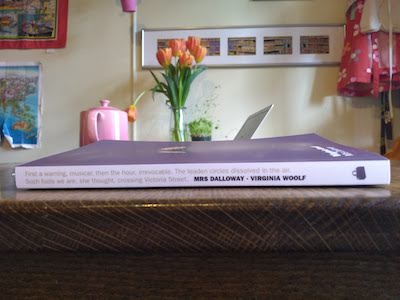
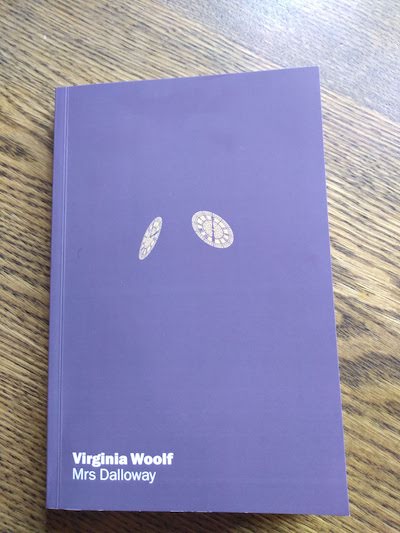
Mrs. Dalloway is the latest release from Ingrid Paulson’s Gladstone Press, which also published The Age of Innocence, a book I read over Christmas and turned me into a full-fledged Gladstone Press enthusiast. And when I heard that Mrs. Dalloway would be the first of their 2019 releases, I was ecstatic, because I love this book. a book I’ve returned to several times since I first learned to read Virginia Woolf (for me, it was not instinctual) twenty years ago when I was an undergraduate. It’s funny, because while I like to read in a stream of literary consciousness, the act of actually reading stream-of-consciousness is not my ideal. Because it’s hard and you have to pay attention and nothing’s fastened you to the plot so you have to do all that work yourself.
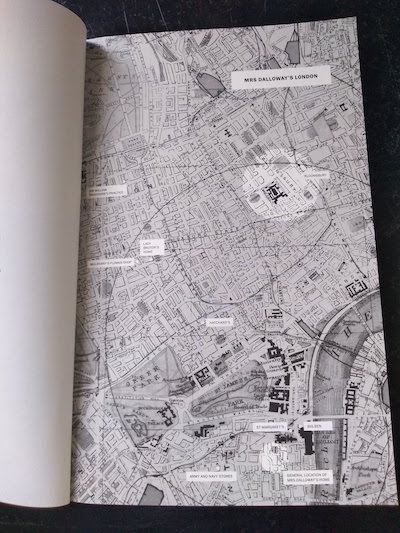
But I can do it with Woolf, with Mrs. Dalloway. Not getting too caught up in the details, letting the atoms fall where they may. It takes practice, and confidence, and patience, but I find it so rewarding. And easier too in a book that’s brand-spanking new, with a map even (my second-hand Penguin paperback that had once belonged to someone called S. Hull, according to the title page, didn’t have that) so I could follow Mrs. Dalloway, and Septimus Smith, and Peter Walsh through the streets of London, through the hours of day in June, right up to the party. For which Mrs. Dalloway had bought the flowers herself.
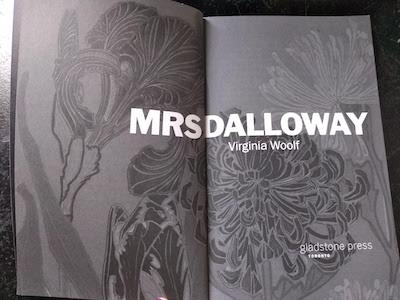
Gladstone Press books are available for purchase via their website, and are also currently for sale at Type Books on Queen Street West in Toronto. And as for me, my walk with Mrs. Dalloway led next into a walk with Alicia Elliott in her extraordinary and now bestselling essay collection A Mind Spread Out On the Ground, and then to Anna Burns’ award-winning Milkman, which is another walking book. And I’ll keep you posted as to where my literary journeys take me next.
March 27, 2019
A To the Lighthouse Memoir
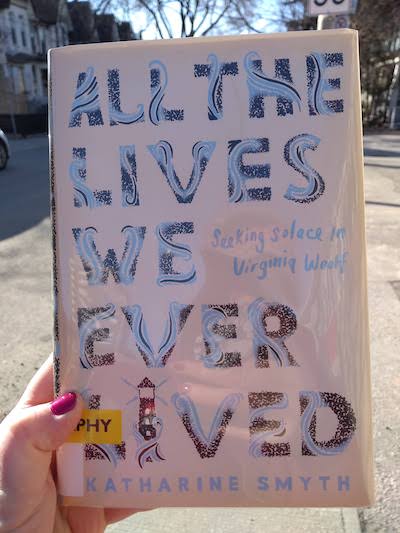
“…one of the wonders of Woolf’s novel is its seemingly endless capacity to meet you whenever you happen to be, as if, while you were off getting married and divorced, it had been quietly shifting its shape on the bookshelf” —Katharine Smyth
Lost somewhere in the flotsam and jetsam of Instagram is the post (from who? and when?) that prompted me to put Katharine Smyth’s memoir All the Lives We Ever Lived: Seeking Solace in Virginia Woolf on hold at the library. It might have been the cover that did it, a wonderful retro Hogarthian design, or maybe just the premise itself, a memoir via To the Lighthouse (and you either go in for such things or maybe you don’t—for the record, I was the target audience for Rebecca Mead’s My Life in Middlemarch Memoirs framed by reading experiences are so up my middlebrow street). To the Lighthouse is a book I’ve returned to again and again since I first read it in a university class 20 years ago—I was rereading it the summer I wrote my first novel, which is part of the reason why my protagonist ends up reading it for her book club. And the other part of the reason why To the Lighthouse turned up in my book is because of the uncanny way that it (like much of Woolf’s oeuvre) ends up seemingly connected to all things, wrapping its way around our own lives like tentacles. It is a book that one only appreciates more upon acquiring some life experience, and then some, a kaleidoscopic novel that contains multitudes: from Katharine Smyth, “To the Lighthouse tells the story of everything.”
I wonder if anyone who loves To the Lighthouse could write a memoir using the book as a framework—but they would probably not do nearly as good a job of it as Katharine Smyth has. Smyth, who studied at Oxford and took classes with Hermione Lee, who knows of what she writes, and whose prose does not read skimpily alongside Woolf’s own. Smyth is a writer with tremendous descriptive powers, a reveller of words and language—she sent me to the dictionary to look up “tenebrous.” And her own story is not a To the Lighthouse redux, but rather she tells the story of her father’s death—and also the story of her parents’ marriage, of her childhood, of her father’s alcoholism and years with cancer, of their waterfront home in Rhode Island—and it maps onto Woolf’s narrative enough to provide glimpses of illumination, just as Woolf’s own biography—her family’s home at St. Ives, the death of her mother, the devastation wrought by the Great War—illuminates her novel.
If it’s true that we tell stories in order to live, I think that we read them for the same reasons, to discover context, evidence, and meaning. After the death of her father, Smyth goes back to Woolf to better understand what happened to her family, to examine their complicated relationship, to bridge a gap between her memories of him and her life without him (ie [Time passes]). Hers would be an interesting story anyway, and she’s a wonderful writer, but it’s all the richer when regarded through Woolf’s literary lens and so is her reader’s connection to it.
November 2, 2014
On Uncertainty, Mistakes, and Accidental Cake
 Tomorrow night in my blogging course, we will be discussing Rebecca Solnit’s essay, “Woolf’s Darkness: Embracing the Inexplicable”, which really might be one of my favourite pieces of writing ever, and whose wisdom is remarkably applicable to blogging, as well as to life itself. “To me, the grounds for hope are simply that we don’t know what will happen next, and that the unlikely and the unimaginable transpire quite regularly.”
So I’ve been rereading the essay, following its twists and turns (and thinking about how much the public streets walked by Woolf’s narrator in “Street Haunting” can stand in for the blogosphere, “a form of society that doesn’t enforce identity but liberates it, the society of strangers, the republic of the streets, the experience of being anonymous and free that big cities invented”).
And then there was an excursion to Kensington Market to purchase not a pencil, but boots for the grown-ups in our family, because the shop there that caters to Portuguese construction workers is the best place we know to buy new Sorels. This was yesterday, and we’d woken up to flurries, so it seemed essential that we buy boots immediately. Plus while in the market, we’d get to pick up wood-smoked bagels and sausages from Sanagans for our evening meal. Once the boots were bought, Stuart with stroller was sent on the bagel errand, while Harriet and I took a quick diversion into Good Egg to scope out potential birthday presents for him.
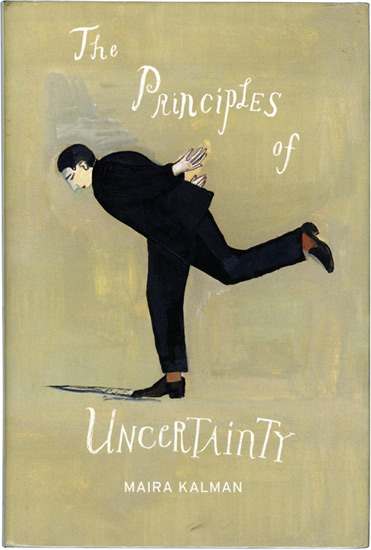
Where I found this book, Maira Kalman’s The Principles of Uncertainty, based on her illustrated New York Times column. I’d never read the column, but I had been reading Solnit’s essay, which references Kalman’s work, her art, this book. And here was the book in my hands, so I had to have it. I came out of the shop with a stack of books, but pleased with myself. “Only one of these is for me.”
When I got home and went through the Solnit essay again, however, I found that I’d been mistaken. While a section of “Woolf’s Darkness” indeed shares a title with Kalman’s book, Solnit doesn’t mention Kalman at all. I’d made the whole thing up. I’d bought the book by accident. Which was kind of interesting to me, because I am so interested in the connections between books, how they speak to one another, and now I’m fascinated too by the idea of the mistaken allusion, the connection that was never there at all. But now it is, because I supposed it was. Our reading lives are such a tangled web.
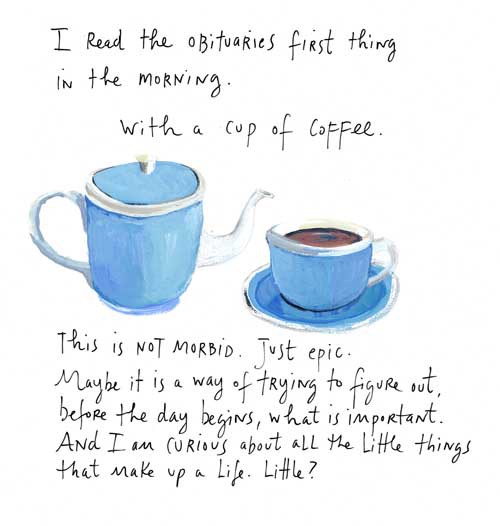
All was not lost though. While Kalman’s book was far from Solnit’s essay (though for me, the two shall be linked forevermore—and they’re actually interesting companions), the book was wonderful. It was as though my mistaken allusion had been a trick to get The Principles of Uncertainty into my hands, where it had belonged all the while.
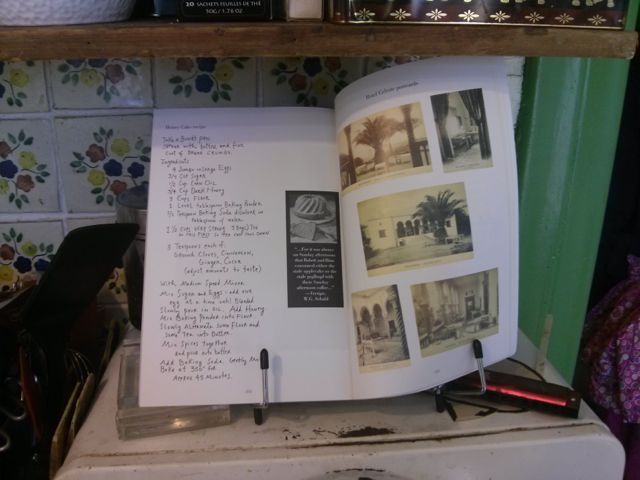
Full of gorgeous images, funny stories, curious questions, and delightful things. It has an index, as all the best books do, and an appendix with images of postcard collections (one of postcards with waterfalls), collected food packets, a list of all the characters in The Idiot by Dostoevsky, and the family recipe for the honey cake referenced on page 54:
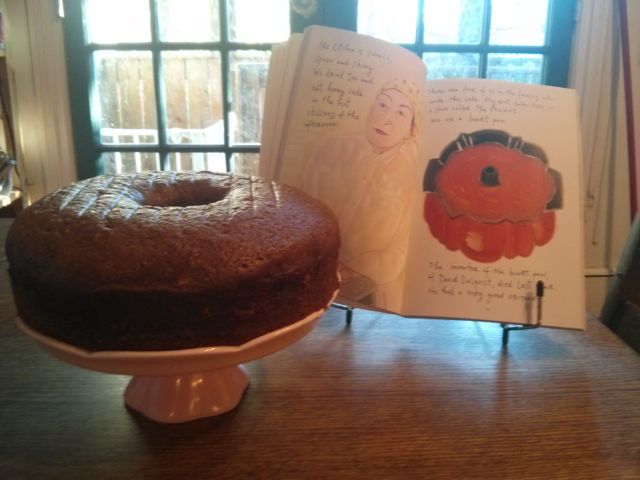
“The kitchen is small, spare and shiny. We drink tea an eat honey cake in the hot stillness of the afternoon.”
This afternoon, I baked that cake with Harriet, because today had an extra hour within and there was space for such a thing. We had to borrow a bundt pan from our neighbour, Sarit, because we don’t have a bundt pan even though I thought we did. It seems there is no limit to what I’m capable of remembering wrong.
We had a good time baking—it is much less frustrating baking with Harriet now than when she was three and compelled to stick her hands in the batter (and she sneezes in the bowl hardly ever now). I explained to her that we were making a cake from the book that I had bought by mistake, and it’s that a wonderful thing about the universe—that an accidental book can lead to cake in the oven on a sunny afternoon:
“And then the all-clear sounded and people returned, hope undiminished. They returned, so elegant and purposeful to the books. / What does this have to do with bobby pins and radiators and kokoshniks? One thing leads to another.”
Then when we were all done, I proceeded to TWICE pick up the bundt pan (which was constructed of two parts) incorrectly, separating the bottom from the sides and batter seeping out onto the table. (“I heard at least two ‘fucks,'” Stuart inquired after. “What went wrong?”) As I spatula’d up the mess, Harriet patiently parroted what I’d been saying to her about the accidental book as we’d baked, that sometimes mistakes lead us in the most interesting directions.
“I don’t know if it’s quite the same with baking,” I confessed, sorry that everything was not so poetic, but perhaps it is, or it’s just that this cake is forgiving, because it was, and the cake was wonderful. Delicious, moist, and a perfect balance of spice and sweet. One thing leading to another indeed, and what good fortune when the thing one’s being led to is cake.
March 15, 2012
Virginia Wolf by Kyo Maclear and Isabelle Arsenault
 Kyo Maclear is author of the beloved 2007 novel The Letter Opener and is, with illustrator Isabelle Arsenault, the force behind the acclaimed Spork. Her latest picture book with Arsenault is Virginia Wolf, a story loosely based on the Woolfian one of the similar name and her relationship with her sister Vanessa.
There is precedent for a literary rendering of the child Virginia– those of us steeped in Woolf lore know well the stories of Virginia, Vanessa and their brother Thoby of 22 Hyde Park, and their childhood family newspaper was published in book form in 2006. And it is those of us steeped in Woolf lore who will seize to these connections, though Maclear herself emphasizes the looseness of her basis. So what is its point then? The Woolf connection is not a necessary element of the text, but it provides the book with additional texture, literary and otherwise.
In this story of two sisters, one of them, Virginia, overcome by the doldrums, is captured by a wolfish mood. This mood has an effect on the whole household: “Up became down. Bright became dim. Glad became gloom.” The other sister, Vanessa, tries to cheer Virginia up, but nothing works. Finally, Vanessa lies in bed with her sad sister and listens to her describe the world she longs to escape to, called “Bloomsberry”. Virginia is freed from her wolfish mood after Vanessa creates a version of Bloomsberry on the bedroom walls, and by the story’s end, she’s well enough to go back into the world. Down is up again.
(Must point out connections between this and another wonderful book from KidsCanPress about painted gardens and their restorative effects– Andrew Larsen’s The Imaginary Garden is much adored at our house.)
Very young children (and their parents) will be delighted by the book’s illustrations– Harriet is particularly taken with Virginia’s transformation from wolf to girl on the book’s final pages. They will also come to understand the plot at its most basic level– that there are times when we all feel a bit wolfish. It’s a name to put to what happens on those tantrum-filled days, or when Mommy’s patience is particularly limited. Wolfish moods happen, there’s no real reason for them, and they pass. We feel better.
For older readers who’ve had family members suffering from depression, I imagine this book would be particularly valuable. Yes, it is a simplified depiction of the disease but that simplification is essential for a child to obtain any real understanding what’s going on around them. The reader will understand that nothing they have done has caused their loved one’s suffering, and also that there is little they can do to relieve it.What Vanessa does to help her sister is be near her, to listen to her talk, to lie in bed beside her and look out the window to see the world through her eyes.
Of everything Vanessa paints in Bloomsberry though, most essential is the ladder, “so what was down could climb up”– a recognition that the journey will be Virginia’s alone to make. To her painting she adds also room for Virginia to wander, because wandering is what wolves like to do. And while Maclear has Virginia feeling much better the next morning, the ladder and the wandering space function on a metaphoric level to acknowledge the true complexity of her character’s experience.
The elephant in the room of course is Woolf’s own suicide, and that any child who comes to know the author through Virginia Wolf will discover a very different end to the story. Though I would argue this point by resisting the notion of reducing Woolf’s life and her legacy to her mental illness and the circumstances of her death. Yes, she suffered substantially through her life, but anyone who knows her work well will understand that she had a capacity for joy as great as she had for sorrow. There is so much more to Woolf than the stones in her pockets, and I love that this book celebrates that. She survived her bouts in the doldrums over and over again, and that she finally didn’t in no way undermines the achievement of her life, all 59 years of it. Further, rather than overlooking the circumstances of Woolf’s death, I think that Maclear is using it externally as a fitting counter to her book’s sunny ending. It doesn’t belong in the book, but the connection is there for the reader to make, and I think it is an important one.
May 16, 2011
On the resistance: books, e-books and the future
 Natalee Caple anticipates my reaction to her essay “Resisting borders”, noting that to be the e-book doubter that I am, I am therefore “an unforgivable elitist who really fears becoming antiquated and so losing [my] bragging rights”. And I’m not sure about that, putting my doubting more down to me being the kind of person who carried a Sony Sports Walkman until 2002, and only stopped buying VHS a couple of years ago. But yes, it’s also about my love of books, and while I am as concerned as Caple about current threats to literary culture, I remain unconvinced that e-books are the answer to our prayers and not just cause to say another one.
First, because if we’re going to talk about “elitist” (and let’s face it, I don’t want to. As soon as anyone uses the word “hegemonic”, I start tuning out. I didn’t do that well in grad school), I’m not sure books are the culprit. Sure, e-books are accessible to writers, but in order for somebody to read one, they have to spend a couple of hundred dollars on an electronic device (that has potential for bugs in hardware and software, is going to end up obsolete in a matter of months, then live forever more in a landfill, leaking toxins into the ground). A book, on the other hand, is accessible to anybody for has the good fortune of literacy and a couple of bucks. Plus, books can live long, long second-hand lives that the e-book will only ever dream about.
For writers, on the other hand, I am not entirely convinced I want publishing to be quite so accessible. In “A Room of One’s Own”, Virginia Woolf wasn’t writing about publishing. She was writing about what a woman with the appropriate brains and talent requires to actually get down and write, and she certainly wasn’t prescribing the writing life for everyone. (You want an elitist? Introducing Virginia Woolf. I think she’d also fear being tarred as a supporter of “midlists” out of disdain for anything “mid.”) Yes, traditional publishing structures have kept diverse voices from telling their stories, and mechanisms have to be in place for this to keep changing, but I do value traditional structures for keeping truly terrible writing at home in the drawer where it belongs. My strong feelings in this area come from an experience I had which involved me having to read ten self-published novels which were so unbearably, unequivocally awful. And whose writers were so unbelievably arrogant that they believed they could publish a book even though they evidently had never read one, and certainly had no idea how to use the materials a book is constructed of (like plot, character, words, grammar, layout, etc.). This kind of access is good for nobody (and enables self-deluded would-be writers to waste extortionate amounts of money). Natalee Caple has a noble dream of re-inventing democracy, and that’s fair enough, but I wonder if she’d have a different point of view had she had to have read those ten books I did.
I am however (and so would be Virginia) fully on board with Natalee Caple’s plea for the midlists, that publishers’ drives for best-sellerdom does literature a disservice. That Lynn Coady’s Play the Monster Blind is out of print, for example, is ridiculous and tragic, but at least I found a second-hand copy that will now live forevermore on my bookshelf. Would I have had such fortune if Play the Monster… had been an e-book, however? If Play the Monster… had been an e-book, wouldn’t it have been published in a format that no device would be able to read now? (I always find myself thinking of the laserdisc at times like these).
Natalee Caple is so right, right, right in her enthusiasm, in her hypothoses about technology breaking down borders, and in her faith in the future of books in general. It’s not all about us and them though, or this and that, or about throwing out babies or bathwater. (It also isn’t about how the average reader is on Twitter, because most people really aren’t on Twitter. Broadly speaking, this is a fact.) But it’s about treading ambitiously (as Natalee is doing), and carefully (as I am inclined to do), breaking down the right borders and ensuring that the way forward will only make our literature better.
March 6, 2011
Below stairs
 My Anglophilia is really curious when you consider that if I’d lived in England back when times were really merrie, I would have worked six days a week in a cotton mill and my husband would have been killed in a coalmine, because truly, this is the stock we descend from. If I was in a Barbara Pym novel, I would probably be the charwoman. Virgina Woolf would have kept me safely below-stairs. Class is such a funny thing, easy to overlook when we’re reading Rachel Cusk back home in Canada, but while reading her during the few days we spent in Windsor, I realized that I’m not the kind of woman Rachel Cusk writes about at all. I have never seen such well-dressed women as those I saw pushing expensive prams up and down Windsor’s cobblestone streets, whose accents were so cultivated I could scarcely understand them, which didn’t matter because they weren’t talking to me anyway. These women made me terribly ashamed of my shoes, perhaps for good reason.
 Nevertheless, it is my great fortune to be a Canadian married to an Englishman, because it means my English indulgences also fulfill familial obligation, but moreover that said family puts us up in the spare-room and entertains the baby. It means that I get to call myself middle-class, and that Kate Middleton is also middle-class, even though her parents are millionaires and she has nice shoes. It means that I can go rural-England crazy again (too much Midsomer Murders) and start lusting after a floral-printed garden spade with matching Wellington boots. I start raiding farm shops for delectable sausage. It is a good thing we get to come home from England, because I’m so annoying when I’m there, and my husband would probably divorce me if we stayed too long.
Last week, I bought a gorgeous new string of bunting from a woman who has survived the 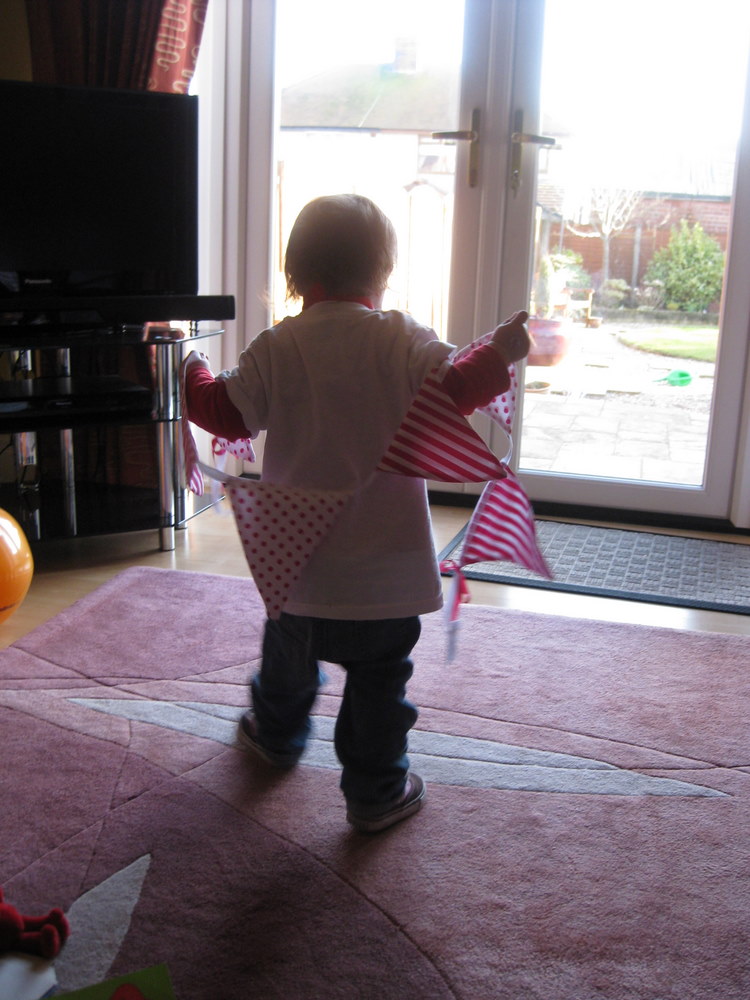 recession by going into the bunting biz. It seems the English are stringing a lot of the stuff these days, while stiffening their upper lips, and it’s kind of admirable. So many empty store-fronts– it’s devastating, really, in a way we barely fathom over here. And maybe it’s just spring time, but things do seem to be beginning to make a turn for the better. The tulips are up, and there are buds on the trees. Here, there is just fresh snow.
We had the most wonderful trip. I bought all kinds of books, but managed to read almost all of them en route, so it’s like I didn’t buy any books at all (very frugal). Stay tuned for an upcoming post about our literary escapades. In fact, stay tuned for upcoming posts galore, but only about our trip, because I can’t think of anything else right now. Real life will come back quickly, I’m sure, but we’re still not finished our washing, I’m still not finished reading my new English books, and there is a bar of Dairy Milk still to be devoured (but not much longer).
December 20, 2010
"A Simple Poem for Virginia Woolf" by Bronwen Wallace
This started out as a simple poem
for Virginia Woolf you know the kind
we women writers write these days
in our own rooms
on our own time
a salute a gesture of friendship
a psychological debt
paid off
I wanted it simple
and perfect round
hard as an
egg I thought
only once I’d said egg
I thought of the smell
of bacon grease and dirty frying-pans
and whether there were enough for breakfast
I couldn’t help it
I wanted the poem to be carefree and easy
like children playing in the snow
I didn’t mean to mention
the price of snowsuits or
how even on the most expensive ones
the zippers always snag
just when you’re late for work
and trying to get the children
off to school on time
a straightforward poem
for Virginia Woolf that’s all
I wanted really
not something tangled in
domestic life the way
Jane Austen’s novels tangled
with her knitting her embroidery
whatever it was she hid them under
I didn’t mean to go into all that
didn’t intend to get confessional
and tell you how
every time I read a good poem
by a woman writer I’m always peeking
behind it trying to see
if she’s still married
or has a lover at least
wanted to know what she did
with her kids while she wrote it
or whether she had any
and if she didn’t if she’d chosen
not to or if she did did she
choose and why I didn’t mean
to bother with that
and I certainly wasn’t going
to tell you about the time
my best friend was sick in intensive care
and I went down to see her
but they wouldn’t let me in
because I wasn’t her husband
or her father her mother
I wasn’t family
I was just her friend
and the friendship of women
wasn’t mentioned
in hospital policy
or how I went out and kicked
a dent in the fender of my car
and sat there crying because
if she died I wouldn’t be able
to tell her how much I loved her
(though she didn’t and we laugh
about it now) but that’s what got me
started I suppose wanting to write
a gesture of friendship
for a woman for a woman writer
for Virginia Woolf
and thinking I could do it
easily separating the words
from the lives they come from
that’s what a good poem should do
after all and I wasn’t going to make excuses
for being a woman blaming years of silence
for leaving us
so much to say
This started out as a simple poem
for Virginia Woolf
it wasn’t going to mention history
or choices or women’s lives
the complexities of women’s friendships
or the countless gritty details
of an ordinary woman’s life
that never appear in poems at all
yet even as I write these words
those ordinary details intervene
between the poem I meant to write
and this one where the delicate faces
of my children faces of friends
of women I have never even seen
glow on the blank pages
and deeper than any silence
press around me
waiting their turn
by Bronwen Wallace
October 19, 2010
Notables: Street Haunting by Virginia Woolf
 May/June 2005 was certainly an exciting time in the history of the universe– Penguin Books had just turned 70, and I was about to get married. These two occasions colliding one day on Oxford Street in London where I happened to be shopping for a wedding dress, and had stopped into a Waterstones where Priscilla Presley was scheduled to be appearing. Though I was devastated to discover that we’d shown up for Priscilla precisely one day late, so I never got to see her promoting her new book. Instead, I bought a copy of Virginia Woolf’s Street Haunting, a gorgeous little volume (for 1 pound fifty!) that had been published as part of Penguin’s birthday celebration.
So it’s not an especially rare book, or an old one, but it’s notable to me. It contains six examples of Woolf’s essays and short fiction, which blur the lines between the two particularly. And to be honest, I would have had an impossible time ever cracking this book and getting through its 56 page had I a month later not happened to sign up for a course in Woolf’s essays and short fiction at UofT where I was to begin graduate studies in September. Woolf’s essays and short fiction meaning nothing to me previously– I’d bought the book because I liked the idea of Woolf more than I really understood her work, and I’d signed up for the course because it was the only Woolf-course available.
My performance in the course was positively dismal, and if you never see me in graduate school again (which, I assure you, you won’t!), the challenges I faced in that course are all the reasons why. If by challenges, of course, you mean the brick wall I kept banging my head against in an attempt to understand academic theory, which, oddly enough, no one had ever mentioned to me during my undergraduate career, or just my efforts to get along in grad school life in general, which met with very poor results. Grad school taught me that I’m really not cut out for grad school, BUT, I learned so very much along the way. Like how to read Virginia Woolf, and that changed everything.
Because I found that her essays and short fiction really are the key to understanding her larger projects, and the foundations behind them. From reading her book reviews, and her Common Reader essays, and her short stories, I found myself positively immersed in her work, and my general academic stupidity aside, I became fluent in Woolf. I understand Woolfian arguments now, and how they turn and wobble, and the straight path was never her intention, so if you get confused reading Virginia Woolf, it’s because you’re supposed to.
And I couldn’t have learned any of this all on my own– if I’d taken a break from wedding planning during that day to read Street Haunting as I was swept along with the Oxford Street tide, I would have found myself baffled and disappointed. I would have read all that weirdness and thought the problem was me. I was sorely in need of a little guidance to illuminate just what was going on, and never mind that that guidance was just showing me the door out of academia, but en route, oh what I learned as I shuffled to the exit.
I learned to read Virginia Woolf— because there’s a knack to it, of course. It’s hard and weird, but infinitely rewarding, and the universe is a more mesmerizing place for it. I could pick up a copy of Street Haunting now and follow its meanderings for hours.
So I like this book because it’s a souvenir, and also because I learned to read Virginia Woolf is another way of saying I have lived.
August 23, 2010
A Room of One's Own
 In March, I spent $130 signing up for ten yoga classes, of which I’ve gone to two, and my pass expires this week. Which is good actually, because then I get to feel less bad about the money that’s gone to waste. I’m not typically a quitter, or one who doesn’t follow through, but when I signed up for yoga class, thinking it would give me a fine escape from the stay-at-home nature of stay-at-home-motherhood, I really had the wrong idea. After a long day alone with a pre-verbal midget, the last thing I need is to be silent in a room of levitating hipsters. It is also distinctly possible that I just picked the wrong yoga studio, but that is another story.
What the story is, however, is that it turned out I didn’t need that much push to get out of the house after all. Yes, indeed, I could probably do with more exercise, but I’ve also joined a fabulous book club, take part in an incredible writers group, and do some work for a charity’s board, and that takes care of quite a few evenings each month. And I enjoy these evenings out so completely, their social nature in particular, because it turns out what I need at the end of the day is company and conversation, but I didn’t know that in March.
Similarly, I have abandoned my garret. Tragic, I know, that the garret is forced to make do without me, and I find myself garret-less. And yes, the garret was a bit bleak, actually being the back of my very strange bedroom closet/storage area, and now it’s packed to the sloped ceiling with newborn baby gear (which, yes, we haven’t gotten rid of. Though it won’t be put back into use for a very long time), but it was a garret, and it had a window, and an outlet, and it was nothing to scoff at, being a room of one’s own. Or at least a corner of an expansive closet of one’s own, which was plenty.
But it turns out that after a day at home alone with a young child, spending an evening alone in the back of a closet is bad for the soul. Or so I imagine, having not bothered to try. For the last year, my office has been a chair in the corner of my living room, by the window with my laptop, with my husband busy at his actual desk on the other side of the room. I miss him when he’s at work, and when he’s home I like to be close to him, even if neither of us are talking and both of us are working on various projects. I’ve contemplated moving back upstairs, but this arrangement seems to be working, and so my desk in the garret sits terribly empty, a magnet for layer upon layer of dust.
One of the best things I own is my A Room of One’s Own tea towel, which was a gift from my friend Paul. Due to its literary nature, it used to hang in our library, before the library became Harriet’s room. Since then, the tea towel has been homeless, and I’ve wondered where to put it, no longer actually having a room of my own (or rather, now that my room of my own is usually empty. Which would make hanging the tea towel there particularly sad).
Last night I finally hung it up in the living room, on the last bare spot left on our increasingly riotous walls. True, this room isn’t one of my own, but I’ve decided to regard Woolf’s idea as a metaphor. This idea underlined by Rachel Cusk’s suggestion that perhaps the greatness and distinction of women’s writing came from women not having rooms of their own, from their novels being composed amidst the hustle and bustle of family life.
Perhaps she’s right, or maybe that only works for some people, and I’ve no doubt my mind and my location will be changing one of these days, but having the tea towel up again, I feel that I’ve arrived somehow. Or that I’m home again, settled, and that it’s not so much a room of my own that I need as much as simply room.
*I guess this is my how NOT to be alone post. I never claimed to be consistant.