October 17, 2015
Happy Birthday, Lillian H. Smith, and The Story Project

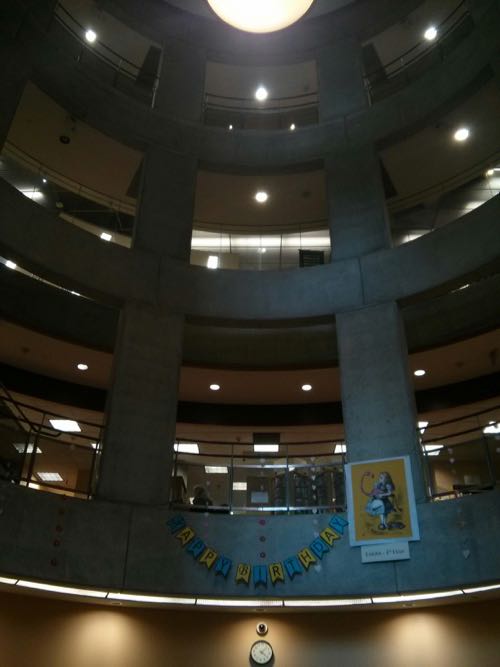 Today was the Lillian H. Smith Library’s 20th birthday party, and we rushed down to College Street after Iris’s nap to catch the end of it. The library has been a special part of our family for the last five years—I wrote about it first in 2011 as part of my “Wild Libraries I Have Known” series, and it also came up in my post about Joan Bodger and Mad Men. It’s truly an extraordinary place—we were there for the Crayon Creators event just a few weeks ago, and last summer completely by mistake we stumbled upon an amazing African drumming workshop because that’s the kind of thing that just happens at the Lillian H. Smith Library.
So we wanted to share in the celebration, and yes, we were told there would be cake. And there was! Plus spring rolls and cups of tea (ala Alice!—“Illustrating Alice” is the exhibit currently on at the Osborne Collection of Early Children’s Books). We were glad to see our beloved Joanne, children’s librarian extraordinaire. There were crafts and face-painting. And the gorgeous bookish birthday table…

Even better? Today was also the launch of the Lillian H. Smith Library Story Project, imagined and brought to reality by the amazing Christina Wong, a library page. Over the summer she collected stories from people with connections to the library, and put them all together on the site. I was happy to share stories about how the library has been so important to my experiences as a mother and our family life in the city: you can listen to it here. (Interestingly, it’s the first time that listening to my voice has not made me want to die… I’m really pleased with how our interview turned out.)
So far I’ve also listened to Andrew Larsen on the role the library has played in his development as a children’s author, and Ken Setterington on the story of Joan Bodger and her husband’s ashes. Looking forward to listening to the rest.
And I’m so happy to have been a part of this project, which celebrates one of my favourite places in the world.
August 19, 2014
Wild Libraries: Fort York
 Yesterday, we took a trip on the streetcar to the newest (and 99th!) branch of the Toronto Public Library, the Fort York Library at the foot of Bathurst Street, a place that is helping to turn this former no-man’s land between the rail-lines and the waterfront into an actual neighbourhood. A bright, airy building with floor to ceiling windows, Fort York Library is a transport vehicle-loving toddler’s paradise, actually, with streetcars and cement-mixers rumbling over the Bathurst Bridge, trains running by to the north, and cars on the Gardiner Expressway whizzing by overhead. Not to mention condo towers going up all around us, cranes in the air, the CN tower so close—what a spectacular view of the city!
We walked in and were drawn to the views, and then to the new books on display in the foyer (and the great thing about a new library is that every book is a new book, and it was an excellent selection of new releases and classics, nary a dog-ear among them yet). And then Harriet and Iris made their way into the kids’ section, where they felt immediately at home.


Harriet was pleased to find a Superman picture book, and I tried to read it to her, all the while chasing Iris around the library. (I have found that visiting the library with both children on my own is a pretty ridiculous experience.) Both girls had fun climbing in the letters and picking books off the shelves, and recognizing some of their favourites among the collection.
And then Iris discovered there was a staircase, and so of course, she had to climb it. Big Sister led the way.

They spun around in the spiffy red chairs and didn’t annoy the other patrons too much.

We were intrigued by the sight of the 3-D printer, and the objects it has made. Lots of space for reading, and group and individual study up there on the second floor too, and a really nice selection of books for teens, brand new gorgeous art books and graphic novels.
When it was time to go, Harriet signed her Superman book out.

And then we took a selfie as we waited for the streetcar, which delivered us home just in time for lunch.

July 8, 2012
Wild Libraries I Have Known: Wychwood (TPL Branch)
 Last week, Harriet was enrolled in day camp in the mornings, which gave me some time to get a lot of work done and the opportunity to fall in love with a new wild library. Wychwood Library has a fascinating history, with origins as part of a tanning factory the late 19th century. In 1904, most of the library’s volumes were destroyed by fire, except for those loaned out to patrons (and thank heaven for the overdue ones). In the years following, the library was housed in the local fire hall, and at Wychwood/Hillcrest School. When Wychwood District was annexed to the City of Toronto in 1909, the library joined the Toronto Public Library system. In 1915, the Carnegie Corporation granted $50,000 to the TPL to build 3 identical libraries, of which Wychwood would be one along with Beaches and High Park.
The library’s design is stunning and smart. The first floor children’s area is spacious, bright, full of things to look at, and so many books. The second floor is a site of scholastic reverence, a grand hall with a timber roof that is 29 metres at its highest point. Sun pours in through the windows, the library is buzzing with patrons of all sorts, pages flipped and keyboards clacking. Community notices are posted all over the place. The grand fireplace lends a touch of warmth and home.
 I spent the week working up in the rafters, taking in the atmosphere and studying the spider-webs (which were beautiful). I claimed a carrel on the small balcony at the west end of the building, and whenever I looked up from my work I was granted a view of the most stunning vista. It was a tremendously productive week, partly because 3 years of motherhood have shown me that not a second of 10 hours of time to work should over be put to waste, but also because my surroundings spurred me on. Wychwood seemed a proper place in which to think, to work, to get things done.
And it’s a wonderful thing about libraries, isn’t it, the way they can offer themselves to us for a little while. Their doors open to strangers, people just passing through, how the words I wrote last week will forever be set there.
February 12, 2012
Wild Libraries I Have Known: Quiet Reading Room at the Amundsen Scott South Pole Station
 How exciting that the Wild Libraries series hits its 5th continent with this post by Laura Conchelos, perhaps our wildest post yet (or at least most extreme). I met Laura nearly twenty years ago, and ever after, she’s been one of my most fascinating friends. I enjoy her adventures vicariously, and delight in the Christmas cards to the South Pole that our friendship gives me occasion to send.
 It may not look like much but the Quiet Reading Room at the Amundsen Scott South Pole Station is pretty important to us. We work for the United States Antarctic Program which runs and supports science at the South Pole with the National Science Foundation. Unlike many libraries these days, it’s strictly books and magazines here with some audio books and CDs thrown in for good measure. For our computer needs, we use our own laptops in our rooms or go to the computer room.
This room isn’t as cute or cozy as many libraries but it is chock full of good reading for  those with the patience to look. Most recent bestsellers can be found here, left by someone else and available for the taking. I usually end up with a stack of books from this room next to my bed that I have to return at the end of our four-month season. Usually I haven’t read half of them! By the end of the 8-month South Pole winter, the Reading Room looks grand, as somebody often has taken it under his or her wing and put energy into reorganizing and labeling the books. Most of the books are novels but there are history books, short stories, poetry, travel, religion and education sections, amongst others. Just as the books get donated over the years, the reading room has been decorated with odds and ends over time, my favorite items being the masks that were made for our wearable art show a few years ago and which can be seen here.
 A locked cabinet in the room keeps most of the Antarctic-themed books and other coveted reading. Most of the knitting books get kept in the cabinet, as do the travel guides like the Lonely Planet. All one needs to do to sign these books out is get the keys from the store during its daily hours of operation.
Apart from pilfering for good reading or doing crossword puzzles here on Sundays  (our one day off), I spend little time in this room. It does get a lot of use from others, however. As the station is such a public place, there are not many locations within it that offer some sort of quiet. People go here to read, write letters, and nap when they don’t want to make the long trek to their rooms. This room is also used by visiting clergy for Masses and church services.
January 9, 2012
Wild Libraries I Have Known: Frances Morrison Children's Library
 Alexis Kienlen is the author of 2 poetry collections- She dreams in Red and 13. She currently works as an agricultural journalist, and writes a weekly book column for The Grande Prairie Daily Herald Tribune. She is a great lover of books and libraries and has a special place in her heart for teenagers and teen fiction.
The children’s library at the Frances Morrison Branch in Saskatoon is one of my favourite libraries. This particular space is what made me a library lover. Just look at how beautiful it is!
The giant Pooh bear has been there for years, and the entrance way and door to the treehouse haven’t changed since I was a child. I love that this library is created in a way that pays homage to a great literary character. (Note- the Disney version has never crept into this place.) Check out the decorations about the mudroom area, and the door to the treehouse storytelling area.
This space is wonderful, and always has been. This big window looks out onto the street, and you used to be able to watch the activity at the Saturday Saskatoon farmers’ market. You can also see City Hall and the park in front of it, where my teenage friends and I used to play a creepy, made up game called “Bone Yard” late at night. If you sit up here in the window, you feel like you’re spying on people.
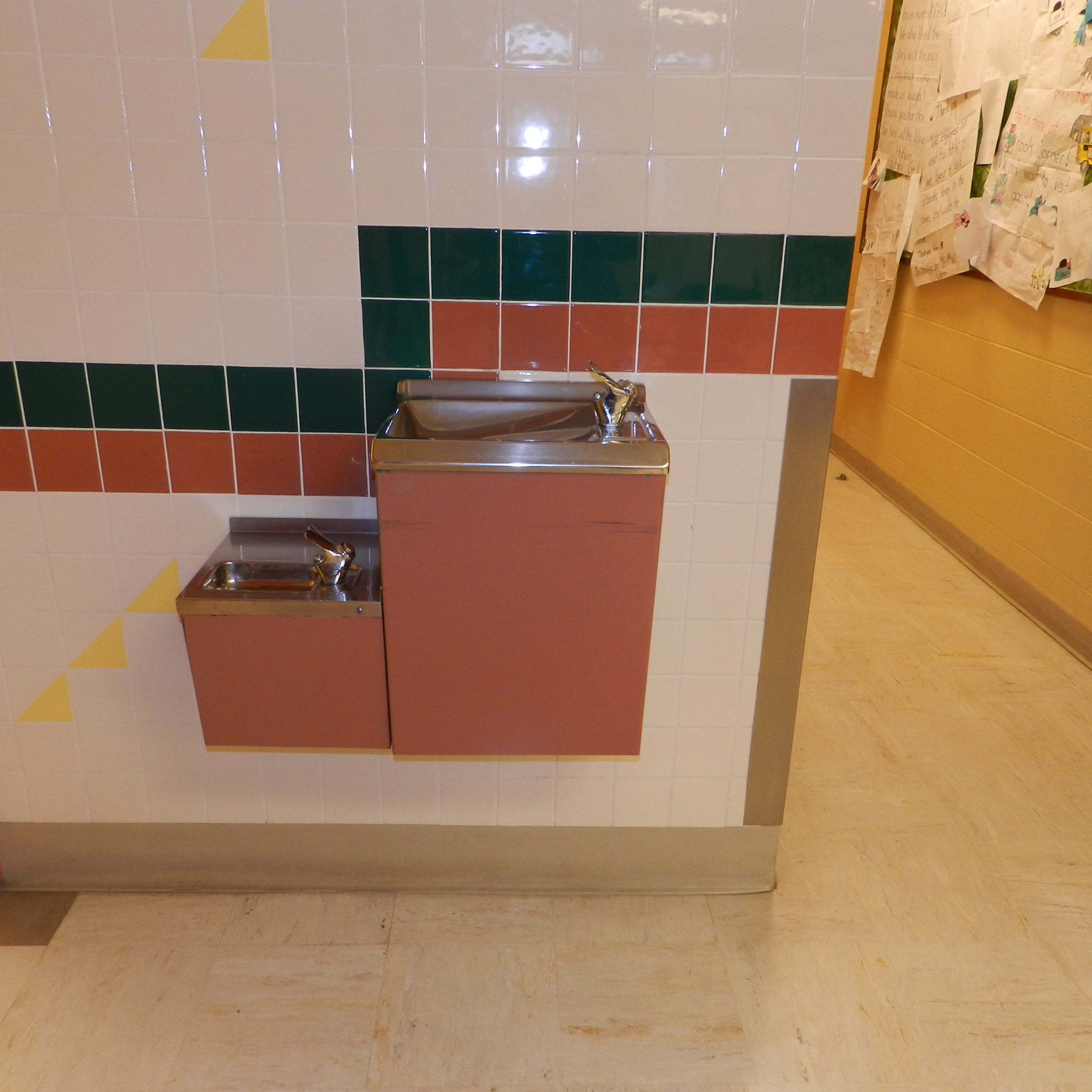 The Children’s Library is on the second floor of the library in its own room. The location is designed specifically for children, with a step-stool so children can sign out their own books at the check out desk, and water fountains at the perfect height for both parents and kids.
Pooh Corner is over 45 years old, and the branch held a homecoming to celebrate their 40th anniversary on November 4, 2006. All past patrons were invited to the celebration, and the library even created a blog and asked people to send in their memories of the space. (I liked the story about the family of three generations who visited Pooh Corner, and the story of the riot.)
I’ve travelled and moved a lot, and I’m convinced the children’s library at the Frances Morrison Branch is one of the best things I’ve  ever seen. I grew up in Saskatoon and used to go here as a child to take out books and to attend story time. The story times were held in the Pooh Corner treehouse, which was shaped like a little cave. If I remember correctly, there are lights on the ceiling. It was here that you would get to hear great puppet shows and stories. (Apparently children went into the space with only a few adults. I bet that’s not the case today)
Many of the staff members have worked in the library for over 20 years. Some of the storytellers and librarians that I knew as a child are still there. And some of them were just wonderful! I remember one particular woman, Judith Benninger, who is now retired. Judith recited “The Cremation of Sam McGee” as creepy shadow puppets acted out the story behind her. All I have to do is think about her telling the story and I get chills up my spine.
One of the incredibly special things about Pooh Corner is the positive memories people have about the space. When I was working in the northern Alberta city of Grande Prairie, I met children’s writer and former librarian Linda Smith, who has since passed away. When Linda found out I was from Saskatoon, she got very excited and told me that she had loved working in Pooh corner and had fond memories of the best. “That is the best children’s library,” she said.
(As I left the library after taking pictures for this post, I ran into an acquaintance, who introduced me to his friend, who is the current director of Pooh Corner. Serendipity!)
July 26, 2011
Wild Libraries I have known: The John Hay Library
 The lovely Julia Zarankin goes looking for love in the stacks of Brown University’s John Hay Library, and finds it!
I walked into the John Hay Library without knowing anything about it. I was a freshman in college, desperately searching for a part time job and convinced that a library job would increase my likelihood of finding a boyfriend (which high school had not afforded). I imagined scenarios where the elusive boy and I would meet at the circulation desk, debate philosophical problems and run off into the stacks together to kiss passionately (preferably next to collected works by Flaubert, on whom I had a slight, inexplicable crush). And finally, life would be worth living.
I ended up getting a job at Brown University’s Rare Book library – the John Hay Library – where I was one of three female work-study students and worked with a group of middle-aged female librarians. The boyfriend I had imagined meeting was nowhere to be found.
Instead, I discovered books and fell in love with their smell, their feel, their inscriptions, and their histories. I had always been a reader, but before working at the Hay, I never stopped to consider the book as a physical and historical object. Books had merely been containers of information; now they were transforming into living beings. (I did end up meeting that elusive boyfriend, but it didn’t happen in a library, and in the end he didn’t really make life worth living, not to mention that our philosophical discussions never quite got off the ground; the whole thing was slightly underwhelming, but I never would have believed that as an 18-year-old.)
I worked at the reception desk at the John Hay Library for seven hours every Monday and Friday of my freshman year. My job should have been boring and repetitive, but wasn’t: patrons arrived, I helped them fill out request forms, escorted them into the (locked!) reading room, ensured that they had nothing but a pencil and notebook in their possession, entered the request form information into a meticulous log, asked permission to search for the requested book in the stacks, returned with said book, delivered it to the patron and repeated the process.
Sometimes, patrons came to me with research questions and I loved the job for the random conversations and chance encounters. Once, I helped a patron amass bibliographical citations for an art project about vomit in 18th century medical literature. She was a RISD student (the art school down the street) and wore a green boa wrapped around her neck. She returned months later, to thank me for my help, but I never did see her art project. The library also housed a remarkable American literature collection, a medical history collection (hence the vomit-book quest), a military collection replete with toy soldiers, an occult collection, along with all sorts of magician-paraphernalia from the ages, and a Playboy collection, among other things.
I fell in love with the library mainly for the magic I discovered in the stacks. My favorite task was emptying the returns cart and replacing all the books in their proper place. This involved taking a service elevator down into the depths of the library (most of the floors were below ground, and several degrees colder); the floors were dark, with a musty smell I quickly developed affection for, and I would walk through the stacks, turning the lights on one by one. It was there, in the Harris Collection of American Poetry and Plays that I found first editions of Arthur Miller, H.D., e.e. cummings, Wallace Stevens. I would linger an extra ten minutes among the stacks whose layout I had memorized, opening volumes of poetry, reading inscriptions, learning the cardinal points of a literary map I was only beginning to put together in my own mind.
The Hay plunged me into a world where books mattered; every detail of their existence, health and well-being was of utmost importance. Books at the Hay were alive, and I was intoxicated.
July 17, 2011
Wild Libraries I have known: The Southern African Wildlife College Resource Centre
 In what is no doubt the wildest installment in the series yet, Valli Fraser-Celin brings us The Southern African College Resource Centre (and a lion):
The idea of a “wild library” has extra meaning for me, since since I work in a library that is literally in the wild. I work at the Gold Fields Resource Centre at the Southern African Wildlife College (SAWC), which is situated in the Kruger National Park in South Africa. We are surrounded by hundreds of thousands of hectares of wilderness and a large quantity of wild animals including lions, elephant and rhinos (amongst many more). The SAWC trains natural resource managers from all over Africa by developing their skills in areas such as anti-poaching, animal studies, conservation management, ecology and environmental  education. The extensive range of courses allows students to return to their workplaces with a greater knowledge of how to protect the valuable parks and reserves they work in. The Resource Centre supports their curriculum through conservation management focused materials and provides a space for students to work and study.
So, how did a Canadian librarian end up in this African wilderness?
 Well, I’ve always loved traveling and after having traveled to Africa a couple of times, I became obsessed with returning to this beautiful continent. While completing my Master degree in Library and Information Studies at McGill University, I continually searched for ways to combine librarianship, travel and opportunities to experience different cultures. One of the ways I did this was by joining the Librarians Without Borders McGill student chapter, of which I became the President in
  2009. In 2010, the first service learning trip to Guatemala was organized to help the Miguel Angel Asturias Academy develop their school library. This was my first experience with international librarianship and just as I imagined, I really enjoyed it! Although I loved volunteering in Guatemala, I desperately wanted to go back to Africa, so when a volunteer opportunity became available at the SAWC, I grabbed it.
 Living in the African bush is such a special experience; I never get tired of hearing lions roaring and hyena and jackal calling at night, seeing beautiful African sunsets and starry night skies. The Resource Centre is really a pleasure to work in: we have huge windows that look out onto the bush, we can hear birds singing outside everyday and we have bush babies living in the roof. Not only is our collection full of materials about the environment and conservation but we also have novels and games for those who need down time from their intensive work schedules. We also have a movie area with beanie bags so that students can watch educational movies and a computer lab where they can work on their assignments.
Working in a “wild library” has made me want to enter the field of environment and conservation, but through establishing  environmentally oriented resource centres for organizations that focus on environmental education and research. I doubt that after this experience I’ll ever be able to work and live in a big city again. Being in a place where nature surrounds you and is a part of your daily life becomes addictive and I know I’ll always be striving to work in another “wild library”.
My blog: http://whereisvalli.wordpress.com/
Blog posts can also be read at A Hopeful Sign: http://ahopefulsign.com
Librarians Without Borders: http://www.lwb-online.org/
Twitter: @vallifc
June 27, 2011
Wild Libraries I Have Known: Brewster Ladies Library
 Hamilton writer (and fellow member of the Barbara Pym Society!) Judy Pollard Smith writes about the Brewster Ladies Library in Brewster, Massachusetts:
I have a Golden Rule about Libraries. They have to carry Barbara Pym, May Sarton and Edith Wharton. If they carry all three I know they’ll have everything else that good libraries should have. And last week at the Brewster Ladies Libary, I counted several of each writer’s novels, neatly shelved and waiting for patrons to tuck them into their wicker baskets.
In 1852, when Brewster was a flourishing Cape village, Misses Sarah Augusta Mayo and Mary Louise Cobb, along with friends, raised enough money to place a shelf of lending books in the home of Captain Mayo on Main Street. Over the years the library has added a garden dripping with rich vegetation, and a fabulous addition. The original house still serves as a hushed reading room with stained glass windows and the original fireplace. If you listen you can hear the rustle of the Misses skirts as they pass by.
There is a cheerful children’s room with aquarium, story times, toys and books. There are author chats, book discussions, holiday family programs (works out well if it rains on your vacation!) and local artist’s displays.
There are 200 Senior Volunteers, four of whom were sitting gluing the pages back into books when I was there. There are cosy wing chairs, free internet and a general feeling of amicability. Denise at the Reference Desk redefines the words “pleasant, helpful, lovely.” And summer visitors can get a card for no charge.
I say, “Up with those two Misses who started their lending shelf in 1852!” They had no idea what shining threads they were weaving into the posterity of this tiny village.
June 13, 2011
Wild Libraries I Have Known: West Vancouver Memorial Library
 Reader, Editor and Poet Kate Kennedy (who has known a few libraries in her time) tells us about the West Vancouver Memorial Library.
West Vancouver Memorial is my grandmother’s neighbourhood library and she’d often take my sisters and I along to browse when we were in the city visiting. It was significantly larger than our library in Lillooet (about four hours away) and we were always a little floored by the selection. We didn’t have borrowing privileges, but between them my parents usually got down to the coast every few weeks, and if it could be ascertained that the next visit would be before the next due date, we were allowed to take a few books out on Granny’s card. (The possibility of losing or damaging one of these books once you had it home was fairly terrifying.)
It was through these visits that I read most of Cynthia Voigt’s Tillerman family series (Homecoming, Dicey’s Song, and the rest). I wouldn’t say there was any real lack of tomboy characters in the fiction I read at that age, but Dicey Tillerman (particularly as depicted on the first-edition cover of Dicey’s Song, next to her boat, in her red sweatshirt) seemed to set the bar a little higher. She wasn’t ignoring her appearance because she’d decided that was the type of person she was, in contrast to, say, the artistic character, the flirty character, the geek and the baseball star. Her mother had abandoned her and her siblings in the parking lot of a grocery store and now Dicey had to take care of them all on their long trip to find other living relatives. Dicey didn’t have time to be a type of anything. I haven’t reread much of the fiction I read back then, but I think there was an authenticity to the high stakes in Voigt’s books that wasn’t so common, and maybe isn’t now either.
Apart from the books themselves, what I loved best about the library in West Vancouver was the pair of rounded, enclosed,  wood-panelled study carrels up in the adult section. They were reminiscent of hollowed-out trees and illuminated by inviting pot lights, and the thought of having something to study in one of them was pretty thrilling. Then, when I was in grade eight, I got to spend a year living in the city, attending a private school that went in for the full tie and kilt uniform. Having by this time moved into a lot of boarding school literature (Enid Blyton’s Malory Towers series and Kit Pearson’s The Daring Game, among others) this was heady stuff for me. I found myself one afternoon at the West Vancouver Memorial Library, in my uniform, with a friend, having nabbed one of the precious study carrels, books spread open before us, watching in confusion as this friend began an elaborate process of removing or obscuring all the recognizable parts of her uniform lest we be spotted by public school students. But we were wearing blazers! With crests! In the world’s best study carrel! What could possibly be wrong?
The ambiance of that library was in part, for me, an extension of the ambiance of Vancouver, a city that was always a treat and that I didn’t want to leave when it was time to go, but that I also never figured out how to fit into properly. I eventually came to love the Interior, and would probably now choose it over the coast, but the coast will always feel a bit decadent, full of things that we didn’t have in our town, the books we had to hurry up to read in time but that we didn’t want to ruin by rushing through.
June 6, 2011
Wild Libraries I Have Known: Vanessa's Bedroom
 In which Nathalie Foy tells us about a wild library she has known:
It’s not a library, exactly, but I did borrow books from Vanessa’s bedroom. It was a large, cool and quiet space, with the hushed and reverential atmosphere of a library, and from its shelves, I borrowed many books. When Kerry asked me to contribute to this series, it was memories of Vanessa’s books that came most powerfully to mind.
Port-au-Prince, 1977. We were seven, and Vanessa was my best friend. We lived in Haiti, and attended Union School in Port-au-Prince. Vanessa was an only child and adopted, her pigtails were perfect ringlets and never fell out; I had an annoying younger brother and a boring pedigree, my poker-straight hair sought any means of escape from braids, ponytails or hair bands. Vanessa had a four-poster bed with a canopy in her bedroom, all frills and luxury. Bright pink bougainvillea bloomed outside her window, and in golden rows on her bookshelf sat the complete set of Nancy Drew mysteries. Every single one. All arrayed in numerical order, the yellow spines each had the cameo profile of the girl detective holding her magnifying glass: a vast, crisp expanse of potential. Even the school library did not have the whole set.
Oh, how I envied her that collection! I borrowed and read the books in sequence, but even at the time, I was aware of a definite taint to the experience. There was a limit placed on my pleasure by greed: I wanted the books to be mine. I am certain that the book buyer in me was born in that bedroom, because I do like to own books.
Somehow, at the impressionable age of seven, I conflated the wonders of that complete set of Nancy Drew mysteries and the four-poster bed with being an only child and adopted—all of which were to be envied. It was all so exotic; it was what I was not. I’ve met other only children and adopted children since then, none with complete sets of Nancy Drew, and I like my brother considerably more today than I did when he was five and a pest. I have since learned that Carolyn Keene is a pseudonym for the stable of anonymous writers who wrote the Nancy Drew mysteries for $125 a pop. My life experience has not cured me of my covetousness when it comes to books, though.
I love libraries. I love what they do and what they stand for. I love that they open up the world for us. I am humbled each time I see the crowds outside of the Toronto Reference Library, and I feel a surge of joy when I see the noble griffin protecting the doors of Lillian H. Smith branch of the Toronto Public Library, the branch I use most regularly. Most of the time, I check out books for my three boys, being more reliable with getting things read by the due date with them than for myself. But if we read a book and love it, I itch to buy it. My boys have the luxury of a childhood lived in one place. I moved to a new country every two or three years, and precious few books from my childhood survived the moves. I’m making up for lost time and making my own rows of delicious books to devour.