August 5, 2025
The Road to Tender Hearts, by Annie Hartnett
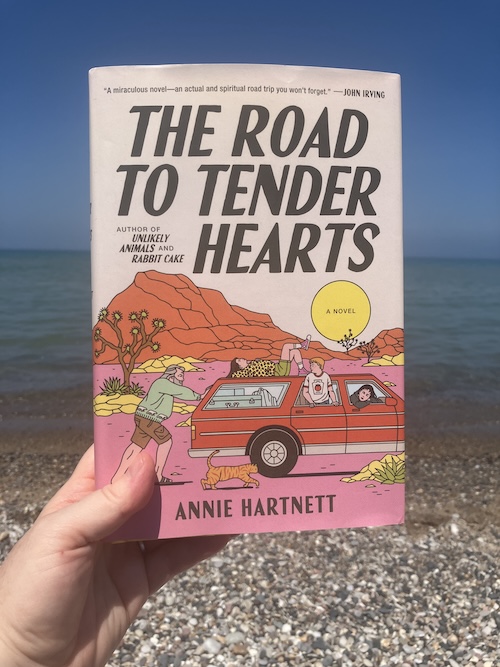
In the acknowledgements for THE ROAD TO TENDER HEARTS, Annie Hartnett explains that her novel was born of a challenge she set for herself around 2021: could she take all her fears and anxieties (especially about death), and her worries about not being a good enough parent or capable enough person, and turn all of these things into a novel that was FUNNY? And reader, she did, she really did, this explanation going a long way toward making sense of this totally bonkers novel that manages to be not remotely off-putting even though it’s about grief after loss of a child, childhood sexual abuse, children who are orphaned in a murder suicide, and one tragic death after another as the narrative goes on, taking its reader on a road trip from the armpit of Massachusetts down to Texas, and then to Arizona where lottery winner and prototypical well-meaning but disappointing dad PJ Halliday hopes to be reunited with Michelle Cobb, the love of his life, whose husband’s obituary has only just appeared in the local paper.
The only complication is that he’s just been saddled with the care of his grand-niece and nephew after their parents’ tragic deaths, and PJ doesn’t have a great track record for care, really. His eldest daughter drowned in a cranberry bog on her prom night 15 years before, and his youngest, Sophie, barely speaks to him now, plus he’s spent the last decade and a half drinking away his pain. And okay, I lied, that’s not the only complication, in fact, everything is a complication for PJ at the moment, in particular that his ex-wife is about to depart on a trip to Alaska and PJ won’t be able to have breakfast every morning at her house anymore. Or that PJ doesn’t have a car anymore after his DUIs. Or Pancakes, the cat, which comes along on the journey and seems to have an instinct for when somebody is about to die…
How does Harnett get away with writing a comic novel about ALL THAT? By acknowledging the best and worst parts of people, by telling the truth, by demonstrating that LOVE means telling the truth, even when the truth is that the people we love or loved are profoundly flawed or terrible.
If you’re up for a sombre book about grief, leave this one alone, but if you’re in the mood for a story that will explode your ideas about what must be treated with seriousness and reverence in fiction, then THE ROAD TO TENDER HEARTS will likely be one of your favourite books of the summer too. Thanks to Stephanie at Betty’s Bookshelf in St. Mary’s, ON, for the recommendation.
July 11, 2025
On the Calculation of Volume 1, by Solvej Balle
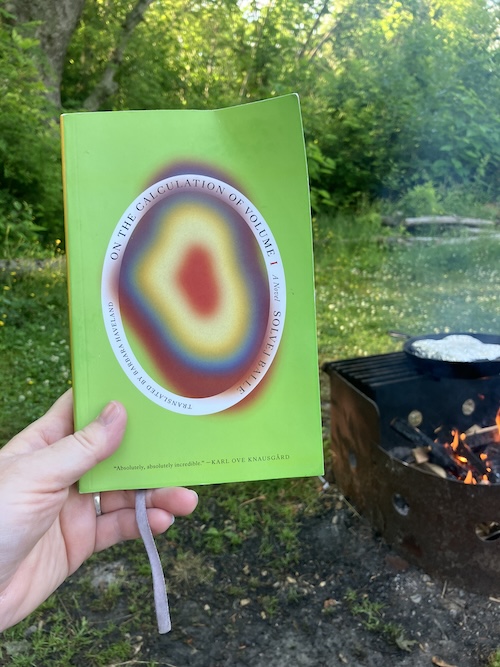
I will only mention Bill Murray this once, and not even name his film’s title that’s become iconic enough to eclipse the film itself, standing in for a narrative approach so overdone that it might be hard to imagine it could be made interesting. And then along comes Danish writer Solvej Balle with a request for us to hold her beer after she, according to a blurb on the back of her novel from LE FIGARO , “went into exile on an island for more than twenty years” and returned with ON THE CALCULATION OF VOLUME, whose first two volumes have been translated into English by Barbara J. Haveland, the first of which I read on a camping trip the weekend before last.
The premise is this. Tara Selter, antiquarian bookseller, has just spent the last 121 days awakening every morning to another November 18 (alas, without Sonny and Cher). It all started on a business trip to Paris, unfathomably strange. Eventually she makes her way back to the home in Northern France that she shares with her husband, Thomas, who is also her business partner, and when we find her, she is hiding out in her spare room because she eventually tired of having to explain to Thomas day after day what she was doing at home instead of Paris, where she’s supposed to be.
This is a quiet narrative, as confined as Tara is within a single day, a limited geography (though apparently the world expands in subsequent volumes). She comes to know all the patterns, when she’ll hear birdsong, when her husband returns home, what the weather will be, everything always the same, although there are strange deviations—sometimes things she acquires one day travels with her into her next day, and other days these acquisitions disappear. Trying to figure out some kind of pattern or logic beneath what’s happening to her becomes a major preoccupations in the her first 50 days or so, but eventually her energy in that direction peters out.
Tara’s loneliness permeates the text, the relief of finding her beloved Thomas eventually ceasing to satisfy her because she realizes how fundamentally she’s alienated from him, even when they are fortunate enough to be together. She realizes that she’s embarked upon a journey that he cannot be part of, no matter how much he wants to be, no matter how much they love each other—which reminds me of what couples experience when one is undergoing a serious illness or even dying, the impossibility of true togetherness, the meagreness of the togetherness they have.
I happen to be rereading Frankenstein right now, and recognize a similar tone in the two novel’s first-person addresses, Tara too a kind of monster, outside the ordinary, people responding to her situation with confusion and disbelief. She spends the novel similarly skulking in the margins (she refers to herself as a ghost), peering in lit windows, set apart from the ordinariness of human experience which she so longs for.
The Calculation of Volume tells an extraordinary story, but what its narrator goes through will be familiar to many readers, underlining the story’s poignancy. This very specific, unlikely tale brings with it a certain universality. Tara tells us, “It seems so odd to me now how one can be so unsettled by the improbable. When we know that our entire existence is founded on freak occurrences and improbable coincidences. That we wouldn’t be here at all if it weren’t for these curious twists of fate. That there are human beings on what we call our planet, that we can move around on a rotating sphere in a vast universe full of inconceivably large bodies comprised of elements so small that the mind simple cannot comprehend how small and how many there are… Anyone would think that this knowledge would equip us in some small way to face the improbable. But the opposite appears to be the case…”
July 2, 2025
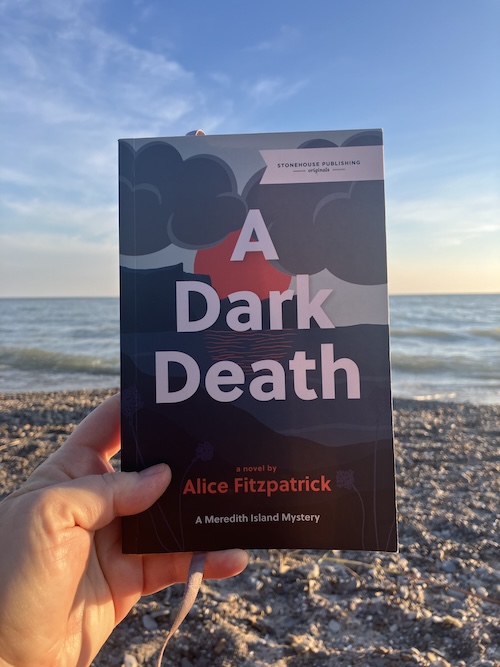
A Dark Death, by Alice Fitzpatrick
I was lucky to be born in Canada, and doubly lucky to also be able to also choose Canada when I moved (back) here with my immigrant spouse exactly 20 years and two days ago. My feelings about Canada Day and nationalism are always complicated (which I think they should be), and they’re additionally complicated this year with Canada’s sovereignty under threat. The world is so weird and interesting, and nations are made-up stories, but also so is everything.
This past long weekend (which stretched four days long) kicked off summer for us with a beautiful weekend camping in one of our favourite places on the shores of Lake Erie. And I was thrilled to delighting in a Canadian novel on the beach, Alice Fitzpatrick’s A DARK DEATH, the second book in her Meredith Island Mystery series (I haven’t read the first, jumped right into this one, and it was fine!). Meredith Island is a small and homey Welsh island where retired teacher Kate Galway (who solved her aunt’s murder the summer before) is hoping to finish her novel, but there is too much happening for that even before the first body turns up. A group of archaeology students is unearthing supposed evidence of a Roman temple, and a conman posing as a psychic is stirring up trouble among her neighbours, and then all hope of tranquility is lost when a body turns up amidst the dig site. Once again, the local constabulary is going to require Kate’s assistance, although they’re calling it meddling. And what about the minister who has locked herself inside the church and seems to have lost her faith? Or the shopkeeper who has fallen under suspicion for the murder, even though Kate knows that surely he hasn’t done it.
The narrative moves between multiple perspectives, Kate sharing the story with her neighbours, with the young police detective who is one of Kate’s former students, her artist friend who is looking to seduce the detective, the Professor leading the dig, his errant students, with the Minister, and her doctor husband. The result is a satisfying (and amusing) picture of a community with Three Pines vibes, each character with his or her own struggles and temptations, and a fun and absorbing mystery to follow, and this series might be joining my own personal list of must-reads.
It’s also one of 49thShelf’s July Summer Reading picks, if you feel like doing some Canadian reading yourself. And even better—each and every title on the list is up for giveaway!
June 26, 2025
In Crisis, On Crisis: Essays in Troubled Times, by James Cairns
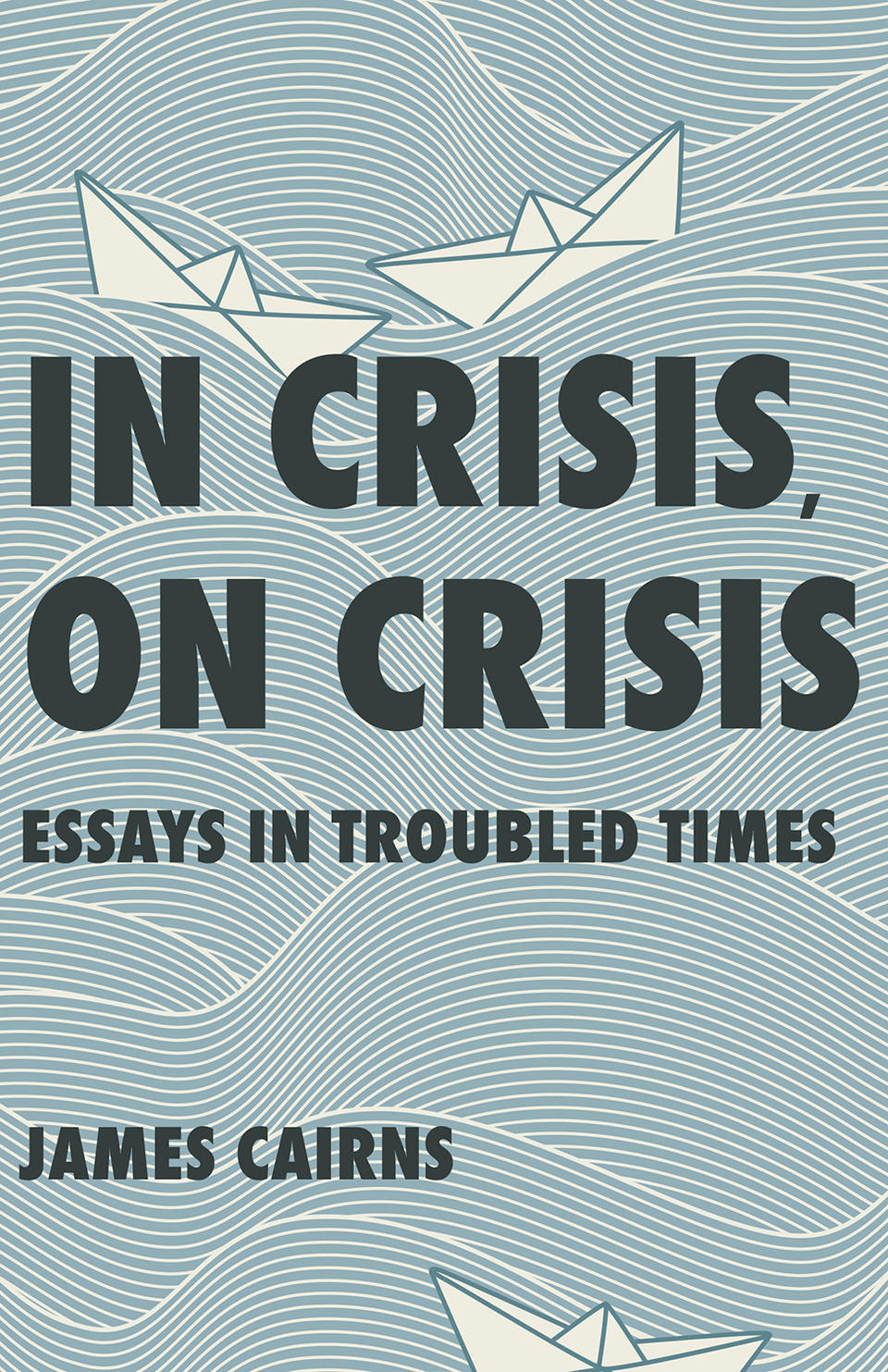
I have trouble with understanding things, with understanding proportion. As someone with anxiety, I tend towards catastrophic thinking anyway, and so I get confused with how the media reports such things, how it all gets compounded. An example, say, like Covid, which came along with the most infectious variant ever, and then the one after that which was even more infectious, and then one that 20 times more infectious, and that was around the time my brain broke into bits, because how is that even possible?
What does it mean when everything everywhere is a crisis? James Cairns’ essay collection In Crisis, On Crisis is an effort to answer that question, and belongs to a genre of literature from which I’ve been finding answers this spring, and includes Leanne Betasamosake Simpson’s Theories of Water and The Snag, by Tessa McWatt. There was a time, a little under a decade ago, when people who marching around holding signs that said, “I WANT YOU TO PANIC,” and let me tell you, I did what they said, but all I got was a mental breakdown. And so what I’m looking for these days are stories for how we can still live rich and meaningful lives in this moment, while envisioning possibilities for a different kind of future.
These essays by Cairns—a professor at Wilfrid Laurier University and also a socialist—are a fascinating blending of personal, cultural, and scholarly, many of his broader ideas about living amidst crisis underlined by his experience as someone who lives with addiction, someone who has relapsed and recovered in the past, and could very well do so again: “The fact is, I’m not going to drink today. And if I relapse tomorrow or ten months from now, I have experience and supports to get me through it. It won’t necessarily mean my life is ruined. But it might. There is no curing, no transcending my alcoholism./ This is a crisis. This is not a crisis.”
How do we live knowing that bad things can happen? How do we live knowing that bad things will happen? In these essays—which delve into Trumpism, apocalyptic reading, whether we are in fact living through a crisis of democracy, midlife crises and Karl Ove Knausgaard, fatalism and Sylvia Plath, the experience of moving during a pandemic, if now is a “post-truth” moment, fears and anxieties about his children and their futures in the face of the climate crisis—Cairns delves deep into these questions and urges the reader to leave room for possibility.
June 20, 2025
Water Borne, by Dan Rubinstein
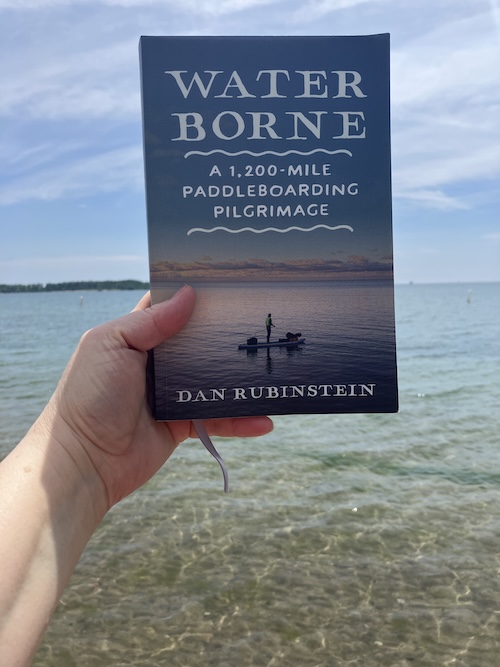
I became an admirer of Dan Rubinstein with his 2015 book BORN TO WALK: THE TRANSFORMATIVE POWER OF A PEDESTRIAN ACT, which I read not long after Rebeccca Solnit’s WANDERLUST, loving how the two books were complementary, and with his latest release, WATER BORNE, I am once again struck by how beautifully his work fits into a wider literary context, specifically books about water and rivers that have also come out this spring by Robert Macfarlane and Leanne Betasamosake Simpson, both of whom would likely also have underlined the following lines from Rubinstein’s book, “…borders, like the fringes of any lake, river, or ocean, are transition zones. The rough margins where change comes slowly, from the friction of daily and seasonal cycles. Or in a tremendous burst, like water breaching a dam.”
WATER BORNE is the story of Rubinstein’s journey by stand-up paddleboard (SUP) from his home in Ottawa, Ontario, to Montreal on the Ottawa River; from Montreal to New York City via the Lake Champlain and the Hudson River; and Albany, NY, to Buffalo, via the Erie Canal; and then from St. Catharines to Kingston, via Lake Ontario; and back home to Ottawa on the Rideau Canal. It’s also the story of the strangers he met along the way, the friends and relations who supported him, odd conversations at campgrounds, a chronicle of lost sunglasses., and the history of these waterways, man-made, histories that tell of the rise and fall of different industries over centuries, a progress that led to the degradation of lakes and rivers and the health of creatures who make their lives by their waters.
But it’s also the story of people who are working to change this cycle, of projects to restore life to waterways, both in terms of the natural world and actually making these waterways accessible to the people who’d most benefit from this access, people who don’t have the luxury of vacation houses or even swimming lessons. Throughout the book, Rubinstein imparts the wonders of “blue spaces,” which are like green spaces, but even better for our mental health. Considering all of this as he paddles during a season where the temperature is breaking heat records and the air is thick with smoke from wildfires. What lessons can blue spaces teach us at a moment when the stakes are oh so high.
Rubinstein’s narrative is funny and engaging, and personal as he weaves his family’s story in among the broader history. (His mother, who tracks his locations, and sends worried texts, is one of the best characters in the book.) Nimbly, he blends memoir with reportage to make a story that flows beautifully, and is both hopeful and inspiring, and a must-read for those of us who love blue spaces already.
June 3, 2025
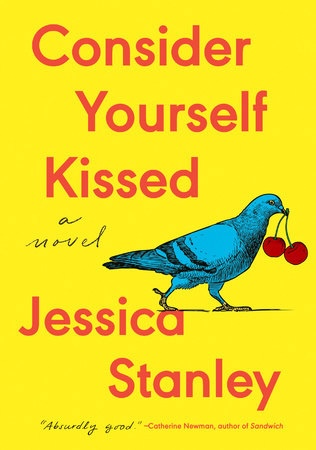
Consider Yourself Kissed, by Jessica Stanley
I periodically wonder if, had I’d lived through any other period from my thirties into my mid-forties, I might look less ravaged by time right now. If I might resemble that woman I was in photographs until around 2013, whose hair was dark brown, her skin unlined, decidedly youthful. And while I have absolutely no complaints about my grey hair and wrinkles (I like how I look and I’ve known too many women who would have given anything to win their grey hair and wrinkles, but didn’t get the chance), I do wonder if the last decade and a bit has been just a bit EXTRA in terms of things that might age one seemingly overnight.
And this is the period that Jessica Stanley documents in her novel Consider Yourself Kissed, the story of a marriage set right close to the eye of the storm—Coralie is a Australian expat who falls in love with divorced dad and political journalist Adam after she rescues his small daughter when she falls into a London pond, and dropped into his world Coralie finds herself BELONGING for perhaps the first time in her life, after a peripatetic childhood, ensconced in a life that is rich and full. But maybe too full? Is there such a thing?
Against a tumultuous decade in British politics (during which Adam’s star only rises), including Brexit and the nightmare of five different Tory Prime Ministers, capped off with a worldwide pandemic, we see Coralie trying to balance the demands of motherhood and marriage with her own career, and failing enough that she feels pretty bad about all of it, all the while neglecting the creative dreams she stuffed in a drawer when she met her husband who had ambition enough for both of them.
Consider Yourself Kissed (the title comes from how a character in Mary McCarthy’s THE GROUP signs letters to his girlfriend, a literary nod to perfunctory love) reminds me of Nora Ephron’s Heartburn, which is pretty much the highest praise a critic can offer to a comic novel bridging the political and domestic. It’s a that book that shows how women ARE that bridge, making the lives of seemingly important men possible, mapping out quotidian details while their husbands are charting epic tales and being celebrated, while these wives stay quiet in the background. Except that Coralie reaches a point where she just can’t do it anymore, which is the moment we find her at when the novel begins, and to explain how she got there, she has to go back to the beginning…
Charming, funny, touching, and so engaging it’s almost exhausting (because WHAT A TIME IT’S BEEN), Consider Yourself Kissed is a complicated love story, and absolutely a delight.
May 23, 2025
The Names, by Florence Knapp

I was swept away by Florence Knapp’s novel THE NAMES a book that came on my radar when UK. bookseller Katie Clapham made it her book club pick. I was besotted by the premise: a mother in 1980s’ England walks to the registry office after a giant storm to register the birth of her son, a child is who intended carry the name of his father and his father’s father before him. But the child’s father is a monster, and so the mother makes a last minute switch and gives her baby a name chosen by his older sister. Or else she makes a different switch, and names the child herself. Or else she goes along with the original plan, naming the baby for her abusive husband as she’s expected to do, and the narrative rolls out in three different threads with what transpires with these different choices. The choices not just about the name the boy will carry—we encounter him and his family at seven year intervals throughout the next four decades—but the novel is so much more richly textured than that, being also about everything else that happens around him, especially his father’s responses to the different things the mother has done in choosing the names that she has and the different narratives that are put into motion, oftentimes unstoppable. (This book is tough to read in places. Imagine how many times the average novel might break your heart, and then multiply it by three. OOF.)
The NAMES recalled Kate Atkinson’s LIFE AFTER LIFE, another novel about fate and chance, and flaps of butterfly wings, and about how it’s impossible to ever get life completely right no matter how many opportunities you have to try. This is true especially in the novel’s depiction of domestic violence—there is not a single choice the mother will make that will ever be the right one. But in a more general sense, life is like that for everyone, every good outcome occurring with something else that’s lost, or other unseen consequences. To be in the world at all is only wild and capricious, risky, amazing, and awesome at once.
May 20, 2025
The Snag, by Tessa McWatt
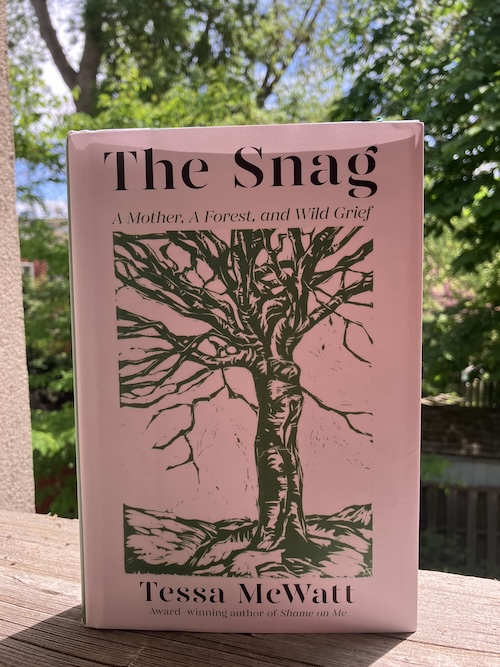
The Snag: A Mother, A Forest, and Wild Grief, by Tessa McWatt, the Guyanese-Canadian writer who lives in England, is a memoir woven of climate grief, the experience of slowly losing an aging parent, and one’s own experience of being in the world. How do we live? And how do we die? Which, of course, is mostly the very same question, and McWatt finds that the answer might lie in forests, and trees. In particular in the trees called “snags,” which are dead trees found in the forest and vital sites for biodiversity, a habitat for all kinds of creatures, and new life and possibilities. McWatt sees an analogy between snags and her own mother, whose dementia is worsening. The book begins on the day that her mother is moving out of her own home, one more uprooting in a life that’s been full of them. It is also, McWatt notes, “the last day of the hottest year in recorded history,” and she recounts a series of the catastrophes wrought by climate change over that year, plus an autumn that so much war and devastation.
“Grief arrives out of rupture. It is evidence of something treasures, now lost. If I sit with this evidence something else will surely come, the way a seed might eventually grow a tree. We are small and hungry and alive.”
Here is the thing that I love about this book, McWatt’s acknowledgement that grief must be sat with, but that also that this sitting is not the end of it. That something can come after this, and it will, but what? And once again, the answer is in the forests and the trees.
The Snag is one of the wisest books I’ve ever read, a memoir about observing, and listening, about music and singing, about the wonders of forests and what we can learn from them about connection and how to care for each other.
“Another world is possible. The extractive, consumptive way we are living demonstrates a severe lack of imagination. But we have the tools, models we use to reclaim, renew, invent. There are communities around the world still rooted, still defending their ecosystems, that are potent sites of resistance. And there are new ones being born.”
May 16, 2025
Encampment, by Maggie Helwig
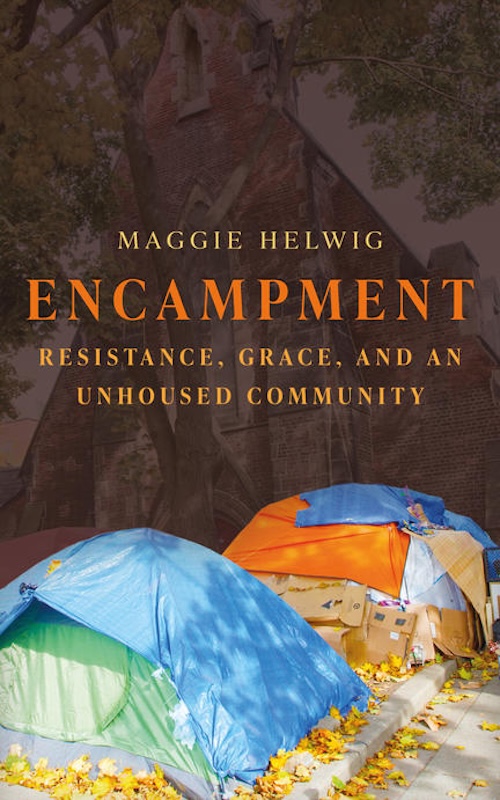
Maggie Helwig—Toronto poet and novelist, human rights activist, and also Anglican priest at St. Stephen-in-the-Fields in Kensington Market, just a few minutes walk from my house—isn’t preaching to the choir when I pick up her new book, Encampment: Resistance, Grace, and an Unhoused Community. It’s not politically fashionable in the circles in which I travel, but my feelings about homeless encampments have often been complicated and less than generous over the last five years. I know how I’m *supposed* to feel—the “I Support My Neighbours in Tents” signs that others installed on their front lawns signal that direction, but I have a hard time conjuring that support, sustaining it. It works in theory, I guess, but then I show up at the park with my kids and the people living in the tents along its perimeter start screaming at each other and it’s disturbing and frightening. And I have a hard time too with being told that my discomfort doesn’t matter, that my complicated feelings are morally dubious, and that the politics behind any of this are simple, that this is simply a case of rich homeowners versus everybody else, as encampments grow and those of us without our own backyards lose access to public parks and green spaces.
And what I appreciated about Encampment is that there was grace for that, for my complicated feelings and frustrations, just as there is grace for the people screaming in the park, and the people who’ve made their home in the encampment in the St. Stephen’s churchyard over the last few years, and so many others. Maggie Helwig’s capacity for grace is absolutely awe-inspiring, and I read Encampment wishing desperately that the world would give the woman a break. Her own challenges and struggles are woven into the text as well, which underlines just how much she needs a break, but also how her refusal to compartmentalize human experience—that of herself and of others—is where her compassion comes from. Humans are messy and hard. Community is messy and hard. Systems are broken, and what else can we do but try to love one another the best we can?
There is a woman in this book who might be me. (I suspect that, no matter who you are, you will see yourself in many of the people in this book.) That woman is a neighbour who stops Mother Maggie one chaotic day in the parking lot. She’s frustrated by some of the encampment residents, she is afraid of violence, but mostly she is angry because she never wanted to be somebody who turned against vulnerable people. And Helwig writes, “Because it is terrible, and it shouldn’t be like this, and coming up hard against the truth that we live in a society that will dump people like garbage on the side of the road, and there is no good thing we can do, is an awful moment for anyone who hasn’t been through it yet.”
Those of us who live in a world where people are well and housed and healthy and stable have no inkling of what life is like for those beyond those limits, and Encampment rectifies that, explaining away the myths of homelessness, dismissing easy solutions—couldn’t they just…? If only…? The most powerful part of the book for me was when Helwig writes about stuff, possessions: “Maybe this is a good time to talk about the relationship that people have with things, and how far it is really just an inflection of our whole society’s relationship with things.”
And it’s this refusal to see any difference between neighbours, regardless of their housing, that makes Helwig’s voice and vision so extraordinary, and what makes Encampment such a necessary, clarifying, and life-changing read for so many of us right now. Some of the most frightening characters in the book are people with six figure incomes and roofs over their heads, not the guy unconscious in the doorway. Helwig writes, “The true, terrible threat is that, if you just one let these people get too close, you might learn that, underneath it all, we actually are the same. Poor bare forked animals in King Lear’s storm, in a world that’s always ending.”
May 7, 2025
A Mouth Full of Salt, by Reem Gaafar
Reem Gaafar’s debut novel, A Mouth Full of Salt, 2023 winner of the Island Prize for a debut novel from Africa (and the first book by a Sudanese writer to be recognized by the prize) grips the reader from its opening line, “Until a body was actually found, they referred to him as ‘missing.'” The body in question is that of a young boy presumed drowned in the Nile, a too frequent incident among the people from his village: “The Nile was a trap that attracted, ensnared, and buried all at once. It took from them as much as it gave.” Which what happened to Fatima’s brother after all, years earlier, a tragedy from which her mother has never recovered, leaving her a little outside the local community of woman, and this Fatima can relate to. She too is also set apart from her peers, although this is by her determination to pursue her education, as opposed to her good friend Sawsan, whose wedding is approaching.
A Mouth Full of Salt moves between Fatima’s perspective and that of Sulafa, the mother of the missing boy, whose been relegated in her household after her failure to have more children, and whose husband’s second wife is currently pregnant with twins. As the villagers keep watch for the boy’s body to resurface, other catastrophes beset the village one-by-one: farm animals are struck by an illness, and die on mass; fires take down gardens and orchards. Villagers are talking about prophecies, worry about a curse, and soon that something has gone very wrong for these people are altogether undeniable.
Like Sudan itself, this novel is cut in two, and in its second half, readers begin to understand how the nation’s history is at the root of what’s happening in the village. From the 1990s, we’re taken back to 1943 and to Nyamakeem, from the country’s south, who has fallen in love with Hassan, a northerner, an Arab. Such unions are rare and frowned upon, and Hassan is rejected by his family. The two of them attempt to build a life together in Khartoum all the same, raising their son, but when Hassan eventually stops coming home to them, Nyamakeem has no choice but to go back to his home village and his family to find out what happened.
How the lives of the women in this novel intersect is the crux of a taut and measured story. Gaafar, who now lives in Ontario, and is also a physician, has crafted a beautiful and compelling novel about women attempting to break free from the limits of their power.