March 26, 2025
A Return to Analogue
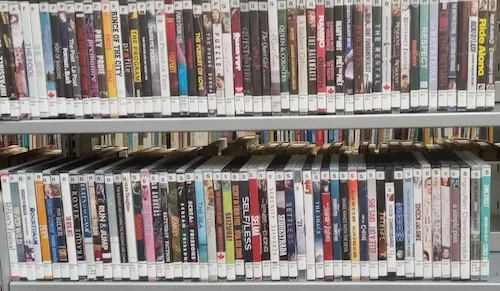
I remember the friction of pulling that tag off the shelf, its plastic a perfect fit inside my palm, and how it felt like I was holding a key to something vital. I would carry the tag to the counter where it would be traded in, more often than not, for the 1988 Lily Tomlin/Bette Midler vehicle Big Business on VHS, a video my sister and I rented from our local corner store so many times that when I watched it again more than 30 years later, I knew the whole thing by heart.
Video rental was such a big deal for the first 20-some years of my life, its high stakes made clear by the FBI warnings that preceded every film, the responsibility to be-kind-please-rewind, and the sinister curtains behind which the dirty movies were kept, not to mention how a certain title’s availability or otherwise would have the power to make or break one’s sleepover party.
I could chart the course of my life by video stores, from the pre-chain hometown joints, to Bay Street Video (which lives on!) during my university years, to our local video store in Japan where we’d pray for subtitles, and then the Queen Video locations we frequented back in Toronto until the last one closed in 2019—although it wasn’t very frequent by then because we didn’t have a DVD player any longer.
But at the end of January, we bought another one, part of a grander plan to combat the overwhelm (at which we’ve not always been successful, I’ve got to say; sheesh, it’s been a time) by cutting ties to corporate entities where possible and focusing on tangible finite things. Streaming services never once delivered the satisfaction I’d received from bringing my plastic tag up to the counter, and they also made my children wrangey and frustrated as there was never anything they wanted to watch enough but always something to suggest they should not give up trying.
So we went back to DVDS, and I want to tell you about the joy of heading to the library DVDs shelf with my 11-year-old daughter for the very first time, about what it felt like to recall the sweet serendipity of this kind of selection and to have her experience it for herself. At dinner the night before, her dad and I had been remembering the 1986 movie Flight of the Navigator, and there it was on the shelf. She also borrowed a collection of Pixar shorts and Inside Out 2, and we felt so lucky and excited at finding these—for free, even. We’re currently #850 of 1125 on the library holds list for the DVD copy of the Wicked movie. We’ve got time and are happy to wait.
Our local secondhand/overstock bookstore has an entire basement full of tapes, CDs, records, VHS, and DVDS, and more, and I’d never been there before a couple of weeks ago when I went to scratch my new DVD itch, and descending those stairs was like arriving back in time (it didn’t help that the walls are the same shade of orange as the High Fidelity poster). We got Four Weddings and a Funeral because my Paddington-watching children have never known floppy-haired Hugh Grant, and Midsomer Murders, and the first season of Glee. There were no Velcro tags in the place, but I could almost imagine them, especially when I closed my eyes and listened to the sounds of flipping media all around me as customers were shuffling and riffling, almost paradise (and yes, I picked up a copy of Footloose while I was there).
-Check out “I don’t want to live in a world without video stores” from the West End Phoenix
(This post is taken from my monthly ENTHUSIASMS newsletter, which is free to all readers. You can sign up for it here. Or you don’t have to, because this site continues to be my home on the internet and you can always find me here!)
December 4, 2023
Clark Griswold: Not a Good Guy
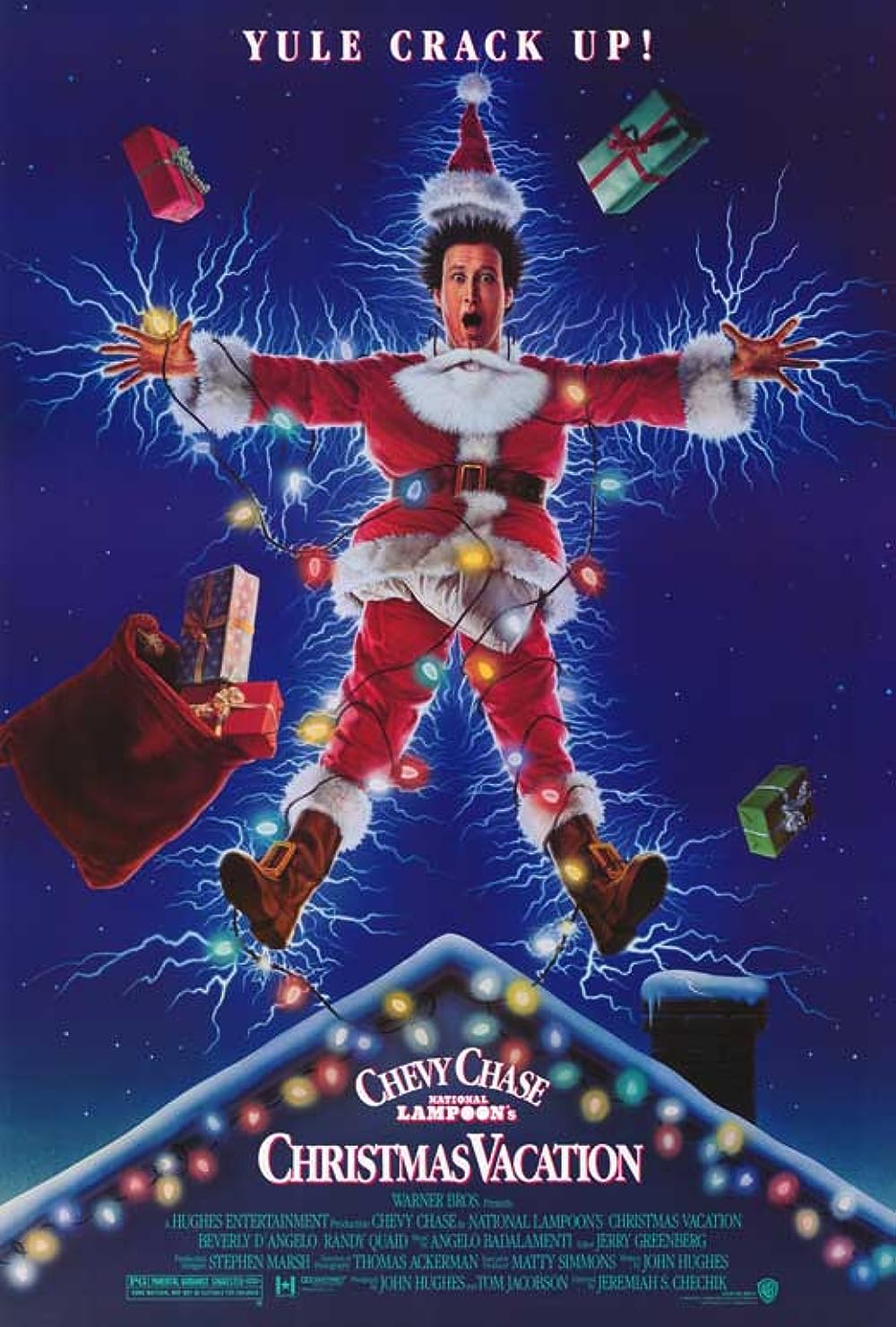
“Well, that’s an hour and forty minutes I’m never going to get back,” said my eldest child as the credits rolled for National Lampoon’s Christmas Vacation, beloved holiday flick of my youth. And she wasn’t wrong—it was terrible. (I’ve never seen the two earlier films in the franchise, and upon perusing the trailers, I wonder if “not terrible” was never actually the point.) Clark Griswold is an awful person, and while I remember spending earlier viewings rolling my eyes at his idiot neighbours, senile aunt, miserable teenage daughter, and dumbass cousin, now I’m not sure how any of them managed to stand him. Not to mention his wife, the longest suffering of all of them. Can you imagine if YOUR husband invited your entire family for Christmas, and then spent the holiday stapling twinkling lights to your roof because he couldn’t actually stand their presence? And apart from nicer clothes, how different is Clark from Cousin Eddie, really? It made me think a lot about the tropes and stories we took for granted in the 1980s and 1990s, be glad that there is been some progress since in terms of what we expect from men/husbands/fathers—and especially that my kids are wise enough to see it.
November 18, 2020
I’ve Had the Time of My Life

Brooke had never seen an abortion in a movie before, and it was surprising, because Dirty Dancing was over thirty years old. So it should have been a throwback, but it was something very new: the character who wants an abortion. There is no other alternative, it doesn’t even make her sad, and she doesn’t change her mind at the last minute, or have a miscarriage as a convenient trick to avoid being an agent in her own destiny. She isn’t even sorry… [And] it seemed symbolic that no one had to live in shame. You could be a fallen woman, and then get up on a stage and dance. This was a huge revelation for Brooke, who had never even considered the possibility, the number of ways a script could go.” —Waiting for a Star to Fall
I introduced my children to Dirty Dancing this summer, and decided that maybe modern parents overthink things too much.
There had been a brief period after the movie’s 1987 release when I’d been forbidden to see Dirty Dancing, though this was mostly a theoretical forbidding since we didn’t have VCR to watch it on. But in the next couple of years, I somehow managed to see it anyway, most likely at a sleepover. I don’t remember my impression of the movie at all, except that the title itself was pretty suggestive, which is why the movie had been judged as unsuitable for my audience, I supposed. And really, it was the soundtrack that loomed largest in my life, my first introduction to the Ronettes, You Don’t Own Me, and Eric Carmen, plus Patrick Swayze actually singing. (Is there anything that man couldn’t do? I am on the record as declaring his autobiography as excellent.) There was also a second soundtrack to Dirty Dancing, with the “Do You Love Me ?” and the Kellerman’s Anthem, but I never had that one.
And now: the million dollar question. How old were you when you realized that Penny was having an abortion? What Billy was talking about regarding the guy with a rusty knife and folding table? What it meant that Penny was knocked up by Robbie the Creep?
The other million dollar question: Why were all the parents totally okay with their nine year old daughters watching this movie over and over again? And could they have known what a gift this movie was to those girls, once we’d worked out the puzzle of what all these different pieces were about—or were they just too busy sitting around worrying about Michael Dukakis and the end of the Cold War?
A movie where a girl has sex and doesn’t die. Where another girl has an abortion and doesn’t die, and is even going to go on to have children if she wants to. Where the woman who has an abortion is treated by a medical authority with kindness and care. Where a girl who has been bonking Patrick Swayze and everybody knows it has absolutely no compunction about dancing with him at the end of her holiday to a mega-smash hit by Jennifer Warnes and some guy who used to be in the Righteous Brothers?
(Later on, the Righteous Brothers would be a big deal when Patrick Swayze was in Ghost, and it makes me wonder if Swayze ever felt he was haunted by the Righteous Brothers?)
Dirty Dancing is on my mind right now because Clementine Ford celebrated the movie in one of her Instagram Deep Dives this weekend (SO GOOD!) and THAT sent to me to the Dirty Dancing episode of the podcast Why Are Dads?, by Sarah Marshall (who’s also co-host of You’re Wrong About, a podcast that isn’t about Dirty Dancing, but lately has had some TOP NOTCH Princess Diana content…)
And because the movie features prominently in my new novel, Waiting for a Star to Fall, and is a point upon which the entire plot turns. If Brooke hadn’t watched Dirty Dancing that afternoon with her roommate Lauren, her life (and the ending of the book) would have gone in a wholly different direction.
Which is why I showed it to my kids in July. Deciding not to think too much about whether or not it was “appropriate.” They’re seven and eleven and talk about abortion around the dinner table more often than other kids their age, because I’m their mother, so I knew the Penny story-line wouldn’t come out of left-field. We’d rented a cottage for a week with nobody else around and only a DVD player for diversions, so I blew the dust off my Dirty Dancing DVD and packed it along with Mary Poppins and The Incredibles.
I wanted them to see it. This iconic summer film, uncanny scenes about a family of four stuck in a cabin while it rains (“Remind me not to get married at Niagara Falls.” “So, you’re go to Acapulco. It will be fine.”) The Schumachers (Sidney and Sylvia?), and the stolen wallets, and the soundtrack, of course, and the romance, and the class dynamics, and the dancing, and the log, and the lake, and lifts. The lifts!
And yes, to know the murderous legacy of illegal abortion, and one of the many ways that abortion becomes part of a person’s life, and how it doesn’t always have to be the point on which the entire plot turns—except that if not for the abortion, Baby wouldn’t have had to dance with Johnny at the Sheldrake, so yes, it’s irrevocably woven into the script, but it’s not everything, is what I mean. A piece of a larger narrative, always.
I want these to be the things my daughters take for granted, just like I did.
May 11, 2017
Did you ever know that you’re my hero?

A thing that happened to me yesterday when I was working on the second draft of my new novel was that I realized I’d totally stolen a plot point from the 1988 Bette Midler vehicle, Beaches. Not so shocking, I guess, considering I am writing a story about two women’s friendship over decades. It’s the part where C.C. Bloom ends up with her theatre director, who’d previously slept with her best friend, and you’ve got to wonder if they’re together not just C.C. wants to be but because she wants to one-up her friend. Of course, my story is a bit different from this, I assured myself, but then I realized that it even takes place around a theatrical production—albeit one that is a very very terrible campus drama society play.
 I should have known this would happen. It is possible that Beaches has been seared onto my DNA. That film was my introduction to all the best things—boardwalks, photo-booths, pen-pals, and Mayim Bialik. We had the record, and I spent hours gazing at the cover, the framed pictures on the piano documenting Hilary and C.C.’s history. I was obsessed with Beaches. I think I saw it in the theatre, and then we had the video. I can recite whole passages—”You did everything you said you were going to do, everything” and “That’s my robe,” and I actually do periodically utter C.C.’s line from when she asks the bartender to carry in Hilary’s bag and her tells her, “I’ve got a bad back.” She said, “You’ve got a bad attitude.” Exactly.
 The New York apartment with a bathtub in the kitchen, into which Hillary moves while on the run from her upper-class destiny, where they string Christmas lights and sing, “Oh Come All Ye Faithful”—in Latin! Basically it stands for everything I ever wanted. I wanted to pound on a radiator while screaming, “Send up the heat!” Such romantic, bohemian deprivation. Remember when Hilary drove a Volkswagen bus and worked for the ACLU, and Hilary’s tousled up-do in the laundromat with C.C. asking her, “Do you really think I have talent?” I wouldn’t recall this scene at all, except I just watched the movie trailer and realized I’d spent my 20s quoting that line, not realizing I wasn’t its original author. I’m sure I’ve also had days where I’ve gone to buy a wrench because we didn’t have one. It is possible that Beaches is in fact my subconscious. I wanted that once-in-a-lifetime friendship that lasts forever, for sure—or at least until someone ends up with a terminal heart condition. (It is also possible that this film was the advent of my hypochondria.)
I loved that movie so much, and had a mass market paperback of the book on which it was based, in which Hilary Whitney was called Bertie Barron, but still died at the end. I think I even read the sequel, Beaches II: I’ll Be There, although I’ve forgotten everything its plot contained. Interestingly (or not, all things considered) I am quite sure that Hilary Whitney’s family home in the movie is the same house at which Roger Sterling hosts his offensive blackface party and sings, “That Old Kentucky Home,” in Mad Men—when you watch a movie 3000 you come to recognize these things. Beaches is also the reason I developed a moderate crush on John Heard, and why when John Hurt died not too long ago, I wasn’t all that bothered, because at least John Heard was okay.
I am afraid to re-watch it. Not just because I have a feeling I might discover that it doesn’t hold up—the acting in the film trailer was kind of…awful—but because I might discover that everything I have I have possibly stolen from Beaches, that in fact I do not exist at all as a singular entity but instead as an amalgam of lines and ideas from late 1980s’ films in which beautiful young women die tragically (and gorgeously). What if all of us are just walking around in Gary Marshall’s dream—or even fragments of the imagination of Iris Myandowski the handwalking queer?
March 12, 2013
A Message for Vickie from Reality Bites, with information she’ll already have been made aware of if she’s had children of her own.
 Dear Vickie,
When I was fourteen, I wanted to be you. I wanted your bangs, your vintage clothing, your string of sexual partners, and friendship with Winona Ryder. I wanted every one of my words to be so laced with irony, to be that cool. You made me want to smoke.
But what I longed for most was your talent for disdain. “My mother,” you told your friend, Winona, while she was filming that documentary about you and your rumpled slacker peers, “goes to the bathroom with the door open.” And I knew exactly what you were talking about. It wasn’t even about doors and mothers and bathrooms, though these certainly stood for something concrete and disgusting, but instead, it was about an entire way of life, the kind of person neither you nor I ever wanted to be.
Vickie, I thought about this again years later, a few weeks before I turned thirty, which is a good half decade older than you’ve ever been. It was three days after the birth of my first child, born by caesarean-section due to her stubborn insistence upon lying sideways across my uterus. She was perfect, my daughter, pink and swaddled in a Perspex box, and I was already going to the bathroom with the door open. And oh, Vickie, that’s not even the half of it.
That I was going to the bathroom at all was a significant milestone, open door notwithstanding. It meant not only had they taken my catheter out (and yes, Vickie, motherhood is really this transcendental), but I’d walked the eleven steps to the bathroom by myself, even though my abdomen had been sliced in two just 36 hours before. I felt like a superwoman, until it came time to pull up my underwear; Vickie, I just couldn’t do it. To bend over so far in this strange new world had become anatomically impossible.
This was, of course, the official moment when the magic died. I had to call for my husband, who’d been gazing dreamily at our sleeping daughter, and summon him to my aid. He would come in to discover me sitting on the toilet, crying with embarrassment and pain. I needed him to pull up my underwear, which was not only a beige mesh hospital-issued pair, but had a diaper-sized sanitary napkin cradled in its crotch, soaked with the kind of blood that only comes post-partum. Dear Vickie, it’s like no period you’ve seen.
There was no mystery between us after that. How could there have been? And in the months that followed, when I got into the habit of going to the bathroom with the door open because if the door was closed, my daughter cried, I thought of you again Vickie, how I’d let us both down, but also of how much I hadn’t known about life and love when I was fourteen years, and you neither, even though you’d been so much older.
See, it was you, Vickie, all along. How you broke your mother, then resented the damage. Turns out it’s not marriage and habit that are passion-killers after all, but instead it’s children. And it turns out also, which is such a revelation, that your mother doesn’t care what you think.
Love, Kerry
February 24, 2013
"Worse still, her parents were always bringing home MORE books."
The Girl Who Hated Books by Jo Meuris, National Film Board of Canada
Three years ago, I posted about this short film, but I’m returning to it again because this weekend I purchased the book upon which it is based for 50 cents from a bake sale/book sale taking place outside Harriet’s swimming lessons (along with a rice crispie square and two slices of cake). The book is The Girl Who Hated Books by Manjusha Pawagi and Leanne Franson, and we love it. I like the glimpses of storybook characters we know and love, but also how the family in the book is a little bit like our own, only far more eccentric:
“There were books in dressers and drawers and desks, in closets, cupboards and chests. There were books on the sofa and books on the stairs, books crammed in the fireplace and stacked on the chairs.
Worse still, her parents were always bringing home MORE books. They kept buying books and borrowing books and ordering books from catalogues. They read at breakfast and lunch and dinner…”
We’re not quite that bad, and while we do have books crammed in the fireplace, on the stairs, and even on our ceiling, we have not yet had to resort to the sink. And reading at dinner is strictly forbidden, though breakfast and lunch is all right, Saturday paper breakfast in particular. Obviously.
I like this book also because it’s a perfect addition to the excellent list we posted at 49thShelf last week, Picture Books Featuring Canadian Children of Colour, compiled by TPL librarian Joanne Schwartz.
December 3, 2012
Talented Friends
 This busy weekend featured a couple of my talented friends, and not for having written books even! On Saturday night, we attended the very exciting Toronto premiere of the short film “How to Keep Your Day Job”, based on the short story of the same name by Rebecca Rosenblum. It was so wonderful to be there in a room full of people, all of us collectively laughing at the humour and gasping at the otherwise. The film was so well done, underlining the goodness of its foundation. The film has already been shown in Calgary, and if you hear of it coming about somewhere near you, definitely go and see it.
 And then last night I went to the theatre! I saw Strolling Player at the Red Sandcastle Theatre in Leslieville, written by Heidi Reimer and her husband Richard Willis, and starring Richard, a 90 minute one-man show about his life in theatre that begins with his birth (on purpose) at Stratford-Upon-Avon. A life in 90 minutes that takes up from a summer theatre in Guernsey, to stages in London’s West End, marriages wrought to ruin by tabloid journalism, exhausting tours across America, and a most unlikely true love discovered in the wilds of West Virginia. It was by turns funny, sad, and always excellent. I was so thrilled to be there, and very excited to learn that the show will be staged this summer as part of the Toronto Fringe Festival. Do not miss this one…
March 25, 2012
Ice cream
 The ice cream shop at the top of our road has opened for the season! They remarked upon how enormous Harriet has grown, and they were kind enough to refrain from mentioning that she was also very filthy (and do note, she has since been bathed). In other local news, yesterday I went to the movies for the first time in nearly three years. We saw Friends With Kids, and I really liked it (its portrayal of breastfeeding in particular, which goes a long, long way). We also bought tickets for a train journey to Ottawa, served clafoutis to friends at brunch yesterday, started reading Tales from Moominvalley, finished watching Downton Abbey Season 1, and are having to wait for Mad Men Season 5 to come out on DVD because we do not have a TV. Which is sad, but also nice to know that my dream of continually having Mad Men before me is forever coming true.
October 26, 2011
On re-watching Reality Bites
 I was a deeply impressionable 14 years old when I first saw Reality Bites, and it came to define “cool” for the remainder of my teenage years and beyond: smoking, vintage dresses, ’70s nostalgia, passionate friendship, complicated relationships, the attractiveness of moody boys, and an obsession with self-obsession (“I’m making a documentary about my friends”). It taught us all to define irony so we wouldn’t be caught on the spot, it was David Spade at his finest (“Have a ‘tude weiner dude, all right.”), and it made angst so attractive, so important, essential. It made me pretend to like “My Sharona” (“Turn it up. You won’t be sorry”), had Crowded House on the soundtrack, sold torturous angst straight-up with U2’s “All I Want is You”, and it brought “Stay, I Missed You” into the world, which was the song that was playing when I was asked to dance by the coolest boy at summer camp (and, sadly, this was to be the peak of my romantic life for years and years and years).
Because I couldn’t find Reality Bites at my local video store and the Toronto Public Library had not seen fit to update its VHS copy, it seemed like all my wishful thinking had conjured the Tenth Anniversary DVD I bought a few weeks ago at a yard sale for a dollar. I sat down to watch it last Friday night with an aim to craft a blog post about literary references in the film. Except that there weren’t any. Nobody reads in Reality Bites, not even Lelaina Pierce, college valedictorian, or Troy Dyer/Ethan Hawke, the greasy-haired philosophy drop-out. Who says things like, “I might do mean things, and I might hurt you. and I might run away without your permission… and you might hate me forever. And I know that that scares the shit out of you because I’m the only real thing that you have.” And what scares the shit out me is that fifteen years ago, I would have considered these lines incredibly romantic.
It’s true, all the movies I spent my teens and twenties thinking were romantic actually turned out to be fucked up stories about people who were emotionally crippled or mentally ill. Perhaps both forces were at work in Reality Bites (and really, we all know how things turned out for Winona). Reality Bites, the land where nobody reads, but people quote 1970s sitcom trivia at parties and Melrose Place is a cultural reference point. “Melrose Place is a really good show,” said Winona, and I’m not sure that I really agree, but I do think that Reality Bites is a really good movie. Still.
It’s an old, old story, contrary to what the newspapers would have you believe. It’s hard be out just of school, to be transitioning to adulthood, to be unemployed or underemployed, to not know where you want to go, and to have your actual options be even more limiting. To have goals but no idea how to make them realities. It’s hard to have ideals in the real world, to make things that matter, to settle down without settling, to decide who to fall in love, and when not to dress like a doily. It’s terrible to spend four years working towards adulthood, and then emerge into the world to find it utterly unwelcoming. To think that you’re not going to be able to have the kind of life your parents did, even if you’re not sure you want that life in the first place. To not get what you’ve been raised to think was your entitlement. To step out into the air and discover that you can’t fly.
We all know that each generation imagines that it discovered sex, but it’s true also that each imagines that disillusionment is something new. Reality Bites says otherwise: being 23 has always, always been terrible, but thankfully being 23 manages to not be the end of the world. It’s only the very beginning, and you learn.
April 20, 2010
I don't know how anyone ever came to respect cinema as an art form
Jenny Diski, from “Mother! Oh God! Mother!” LRB 32.1:
“‘This is where we came in’ is one of those idioms, like ‘dialling’ a phone number, which has long since become unhooked from its original practice, but lives on in speech habits like a ghost that has forgotten the why of its haunting duties. The phrase is used now to indicate a tiresome, repetitive argument, a rant, a bore. But throughout my childhood in the 1950s and into the 1970s, it retained its full meaning: it was time to leave the cinema – although, exceptionally, you might decide to stay and see the movie all over again – because you’d seen the whole programme through. It seems very extraordinary now, and I don’t know how anyone of my generation or older ever came to respect cinema as an art form, but back then almost everyone wandered into the movies whenever they happened to get there, or had finished their supper or lunch, and then left when they recognised the scene at which they’d arrived. Often, one person was more attentive than the other, and a nudge was involved: ‘This is where we came in.’ People popped up and down in their seats and shuffled along the rows, coming and going all though the B-movie, the advertisements, the newsreel and the main feature. No one dreamed of starting a novel on page 72, or dropping into the Old Vic mid-Hamlet (though perhaps music hall worked the same way; was that the origin of the movie habit?), and not even the smallest child would let anyone get away with starting their bedtime story halfway through, but the flicks were looped, both on the projector and in our minds. You went in, saw the end, and after you’d watched the beginning and a bit of the middle you figured out how and why it had happened that way. In the introduction to Postmodernism, or, the Cultural Logic of Late Capitalism, Fredric Jameson claims that postmodernism proper dates from the later 1960s, but let me tell you that the dismantling of narrative was rampant in cinemas up and down the country for decades before that. Maybe, after all, it was an interesting way of learning about story structure, but even so, how odd that no one thought it a strange way to proceed.”