November 9, 2011
Discovered: Brain, Child Magazine
 I’ve been living under a rock, it seems, and so it was only on Monday that a copy of Brain, Child Magazine first appeared in my mailbox. And it’s like I’m right back there years ago discovering MS, Bust, and Bitch for the very first time. All those magazines that changed the way I see myself and the world, that were the turning point when I became a feminist. But after a while, I didn’t need them anymore, and it’s been a really long time since I read indie magazines (um, apart from the five literary magazines that turn up in my mailbox quarterly or more. I do my part, no fear).
But in terms of reading about parenting, it’s been all mainstream over here, and I tired of it much faster than I tired of the others. And not until I finally got my mitts on Brain, Child did I discover that I’ve been parched, starved for story. For essays that run off the page, and are written so well, which challenge and move me (but not too much for the former. Brain, Child seems infinitely readable, even for the bleary-minded. I read the whole thing cover to cover in 36 hours, part of it in the bathtub. It’s like that).
The magazine appeared on my limited radar when the wonderful Stephany Aulenback mentioned her essay published within about her adventures on Ancestry.com– a hilarious piece about her discovery of her children’s alleged royal lineage. And then I read “Glass Half Full”: has telling the “truth” about motherhood been taken to the point of dishonesty? And this was when I decided to buy a subscription, because I wanted a parenting magazine that had Rachel Cusk as a touchstone (and which doesn’t advertise boatloads of unnecessary crap, like that ridiculous stroller that turns into a tricycle, or denim diapers).
I loved the essay about the woman with chicken pox in her third trimester, and the scene where her two-year-old is finally allowed to see her after weeks of separation– the primal way in which the little girl reclaims her mother. In another essay, a mother accompanies her small daughter to her birth mother’s sister’s wedding– and contemplates the ways in which the birth mother will always be disappointing. Or another in which a woman thinks about the meaning of “inappropriate” and links it to her daughters’ discomfort with her body after her mastectomy.
I love that there is fiction here, and loooong book reviews, and that the magazine ends with a poem that is funny. I love the mothercentricity of the magazine’s approach, the literary quality of the writing, that the essays offer more questions than answers, and also that I subscribed for my Fall issue so late that it won’t be long until the Winter one arrives.
September 23, 2011
Weaned
At the age of 2 and one quarter and a bit, Harriet is now officially weaned, which I’m telling you now for a couple of reasons. The first is that I truly enjoying horrifying the kind of people who become horrified by the fact that I’ve breastfed for so long. The second reason is because it’s quite a milestone, and I don’t like the idea of breastfeeding having to be a private thing, business that I keep to myself for fear of horrifying somebody (except when I want to horrify someone, as previously noted), because it really is of the mundane essential stuff of life that I write about on my blog all the time. And the third reason I raise the topic here is because breastfeeding was always when I got my periodical reading done, and the loss of this reading time each day now means that I’ve got magazines piling up in my house at a terrifying rate. Plus it’s September, which means there is a new release out basically every day that I’m meaning to getting around to read, and the Victoria College Book Sale is this weekend (which is, as many of you know, the thing I enjoy in the world more than anything else at all except Afternoon Tea). So there will be books, books and more books, and now I’m a bit terrified at the prospect of my leaning tower of magazines.
September 11, 2011
Ten Years Later
 Like many people, I don’t require an anniversary to allow for reflection about what happened in New York City and around the world on September 11, 2001. So much that has happened since has seemed to spin out of those strange few hours on that blue, blue morning– ours was the same sky, and it was beautiful. But, also like so many people, this tenth anniversary has me reflecting on my own proximity to the tragedy, and remembering that it was the first day of my final year of university, how I heard the news of a plane crash on my pink clock radio and how I turned on our tiny TV, and saw the second tower fall. How the CN Tower was dark that night, and watching CNN on the TV at KOS at College and Bathurst where I ate french fries with my friends. It seemed like the end of something, of the world, of innocence, of the old world order, and that would have been bad enough (and perhaps even good, in a sense), but what that day turned out to be instead was the beginning of something, and that something would only get worse. We’ve come of age in a world I never would have imagined on September 10, 2001, that night I sat on my rooftop balcony and pretended I smoked, and longed for something to happen.
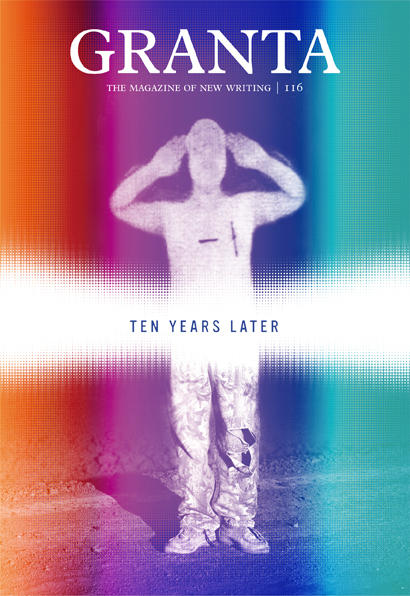
Where we are now is reflected in Granta 116: Ten Years Later, my second foray into this magnificent magazine. (Events are being held around the world in connection with the launch of this issue. I attended on last Wednesday, with readings and discussions.) With all the memorializing, self-indulgent weeping (mine, I mean) and discussions of my pink clock radio, what’s missing, of course, is context, and here we find it in abundance. Here is the kind of memorial that matters, not so much reliving that terrible day but looking around and seeing where it’s taken us. Though theme is loose– “Why this story? Why this issue?” asked Kathryn Kuitenbrouwer, whose short story “Laikas 1” appears here, last Wednesday at the event at Type Books. The connections are not immediately clear, and sometimes they don’t come clear at all, but that’s sort of the way it is with this sort of thing, with how did we get from here there to here. The trajectory is rarely straightforward.
Phil Klay’s “Deployment” is deeply affecting story of a soldier home from Iraq who’s on the verge of breakdown as he struggles to make sense of what he saw there and the things he did there, and the strange connections (or disconnections) between these and the civilian life he’s meant to live again. In “A Tale of Two Martyrs”, we learn of the human stories behind the events that sparked The Arab Spring. In “Crossbones”, a man searches for his son who has disappeared to Somalia to join an Al Queda faction. There are two stories (on fiction, one not) of men who were wrongly sold by Afghan warlords to the Americans for the $5000 reward they were paying for terrorists.
A strange, wonderful story of a North Korean spy aboard a derelict fishing boat, Libyan graffiti artists, photos of Libyan refugees in a camp on the Libyan border. Elliot Woods writes about a variety of perspectives of American serviceman, underlined by his own wretched experiences. Declan Walsh’s phenomenal “Jihad Redux” tells the story of foreign intervention in the Afghan tribal regions over the last 100 years– the same old story, except it’s not, and understanding why is important. Kathryn’s “Laikas 1” is so terribly funny, and gruesome, and its connections to the rest of the issue exalt the issue entire– this story of the TTC and High Park coyotes so belongs here. Then Anthony Shahid’s “American Age, Iraq” about a Jesuit college in Baghdad that thrived from the ‘thirties to the ‘sixties, and about what “America” represented to the rest of the world before it began to mean “boots on the ground.”
Clearly then, there is a world beyond that long ago view from my balcony (though Kathryn’s story affirms that my Toronto view was there), and here we look forwards and backwards to discover it. Posing questions without answers, and challenging the answers I always figured were obvious, and if you really want to retrace the route from there to here, I’d say Granta 116 would be a essential volume to bring on the journey.
September 5, 2011
QUARC
 Throughout August, I had the joy of making my way through QUARC, a joint venture between The New Quarterly and ARC Poetry Magazine. The two estimable mags had decided to put their covers together, just once, and to play on the theme their combined names suggested. And so the issue was devoted to the place where art meets science, writers exploring this most unparticular point in an extraordinary variety of ways.
The whole package is absolutely stunning, with each side of the magazine featuring its own gorgeous colour spread, and so much bang for your buck– it’s the size of a small city phonebook. I started with the ARC side, with Margaret Atwood’s “Annie the Ant”, which she’d written in childhood (and I think this is where EO Wilson got the idea for his novel…), and then a short essay on the story and what we can detect of Atwood’s current preoccupations in her younger self. And then a wonderful selection of poems all about animals (this section has been entitled “Bestiary”), accompanied by illustrations of scientific specimens.
I loved Patricia Young’s poems about the various disturbing ways that animals have sex. There is an excerpt from Joan Thomas’ novel Curiosity, about a real life 19th century fossil hunter (who happened to be female), and then an interview with Thomas, with this wonderful passage: “Maybe we’d think more holistically if we’d retained the terms “natural history” or “natural philosophy” for what we now call “science”. There is a narrative in evolution so huge that it boggles the mind. The deeper we go, the more we find to marvel at…”
Then a series of poems by Danielle Devereaux about and/or starring Rachel Carson. The full colour spread is a series of photos  devoted to the narrative of obsolescence, which is more complex that we imagine– a circuit board from a 1960s computer, a dictaphone from the 1930s, and a cosmic ray machine. A PK Page glosa, Christian Bok as “language as virus”, a fascinating essay by Aradhana Choudhuri called “Code as Poetry”.
The New Quarterly asked its writers for “particle fictions”, creative responses to the rather fanciful names of quarks: Charm, Strange, Up, Down, Top and Bottom (or Truth and Beauty). Following these selections is an interview with Alice Munro by TNQ and ARC editors about her short story “Too Much Happiness”, about the mathematician Sophia Kovalevsky. I loved Robyn Sarah’s “The Scientist as Philosopher”, Alice Major’s mind-twisting “The Ultraviolent Catastrophe”, Don McKay’s “The Holy Ground of Plate Tectonics”, Susan Ioannou’s “Rocks and Words”– all right, I’m just quoting the table of contents now, but you get my point.
And then the exquisite “Ova Aves”, which is a full-colour excerpt from the letterpress book composed of photographs of eggs from the Mount Allison University biology collection, and accompanying poems by Harry Thurston: “Osprey”, “Common Loon”, and (intriguingly), “Unknown”, then an interview with Mount A. ornithologist Gay Hansen, curator of the collection, who answers a question I’d never considered: “What is an egg?”. The issue ends with three poems by Zachariah Wells, which I adored, in particular “The Engineer Produces Intelligent Design”. On eyes: “Shortsighted, longsighted, astigmatic/ crosseyed, walleyed, colour blind, macular/ degeneration, glaucoma, cataracts– that the sucker’s ever work’s miraculous.”
Truth be told, there was lot in these pages that I didn’t understand, but even truthier be told is that this is my experience often when I encounter a literary journal. And yet there was something marvelous about the concreteness of the ideas that still baffled me, and beauty in unpoetic language as rendered poetic.
QUARC is a wondrous object to behold, and I’d urge you to pick up a copy while you still can.
June 11, 2011
Remarkable things about the NMAs
 1) I was pleased to learn that I can be gracious in defeat, though it wasn’t difficult under the circumstances. From Twitter, I gathered that being excited about the National Magazine Awards isn’t cool, but maybe those people get out more than I do. It’s not every Friday night that I get to get dressed up, turn up at a fabulous venue, drink wine, eat delicious, and celebrate Canadian magazines with 600 other well-frocked individuals. It was wonderful. And then, on top of it all, to have my piece on display, to hear my name called and see it up on screen with the other nominees for Personal Journalism– it was completely overwhelming, and more than enough, I thought. And when the winner was announced, and it wasn’t me, I realized that it was really, really was enough, and was happy to remain extraordinarily happy.
2) I was also happy because I spent the evening with Kim Jernigan and Amanda Watkins of The  New Quarterly, and (seriously) the only disappointment I felt was that I wasn’t able to bring home a prize to them and their magazine, which has always been so good to me. Thanks to them, I never once looked forlorn amidst the hubbub. They were splendid company.
3) Speaking of good company, I was also happy to meet and speak with DB Scott, who was recipient of the Foundation Award for Outstanding Achievement.
4) I was also amazed to see that my postal phantom was nominated for a National Magazine Award. He also didn’t win, so there is still no confirmation that he exists apart from in the ether.
5) I saw Dani Couture, and Medeine Tribenevicius, met Priscilla Uppal, and Christopher Doda, knew the bartender from high school, and met Joanna from More Magazine who reads my blog (hello, Joanna!).
6) I really only showed up because I was promised a swim in the famous NMA chocolate fountain, but there was no fountain this year– the first discernible evidence I’ve seen that perhaps the magazine industry is dying. The ice cream sandwiches, however, almost made up for the loss. But maybe I just didn’t know what I was missing.
June 7, 2011
Descant 110: Birthing
 I am an unabashed devotee of small magazines, but secondhand back issues for sale always strikes me as a bit pathetic. Sort of like the used National Geographics in Nikolski, where they never managed to sell a single issue. Does anybody really want to buy a copy of The Fiddlehead from 2003? Every year, the Victoria College Book Sale seems to hope so, but I don’t imagine they have much luck. Or maybe they do–I don’t know. I just think that magazines are meant to be a bit ephemeral.
Not all of them, however, and here’s the proof. Here also is the proof behind that claim that small magazines are where our finest writers get their starts. Ages ago, I bought the Descant 110: Birthing, which was published in 2000. (Clarity note: I am not pregnant. Am reading it now because I’ve made it through the C books in my to-be-reads, and Descant starts with D). I picked it up at a used bookstore because the topic was interesting, and then I bought it because of the writers inside– most of whom hadn’t published books at time the issue was published. Who’s who? Jonathan Garfinkel, Laisha Rosnau, Michelle Berry, Jonathan Bennett and Stephen Marche. Also, Diana Kiesners, now of The Accordian Diaries.
It was an absolutely stellar issue, one of those wonderful thematic ones whose points in common just seem like a coincidence. One of my two favourite pieces was “Hardiness Zones” by JA McCormack, which was way too awesome and assured to have been written by a writer going nowhere. Some googling cleared it up: JA is Judith McCormack, who published The Rule of Last Clear Chance 3 years later, and also a chapbook with Biblioasis. She is also a lawyer, and a law professor, which might explain what’s she’s been up to in years since. (But I want to read her books now).
And then Diana Kiesner’s weird, wonderful and absolutely perfect essay “Long History of a Small Idea” about the practical considerations surrounding getting a poem written on the surface of an egg. And thank goodness the history is long, because it’s also funny, erudite, and full of practical advice should I ever require a poem written on the surface of an egg: “It is the making of something out of nothing; also of nothing (an abstraction) out of something (a perfectly good food source).” Totally weird, and absolutely masterful.
Anyway, this secondhand magazine is going to live on my shelf forevermore. So I guess anything is now officially possible.
Update: Do forgive. I have spent this week quite ill, sleepless and braindead, therefore I forgot to remark upon another exceptional piece in this issue. But then I just read Sarah Henstra’s blog post about clowns, which mentioned her vocal teacher Fides Krucker, who wrote the essay in question– this amazing piece linking the sounds of childhbirth with vocal training, how being a singer helped her in childbirth, and how having given birth made her a better singer. Remarkable for the way the writer describes sounds, and body. Once again, like nothing else I’ve ever read before.
April 18, 2011
We read Room Magazine 34.1
 I wasn’t planning to make a project of this, but I encountered so many wonderful things as I read through the latest issue of Room Magazine that I really had to share them. The cover, first of all, whose colours go so perfectly with the title, and this eye for detail is reflected in the design of the magazine all the way through. And it’s the case with every issue of Room, which is a feminist magazine run by a volunteer collective of women in Vancouver (and used to be called A Room of One’s Own, but decided to open up onto the world more).
Issue 34.1 is themed “Momentous”, and it’s their contest winners’ issue too. Though it reads more cohesively than you’d expect from that, and I forgot about the contest until I finished reading the magazine and reread the cover. I enjoyed Amy Kenny’s story “Chocolate Season” about a woman in an East Coast tourist town carrying on the family business after her father’s death. The full text of Chantal Gibson’s “The Mountain Pine Beetle Suite” is available to read, and it’s great, brutal, subtle and scary. And “The Goddess of Light & Dark”, which won the creative non-fiction category and one of the best things I’ve read lately, full stop, about the education that comes when the author becomes a clinical teaching associate at BC Women’s Hospital, a model and guide for students learning how to do pelvic exams: “Maybe revolutions are about knowledge”.
Sigal Samuel’s “Love and Other Irregular Verbs” is by a woman whose father has seen the women he’s loved as a portal to new languages, and how she learns these languages to erase the distance between them. I enjoyed the interview with Cathleen With about how her experiences teaching in Northern Canada have influenced her fiction, and the ethics of the decisions she’s made: “It’s about bearing witness; because there are many potential storytellers up there, and yet a lot of these kids are too busy being in it to sit down and write about it.”And I liked Wendy Marcus’s “Just John” about a mysterious neighbour and his legacy of plum trees.
I tried to read Nalo Hopkinson’s “Chance” but just couldn’t. I mention this only because Nalo Hopkinson has enough readers that she won’t even notice this one missing, but more because I am fascinated with my inability to read science fiction. I have so little patience with unpacking these stories, when I can find it for so many other works/genres. It is like the fantastical elements of these stories construct a barrier between me and the meat of the story, and I just can’t be bothered scrambling over it. Part of this is definitely my fault, but it’s also that there are some kinds of readers we were never meant to be.
The issue ends with several pieces that resonated with me: Laurie D. Graham’s poem “Say Here, Here”, about words, place and the depths beneath your feet; Christy Ann Conlin’s “Album”, which whisks its reader across decades and a continent; and “Six Reasons I Miss Being Pregnant” by Anne Panning and not just the “A free pass–however briefly– to wear giant corduory overalls”. And then Room’s backpages, which I always enjoy, which gives me the sense that as a Room reader, I am most certainly part of a wider community.
February 14, 2011
Renter's Blues
 No, just kidding. There are no blues, as I’m a renter by choice, and we made that choice because buying a house would mean I’d have to get a full-time job while (however conversely) we’d then be broke, and also living somewhere that wasn’t here. But I have renting on my mind today after reading Beautiful Anomaly, Lauren Kirshner’s amazing essay in Taddle Creek about the Sylvan Apartments, which became more and more boarded up every time I walked by them on my way to the grocery store in 2005/6, back when we lived at College and Ossington. I’d always wondered what their story was, and what a spectacular way to discover it.
From Kirshner’s piece: “In the end, the Sylvan is less a ghost story than a relic from an era when renting didn’t have to be a compromise [emphasis is mine]. The building gave working people amenities usually associated with home ownership. It was a place where people lived well even if they weren’t well off—an idyll that likely will never again be possible for the average renter in downtown Toronto.”
Which is something to think about. And it got me thinking also about what was perhaps my favourite part of Phyllis Brett Young’s The Torontonians: “In Toronto, the word home was still spelled h-o-u-s-e, and anyone who lived in an apartment by choice, and more particularly an apartment downtown, was considered eccentric if not unstable. On Park Avenue in New York, you were told, it was all right to live in an apartment. But in Toronto it was different. In Toronto, if you were stable, you lived in a house. Your Dun and Bradstreet rating was helped considerably if you owned a house, even if, as was usually the case, the mortgage company could put forward a much better claim to stability in this context that you could.”
February 9, 2011
How about this? One magazine thinks about its gender gap.
 From Kim Jernigan’s introduction to The New Quarterly 117: “When making their choices for this issue, the poetry editors were thinking seasonal, in part, but our fiction editors, of which I’m one, were thinking thematic. Worrying, I should say, that our choices might be falling into a predictable pattern, specifically that we were tending too often to mother/daughter stories. Four of our five editors on the fiction side are women, and of those, three are mothers. Were we looking to see our own lives reflected on the page?
…But I think our choices reflect less our demographic than the thematic cast of the submissions as a whole. For whatever reason, the fiction we receive tends not towards work, or war, politics or race relations or environmental catastrophe, but towards the familial and relational.
At least we’ve captured some fathers and sons this round…”
In a week during in which we were once again informed that the gender gap for magazine contributers continues to be gaping, it was refreshing to read of an editor and her editorial board conducting their business with these ideas in mind. It would nice if more editors would do the same, in particular those whose mags are suffering from a dearth of women writers.
And “suffering” is the right word. Come on now, it’s not like magazines are doing really well the way things are. Something needs to change, and correcting this disparity this would be a step in the right direction. I’m not just ranting on principle either– a diverse body of writers makes for better and more interesting content. Everybody wins.
January 31, 2011
Found Press: Stories Everywhere
 I am terribly impressed and very excited about Found Press which produces a quarterly digital literary journal whose contents can be purchased individually. They initially caught my attention because their first issue contains “Addresses”, a new short story by Cynthia Flood, whose The English Stories was one of my favourite books of 2009.
But they impressed me also because their issue is for sale at a price that makes sense for e-publications– short stories for 99 cents each. Seriously, it’s the next best thing to an actual book, and maybe it’s even better. And I love their treatment of the individual short story, each one with gorgeous cover art and an intriguing blurb. Cynthia Flood’s story was terrific, and I look forward to reading the other three by Danny Goodman, Kirsty Logan, and Lana Storey.
Downloads come from kindle or kobo, best-suited to one’s e-reader, but for those of us without such devices, a short story is still perfectly readable on a computer screen. And it’s such a good model, because we get to get what we pay for and pay for what we get, and then everybody wins. I love it.
If this is the future of e-pub, then definitely, sign me up.