March 8, 2019
The Secret Life of Alice Freeman…
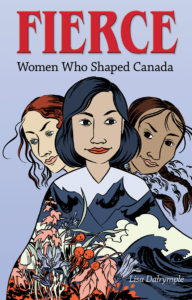
Today at 49thShelf, we’re featuring an excerpt from new book Fierce: Five Women Who Shaped Canada, by Lisa Dalrymple and illustrated by Willow Dawson, which is a book I’ve been reading aloud to my family over the last two weeks, and one we’re all enjoying. In particular the story of Alice Freeman, Toronto schoolteacher in the 1880s who led a secret double-life as an investigative reporter. It’s so good, and you can read it here.
March 1, 2019
Climbing Shadows, by Shannon Bramer and Cindy Derby

I want to sing the praises of the kindergarten lunchtime supervisors, because it’s not often enough that people do. A job that is underpaid, under-appreciated, incompatible with most schedules, and without whom the school day could not proceed. When my eldest child was in kindergarten, her lunchtime supervisor was called Miss Vivian, and—I’m not sure if this is part is even true—all the children believed her to be a retired police officer from Jamaica. You didn’t mess with Miss Vivian, but then some people tried to, and one day my daughter told a story of a notorious boy in her class who’d pulled his pants down, which made me decide to send Miss Vivian a thank-you note for the work she did, plus a gift card for the liquor store.
Not everyone gets an LCBO gift card for being a kindergarten lunchtime supervisor, however. Poet and playwright Shannon Bramer got a collection of poetry instead, a poem for every child in the class that she’d worked with about anything they wanted. “Being a lunchtime supervisor in a kindergarten room involves container opening, orange peeling, snowsuit detangling, and mitten hunting,” she writes in her beautiful Author’s Note, and she also made it about poetry too. She shared the work of her favourite poets with the class, brought in illustrated collections to show them. “My kindies learned that poetry could make them feel and see and remember things. A poem could tell a sad story or it could make them laugh; it could make them think. A poem could be hard to understand beautiful to listen to at the same time.”
Lunch poems are not a new thing, but Bramer’s Climbing Shadows is my favourite twist on the concept yet, a collection that involved out of her collaboration with the children in the class, and which is published now by Groundwood Books with dreamy, appealing whimsical illustrations by Cindy Derby. Poems that remind me of children’s voices, their questions and preoccupations, but which also aren’t pandering and play and delight in language with the deftness of poetry intended for readers of any age. With enough familiarity to draw the reader in, but spaces between the words and lines enough to invite questions and wondering. Poems about octopuses, birthday parties, polka-dots.
“My mom is pushing the stroller/ through slush and broken ice/ and there’s lots of cold water shining/ on the street”
February 8, 2019
Pencil: A Story With a Point
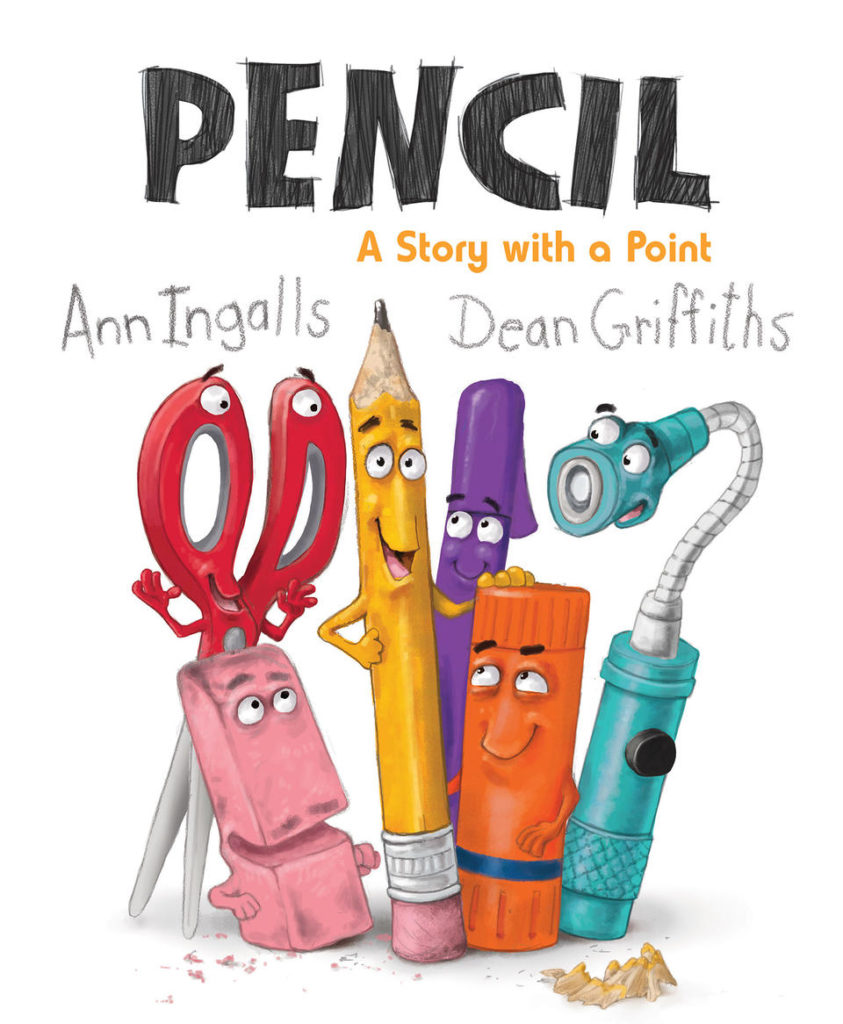
I will admit to being a bit wary of Pencil: A Story With a Point, by Ann Ingalls and Canadian illustrator Dean Griffiths. I am not convinced that the world necessarily needs more stories about anthropomorphized writing or colouring implements, plus I’d flipped through and saw it was also a story about the perils of too much screen time, and I’m wary of morals and screen fear-mongering. But the illustrations are very appealing (including very cool endpapers) so I sat down to read this with my daughter, and told her, “If we’re going to like this book, it’s going to have to be really good.”
And it was. Primarily, because (as might be discerned from the book’s subtitle) Pencil is playful with language and we never got tired of the puns–”You don’t measure up,” says the ruler in the junk drawer, alongside the spare battery who says, “He’ll get a real charge out of that/ ‘”Happy to hold things together,” said Paper Clip and Tape.’ It goes on, ‘”You’re a cut above the rest,’ said Scissors/ “Our friendship is permanent,” said Marker.’
And while this indeed a pencil versus tablet story for our screen saturated age, it’s also more interesting than just that, about a boy who loved his pencil until he abandoned it for tablet pursuits, and then Pencil was rescued from the junk drawer by the boy’s sister, and was there to see it happen: the tablet crashing to the floor and breaking, the boy distraught. Is there anything that Pencil can do?
The part where Pencil fails to make the boy feel better by showing him all the awesome things pencils can do (“He could be a tent pole for a really small tent.”) was very funny, and then, with the help of his junk drawer friends, Pencil arrives at an ingenious solution. Pencil and the boy are reunited. A happy ending to this warm and humorous book which demonstrates that a story with a point is not necessarily a bad thing. It’s all in the delivery, and this one is done right.
January 25, 2019
A Velocity of Being: Letters to a Young Reader
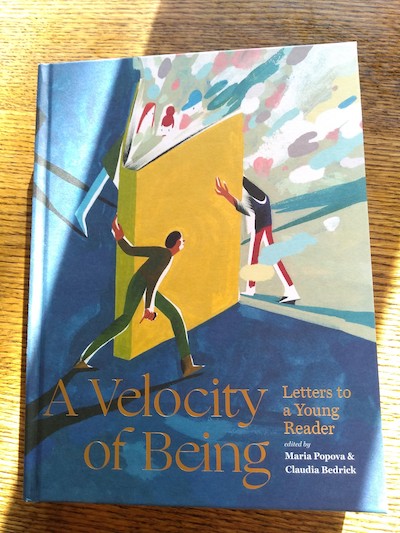
Confession: There are some beautiful books in my house that I have never read. Oversized coffee table volumes with gorgeous design, ribbon bookmarks, incredible illustrations, fascinatingly edited, but they’re more furniture than literature. Or maybe they’re aren’t, but I’m unlikely to ever find out, because while I appreciate these books as objects, nothing has ever compelled me to sit down and start reading them. But A Velocity of Being: Letters to a Young Reader, edited by Maria Popova and Claudia Bedrick, a beautiful book with endpapers to die for? Reader: I read it all, many parts aloud. A book that’s as good as its package; even, a book for the ages—all of them.
This collaboration is a “labour of love” between Popova (of Brainpicker) and Bedrick (publisher of Enchanted Lion Books), with all proceeds benefitting the New York Public Library system, and situated as a demonstration that “a life of reading is a richer, nobler, larger, more shimmering life.” It’s a collection of letters from readers—who also happen to be writers, rock stars, astrophysicists, artists, business moguls, philosophers, Lemony Snickett, Shona Rhimes, activists, composers, radio producers, Judy Blume, and more—about the role of reading in shaping their lives. There’s Rebecca Solnit, and Maud Newton, and Mary Oliver, and Leonard Marcus, and Ann Patchett, and Yo Yo Ma, and Shirley Manson, and Jane Goodall, and Ursula K. Leguin, and so many others, each letter paired with an illustration by artists including Maira Kalman, Isabelle Arsenault, Liniers, Olivers Jeffers, Marianne Dubuc, Shaun Tan, and more.
It’s a beautiful, thoughtful, inspiring book, and the greatest thing I got from it was company. Because while I appreciate the solidarity I share with my bookish friends online and in the world, I have increasingly, lately, wondered if we are outnumbered in the general population. As I read statistics on how few adults read for pleasure, about declining book sales, as I hear one more person who binge-watches Netflix talk about how they just can’t find the time to read. I despair for a future in which people don’t understand the value of reading and the riches that books can deliver us… but then this beautiful book is a reminder that it’s not all lost. Not yet. That these riches are still abundant, and foundational, they bring us together, and they remind us that the world is amazing. Still.
January 18, 2019
Mr. Mergler, Beethoven, and Me, by David Gutnick and Mathilde Cinq-Mars
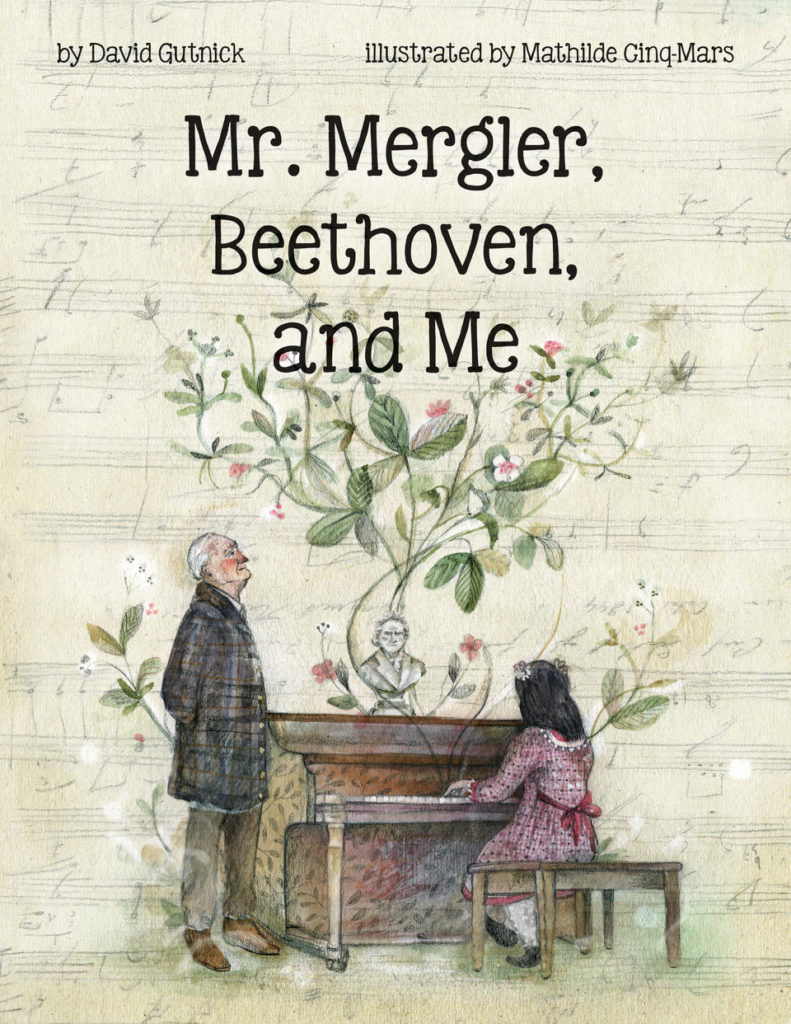
My youngest daughter feels she is on intimate terms with Ludwig van Beethoven, because he’s rendered as a cartoon character in her piano book, and while she’s never heard any of his music properly, she’s played several simple songs inspired by his music, and when we picked up Mr. Mergler, Beethoven, and Me, by David Gutnick and Mathilde Cinq-Mars, she was very impressed and excited to learn that other people know about him too.
David Gutnick is best known for his CBC Radio Documentaries, and his first book for children is inspired by one he created about the legacy of Montreal music teacher Daniel Mergler. The book begins with a young girl who has recently arrived from China whose family meets and elderly man in the park, and as the girl’s father and the man talk together, it is shared that the young girl has a talent for music and that the elderly man, Mr. Mergler, has taught piano for many years. Mr. Mergler agrees to take on the girl as a student, and is not concerned that her family does not have money to pay for lessons: “Something tells me that she understands the magic that music can bring to her life. If she does, that is all the payment I need.”
She begins attended classes at Mr. Mergler’s warm and cluttered studio, evocatively rendered in Cinq-Mars’ illustrations. On top of his piano there is a bust of Beethoven, and he’s scowling. When the girl manages to play her songs with no mistakes, however, she begins to wonder: “Was it my imagination, or did [Beethoven] look a little more friendly?”
Now I have written before about my household’s intolerance for books about death, no matter how much I try to infuse our reading with my own morbid nature. They’re having none of it. And so what is so very excellent about Mr. Mergler, Beethoven, and Me is that the music teacher’s death is handled in a way that is neither corny nor devastating, although the girl certainly is sad, of course. But Gutnick shows how Mr. Mergler’s spirit lives on in the gifts he gave his students, in their passion for music. It’s the most delicate balance, but Gutnick achieves it perfectly.
January 11, 2019
Deep Underwater, by Irene Luxbacher
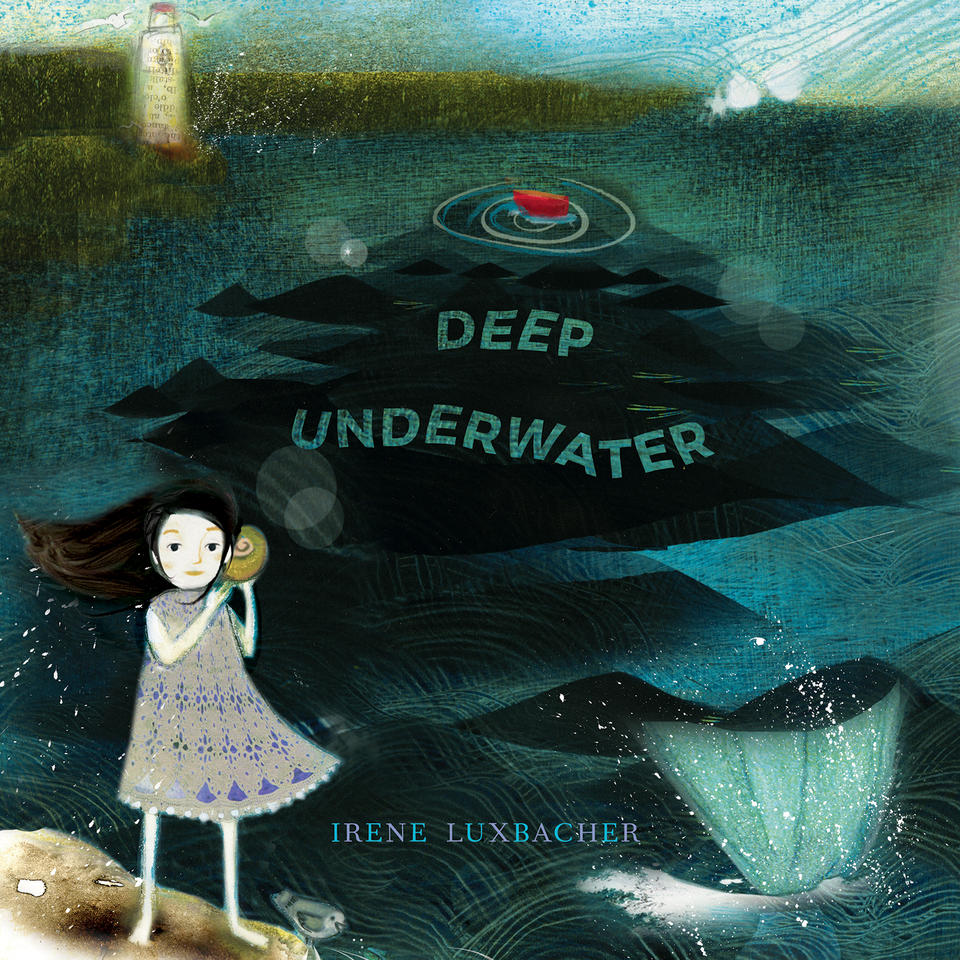
I love Irene Luxbacher’s playful collage illustrations, and they really shine in Deep Underwater, her latest picture book. Shine literally even, because the cover features sparkles. It’s the story of Sophia, who lives by the sea and knows its secrets, and takes the reader on a journey deep underwater to share what she knows. “Deep underwater, tentacles, antennae and teeth disappear into darkness…and an abyss becomes a bottomless pit of possibilities.” Full page spreads to get lost in, with urchins, and anemones, jellyfish and seahorses. Sea turtles, starfish, sardines, and a submarine. A sunken ship where “lost treasures wait silently, patiently hoping to be found.” Sophia tells us, “Deep down, I never feel alone,” contemplating her reflection in a handheld mirror, and we see the mermaid that she is in her mind, and really, who can’t relate?
December 14, 2018
Santa Never Brings me a Banjo, by David Myles
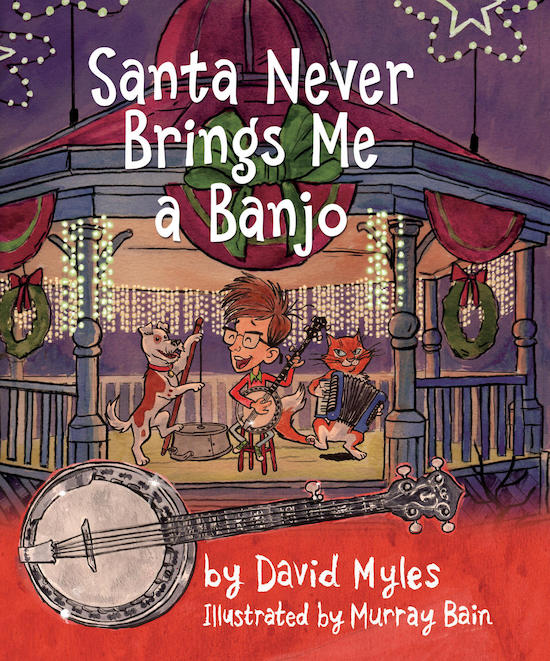
During The Most Wonderful Time of the Year, it can be easy to forget that Christmas is not a season of light for everybody, that those who are struggling can find the holidays particularly trying—and in his song-turned-picture book, Santa Never Brings Me A Banjo musician David Myles gives voice to one boy’s particular plight. Because, see, all he wants is a banjo, a simple request. And year after year, Santa fails to deliver, the boy’s hopes piqued by banjo-shaped packages that turn out to be something entirely different—a fishing net, a unicycle. But not a banjo to be had.
It’s a story of persistence, I suppose. We liked this book a lot and it’s made a great, non-cloying, and original addition to our Christmas library. A story of wanting and yearning and longing and the sweet anticipation of Christmas morning that has always been my favourite part of the season. It’s a story about one child’s love of music, and wishes finally coming true, and also a catchy melody that will get stuck in your head—with the music included, along with the chords. So you can play in on your banjo when all your dreams are realized.
December 7, 2018
Owls Are Good at Keeping Secrets, by Sara O’Leary and Jacob Grant
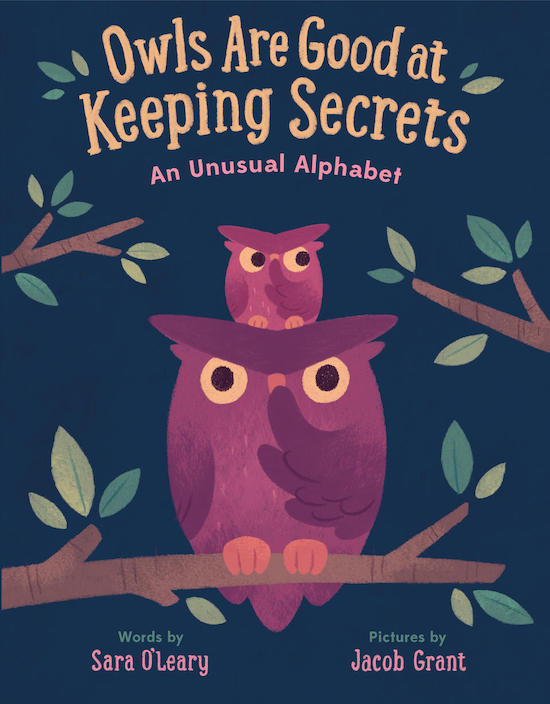
One of my favourite kids’ books this year, a book with a wonderful premise and an execution just as good, is Sara O’Leary’s latest picture book, illustrated by Jacob Grant, the fun, clever and adorable Owls Are Good at Keeping Secrets—and of course they are! It just makes perfect sense, along with “Elephants are happiest at bath time” and “Jellyfish don’t care if you think they look funny when they dance.” And Z is my very favourite of all the alphabetized animal facts appearing in this whimsical abecedary, but I’m not going to tell it here, because that would be a spoiler. Of course, “Raccoons are always the first to arrive for a party,” but did you know that “Narwhals can be perfectly happy all alone”? And just wait until you get to U, which I’m going to let you discover by yourself, but I’ll trust you’ll find it as delightful as I did. The whole thing is good, O’Leary’s pitch perfect character details enriched by Grant’s illustrations, which manage to be cute and stylish at once. Even those who know their ABCs are likely to find this book absolutely enchanting, so while it’s an excellent pick for a Christmas gift for that someone little on your list, it will go over well also for those who are a little bit taller.
November 30, 2018
The Zombie Prince and Mustafa
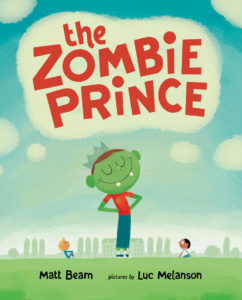 The Zombie Prince, by Matt Beam and Luc Melanson
The first time we read The Zombie Prince, I was entranced by it, its puzzles and strangeness, how curiously it was framed, but the rest of my family weren’t so into it. “I didn’t get it,” they said, but I insisted, that this was a book that was special, that this was a book about boys and their feelings and the powers inherent in being sensitive. So we read it again, and they started to get it, liked the book as much as I do. I book that invites plenty of questions, which is why reading it again and again is worthwhile. “Why did Brandon tear up the flower?” I asked them tonight, and they speculated. This book isn’t breezy and is not a one-off, and runs the risk of being just a bit too subtle, but the illustrations are fun and appealing and the ideas of zombies and vampires are attractive enough to make a reader pick up the book a second time. This is a book with undercurrents, and the discerning reader will be able to put the pieces together. The discerning older reader will also be able to understand the implications of Brandon’s classmate having called him a “fairy,” and that this is a story with big implications. I appreciate its lack of obviousness, and that this is a book about boys and feelings that isn’t cheesy, or preachy. It’s expansive, like all the best books are, and isn’t afraid to ask its readers to think.
*
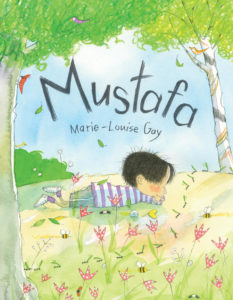
In her latest picture book, Marie-Louise Gay moves from her worlds of flying cats and a brother and sister in bucolic idylls to a different kind of reality, although it still comes with her characteristic whimsy. The title character in Mustafa is a young boy who has moved with his family away from an old country he still dreams of. “Dreams full of smoke and fire and load noises.” Lonely, he plays alone in the near near his new home, and takes in his new surroundings—shiny red bugs with black spots on their backs, trees whose leaves mysterious turn orange and red. “He sees two small animals jumping from branch to branch, They bushy tails wave and curl in the air. They chatter like monkeys.” There’s also a girl who walks a cat on a leash, and Mustafa is fascinated by all of it, but the girl in the particular because he fancies a friend. He asks his mother if perhaps he’s invisible. ‘”If you were invisible, I couldn’t hug you, could I?” answers his mama.’ But then one day the girl gestures for him to follow her, and they go together to watch fish in the pond. And Mustafa doesn’t feel invisible anymore, which makes for a really nice story about a refugee’s experience, but also an interesting exercise in seeing our homes from other people’s points of view, what we all look like from the outside, and how much it means to be invited in.
November 9, 2018
A World of Kindness
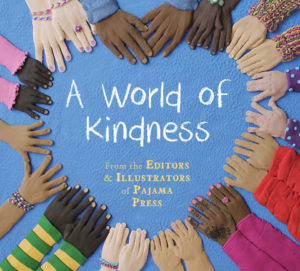 The superhero of my day today was the woman behind the counter of the Second Cup coffee shop where I was working this morning who engaged with every customer like she was happy to see them, who helped at least two elderly customers with fine motor tasks they were struggling with, and you could tell that for some people their conversations with her were the best parts of their days. She was just base level kind to everyone, and I thanked her for it when I finally left, because I liked the world a little bit better due to the fact that she was in it. Hers were little gestures, but they mean so much, and it’s how it all adds up that really matters, which is the point of a new picture book I love, A World of Kindness.
In a note inside the book, Pajama Press Publisher Gail Winskill writes that the idea for the book was born when her three-year-old granddaughter asked her one day, “Nana, how can I be kind?” Dedicated to the memories of Fred Rogers and Ernie Coombs (Misters Rogers and Dressup, respectively), the book has us to begin to contemplate that question, and makes some suggestion toward answers. “Do you wait your turn?/ Will you help someone younger…/or older?” Each page features art by Pajama Press’s acclaimed illustrators, some from previous books and others original (and my children were excited to see illustrations from books they’ve loved before!). Being gentle with animals, saying please and thank you, helping shy friends join in, watching over those who need it. “Will you be a friend to someone new?”
The ideas are simple, but they’re also transformative and profound, and the depth and diversity of illustrations on this book provide another layer of richness, making A World of Kindness a deeply meaningful read. Even better: royalties from the book will be donated to Think Kindness.