October 10, 2019
The Girl Who Rode a Shark, by Ailsa Ross and Amy Blackwell
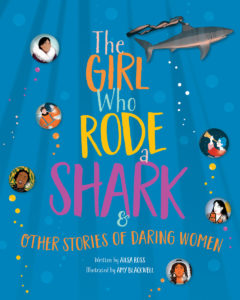
I’m not yet bored of stories of brave and uncommon women, and this is not even a genre that began with Good Night Stories for Rebel Girls. Virginia Woolf published several biographical essay throughout her career—it was from “Lives of the Obscure,” in The Common Reader, that I learned about the Victoria entomologist Eleanor Ormerod, for example, and without Woolf we wouldn’t even know about Shakespeare’s Sister at all. Truth be told, I actually found Good Night Stories... a bit wanting…but that’s because I’d read Rad Women Worldwide before it, and liked it so much better.
But another similar book, The Girl Who Rode a Shark, by Ailsa Ross (who lives in Alberta!) and Amy Blackwell, has managed to live up to my expectations. My favourite bit is the Canadian content—we’re almost at the Roberta Bondar essay. And Indigenous hero Shannon Koostachin is included in “The Activists” chapter.
The women profiled in the book come from places all over the world, include many women of colour, and also women with disabilities. Even better—while many of the profiles are of historical figures, just as many are contemporary, young women who are out there doing brave and groundbreaking things as we’re reading. A few of these figures are familiar, but more are new to us, and their stories are made vivid and compelling through the book’s beautiful artwork and smart and engaging prose.
October 2, 2019
It Began With a Page, by Kyo Maclear and Julie Morstad
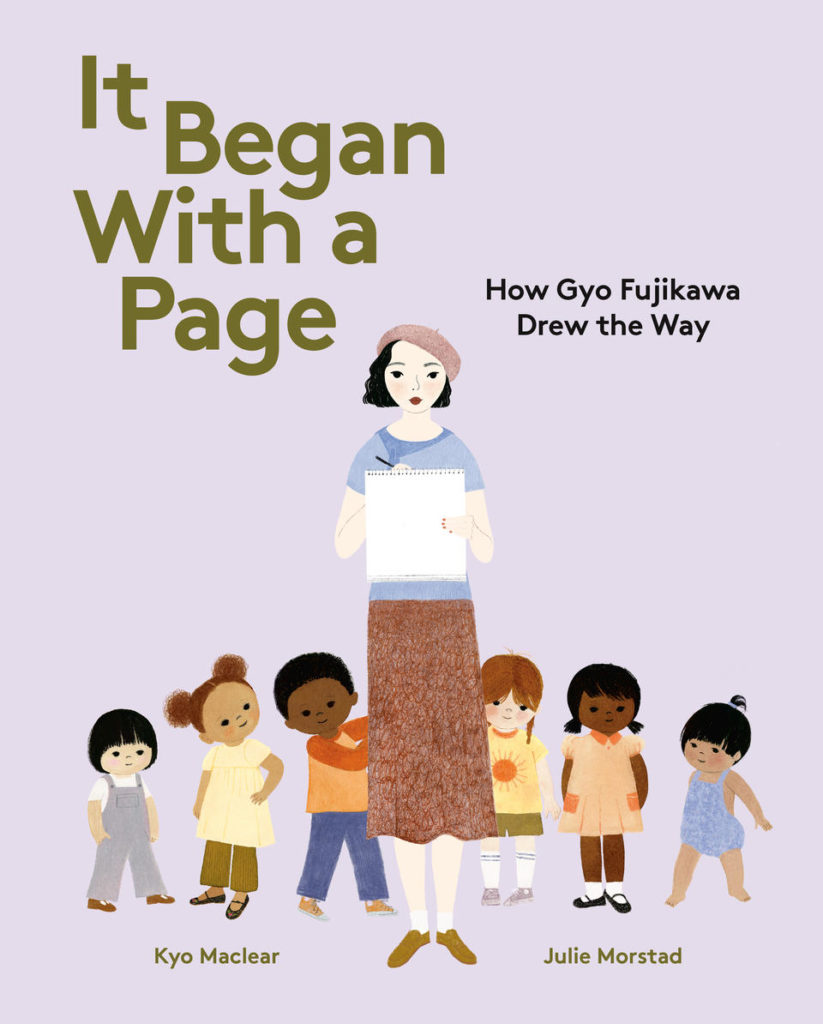
It Began With a Page, the new picture book collaboration by Kyo Maclear and Julie Morstad—who are already known for their picture book biographies(ish) of Julia Child, Elsa Schiaparelli, Anna Pavlova (illustrated by Morstad, written by Laurel Snyder), and Virginia Woolf (written by Maclear, illustrated by Isabelle Arsenault)—has everything. And to have Kyo Maclear, a leading Asian-Canadian author writing about THE pioneering Asian-American children’s author/illustrator, with illustrations by Julie Morstad who does such justice to her source material. Which is, of course, Gyo Fujikawa’s babies, an adorable array of little people from different ethnic backgrounds, all playing together—Fujikawa has clearly been an inspiration to Morstad since the beginning of her career. But what contemporary readers might not appreciate until reading It Began With a Page—which tells Fujikawa’s life story—is that it wasn’t long ago that picture book illustrations of children with different skin colours all playing together was revolutionary, and before that even not condoned.
Which is a convenient metaphor with which to tell a story of a society in which, just say, people from a certain ethnicity have their land and belongings confiscated and are sent to concentration camps. Although Maclear eschews metaphor altogether here, and sticks with the facts: “In early 1942, terrible things were happening. Bombs and gunfire rocked the world. America was at war with Japan. Kyo was shocked to discover that anyone who looked Japanese or had a Japanese name was no suspected of being the enemy… Gyo’s family was sent to a prison camp far, far away from their home.”
But first: “It began with a page, bright and beckoning.” A five-year-old girl with a pencil in her hand. “The dance and glide of a line. How a new colour could change everything: a bright splash of yellow, a sleep stroke of blue.” The girl fills her pages with drawings, and as she grows older, her talent is natured by a supportive teacher who pays for her art lessons Gyo Fujikawa is one of the few girls, let alone Asian-American girls, who goes to college in 1926. She travels to Japan, her ancestral homeland, to learn about the tradition of Japanese brush painting, and after she returns to America gets a temporary job designing books at Walt Disney’s studio in New York. Which means she is far away from her family when the Japanese internment takes place, but the distance only increases her heartbreak at what is happening in her country.
After the war, Fujikawa continues to work as an artist, and Maclear shows her awareness of the dawning civil rights movement. “Still, there was so much that hadn’t changed. At the library and bookshop, it was the same old stories—mothers in aprons and fathers with pipes and a world of only white children.”
But when Fujikawa submits her manuscript featuring “Babies! Chubby cheeked, squat-legged, bouncy-bottomed babies,” the book is rejected. “No to mixing white babies and black babies. It was not done in early 1960s America, a country with laws that separated people by skin colour.”
Fujikawa, however, does not give up on her vision. And eventually, the book is accepted, and is a huge success, the beginning of an incredible career for this illustrator whose drawings would create “a bigger, better world.”
The story includes a timeline of Gyo Fujikawa’s life, and photographs, and a note from Maclear and Morstad to readers about Fujikawa’s legacy (“Gyo as a TRAILBLAZER…and a RULE BREAKER”) was and how her family supported this book (Fujikawa died in 1998), providing access to stories, photos and archival materials.
June 14, 2019
Ruby’s Birds, by Mya Thompson and Claudia Dávila
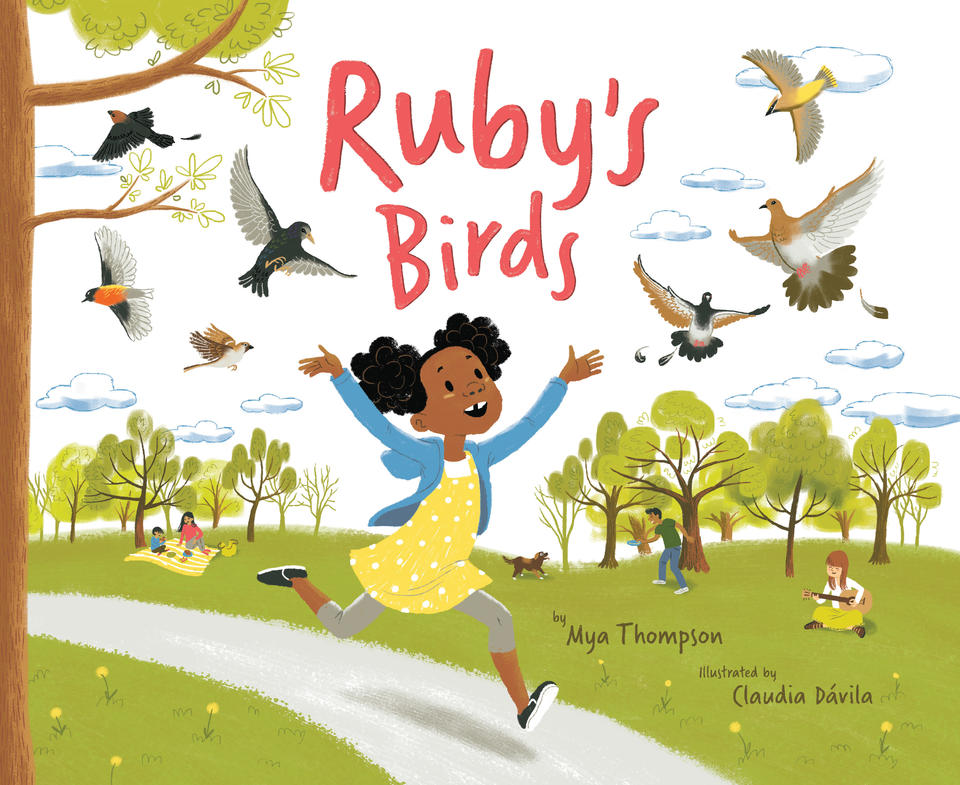
Having recently read and loved Ariel Gordon’s celebration of urban forests, not to mention still coming off a recent trip to New York City, Ruby’s Birds, by Mya Thompson and Canadian illustrator Claudia Dávila (we’re big fans of hers) is high up on our list at the moment. It’s the story of Ruby, a young girl with too much energy—so much so that she’s driving her family batty as they’re cooped up in their apartment. And so when a neighbour offers to take Ruby on an adventure to Central Park, she’s totally game, and brings her usual merrymaking self—which is a bit of a problem. Because they’ve gone birding, for which a person must necessarily be quiet, and be patient. Which does not come easy to Ruby at all, but then her patience is rewarded at the sight of a golden-winged warbler.
“We move carefully. We’re serious. We pay attention. We watch for tiny movements in the leaves. We try and try.”
Ruby’s Birds is published by Cornell Lab of Ornithology, whose mission is advancing the understanding and protection of the natural world. The story is fun, the illustrations interesting and dynamic, and the book concludes with information about city birds, the Cornell Lab’s Celebrate Urban Birds project, a list of 14 different species that can be located in the pages of the book and even in the reader’s own city, plus a list of inspiring tips for nature walks. It’s a great book to inspire readers to get outside and get exploring, and perfect for spring.
May 17, 2019
A Little House in a Big Place, by Alison Acheson and Valériane Leblond
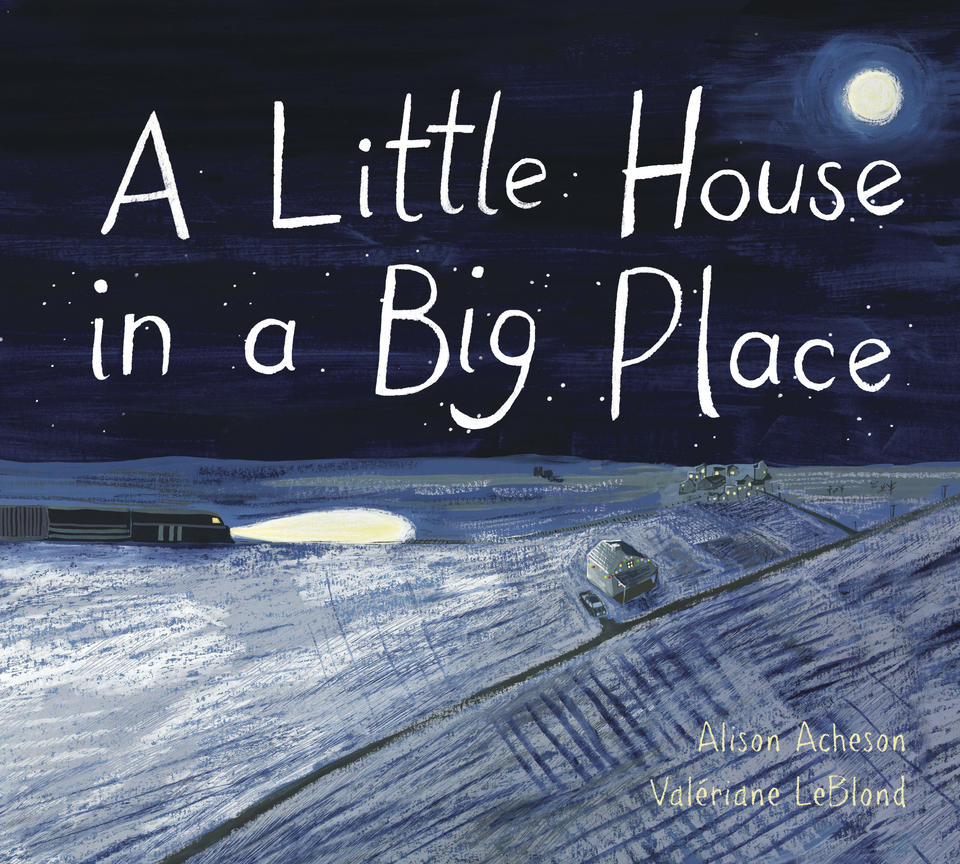
We are in love with A Little House in a Big Place, by Alison Acheson and Valériane Leblond, a picture that manages to combine an old-fashioned sensibility with a storyline that’s utterly surprising. It’s the story of a young girl who lives in a house on the edge of a small prairie town, and every day she stands at her window and wave that the train engineer who goes past. “…[A]nd she wondered. About where he came from and where he went. And if she might go away too, someday.”
And we hear the story too from the point of view of the engineer, who waves to the girl everyday. The prairie landscape informing the narrative’s perspective: “His train came over the horizon every morning. One moment there was only sky, and the next moment there would be a dot/ that got bigger/ and bigger/ and bigger [the text getting larger with each line] and the dot would become the train.” And the train rushes away until it becomes a dot again. “But his wave and her wave together made a home in [the girl’s] heart.”
The girl wonders about the engineer, as he no doubt wonders about the girl in the window of the small house on the prairie, and they’re connected to each other, though neither knows the other at all. The girl has no idea that one day will be the train engineer’s last day on the job—but then he throws something from his window that she runs through the fields to find. And he will never know it, but the girl will carry it with her through her life.
I have a theory that this book is a secret ode to Joni Mitchell, because the end of the story finds that small girl who grew up in a prairie town living in a place far eastward, strumming her guitar in a coffee shop. But there is a universality about the story too, about the anonymous people who touch our lives, and about the places where we come from, which set us on the road towards where we’re meant to be.
May 3, 2019
Me, Toma and the Concrete Garden, by Andrew Larsen and Anne Villeneuve
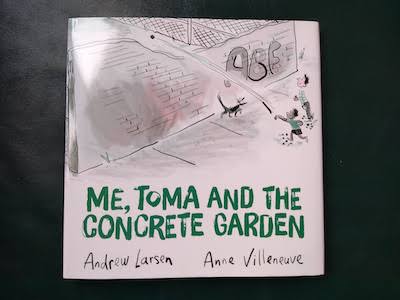
Everything I’m hungry for in the world right now I can find within the pages of my friend Andrew Larsen’s new picture book, Me, Toma and the Concrete Garden, illustrated by Anne Villeneuve. It’s a book about cities and concrete, about connections and community. It’s about the beautiful things we grow by accident, and how small changes can have huge ramifications. But it’s also a story about two kids throwing balls of dirt over a fence, about meaningless fun, and my children like it too, compelled by the wonderful details in Villeneuve’s illustrations and also Larsen’s winsome narrative voice, which is my favourite thing about all his books. He writes voices that really sound like kids, kids who aren’t quite aware that their stories are bigger than the story they think they’re telling. There are lessons and morals in this book, but you’ve got to read between the lines to find them, which is what makes Larsen’s books—beloved by children—especially rich for adult readers as well.
April 12, 2019
Seaside Treasures, by Sarah Grindler
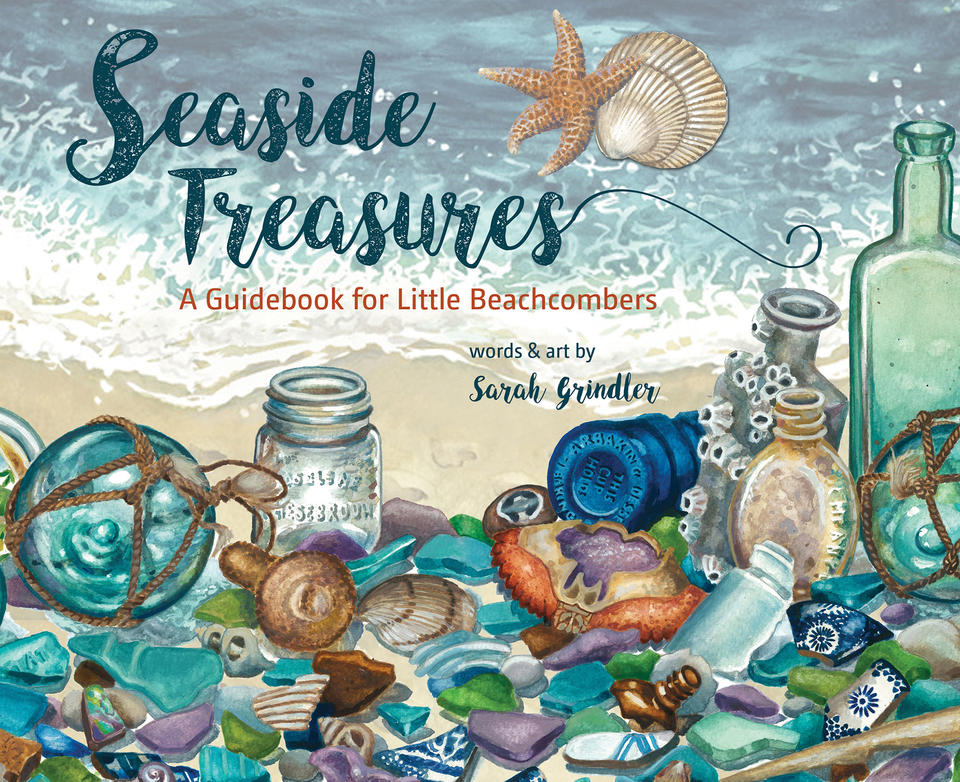
This week has been aggravating for all kinds of reasons, macro and micro, and not least among the troubles is that people kept waking me up at 4am, and thereafter I’d lie awake in bed taking inventory of all the items that are weighing on my mind, which is no way to fall back to sleep, I tell you. So finally I came up with a plan, the night after I first read Seaside Treasures, by Sarah Grindler. My worries, I imagined, put away in a drawstring bag in the place where I was in my mind, which was the beach at Humber Bay Shores, a beach where the beach glass tends to be yellow, which fascinates me because out in the east end of the city it’s mostly green, and I wonder why the distinction. I would leave the bag behind me as I went to explore the beach instead, picking up mussel shells, slate perfect for skipping, round stones to hurl, and others with stripes to admire, the sun sparkling on the surface.
It’s possible I’m just dreaming of summer anyway, mid-April with snowflakes, but Seaside Treasures is a portal to there, and I love it so much. We’re beach treasure enthusiasts in our family, collectors of two glass jars of beach glass so far (and counting), with purple being ever elusive, but the odd fragment of painted china has made up for it in the meantime. And even though our beach is not a seaside, instead by a lake (but still, a GREAT lake) and we will never find a sand dollar or an urchin shell, this book is still right up our street, and makes us excited and inspired to go exploring local beaches again.
Grindler’s realistic painted illustrations are beautiful, a different hue for every page—blue sea glass, then purple—both rare. “Other hard-to-find sea glass colours are red, orange, and yellow You can find pieces of green, brown, and white glass more easily. What is your favourite colour of sea glass?” she asks, in text as engaging as the pictures are. She shows glass fishing floats, arrowheads from the Indigenous people who lived on these lands long before we did, seashells, and also pieces of china. “Do you wonder who might have used them? Perhaps sailors, merchants, or pirates!”
And then there’s garbage, which washes up among the rest of it, which led to a really interesting discussion (and a general consensus that cigarette butts are disgusting). Isn’t it funny that some garbage gets to be treasure and other isn’t? A marble on the beach is treasure indeed, but what about the toy car with its wheels missing? Grindler writes, “When I find garbage, I collect it to help keep our oceans and beaches clean.”
The final spreads invite the reader to search specific objects on a crowded page of beachy treasures, and then to imagine what kinds of art and objects could be made from these objects as well. Ending with a question: “What will you find?”
(Hopefully serenity.)
April 5, 2019
The Biggest Puddle in the World, by Mark Lee and Nathalie Dion
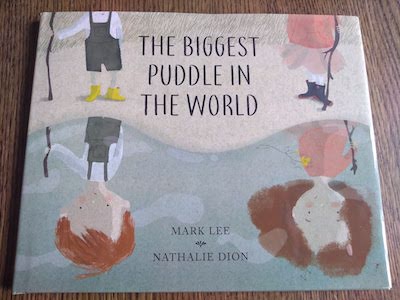
I’ve been meditating a lot on connection lately, how one thing leads to another, the ways that small things can cumulate in big things—which is the underlying message of The Biggest Puddle in the World, by Mark Lee and Nathalie Dion. But it’s a message that’s buried deep inside a wonderful old-fashioned story about two siblings who go to stay with their grandparents (Granny B. and Big T) for six whole days while their parents are away. In beautiful illustrations rich with gorgeous mismatched prints (damask wallpaper, floral duvet, mattress stripes to die for) we’re shown the siblings exploring their grandparents house as the weather outside just rains and rains and pretty soon the two are out of playtime options. But then: “The next morning patches of sunlight appeared on the kitchen floor.”
And so they head outside wth Big T. with a challenge: a search for “the biggest puddle in the world.” “The wet earth and the shiny grass smelled like spring. During the rain, a clump of mushrooms had popped up on a log.” They find one puddle, and then more puddles, but none of them constitute “the biggest puddle in the world.” Their grandfather encourages them, “Follow the water,” and they do, as the trickles from puddles turn into a stream, and then a pond. And they take a break from searching to create a puddle map, and then learn how puddles turn into clouds, which are made from bodies of waters everywhere, including that still-elusive big puddle that they’re looking for. Which they find by following a river through thorn bushes and down a muddle hill to reach a beach, and there it was: the ocean. The biggest puddle in the world!
The prose is lovely to read and the illustrations soft, dreamy and detailed, as absorbing as the story is. Just the book for April, and all its showers—it’s a perfect springtime read.
March 29, 2019
Nature All Around: Trees, by Pamela Hickman and Carolyn Gavin

My nine year old daughter Harriet knows everything, and she continually surprises me. Because who was it that taught her about constellations, garden slugs, axolotls, or the life cycle of a piraña? It wasn’t me, who still sometimes gets tulips and daffodils mixed up, and didn’t actually know what an iris looked like until after I’d given that name to a human. But it’s not altogether a mystery, where Harriet gets her knowledge from, because she’s an avid reader of nonfiction, devouring the “Do you know…” series from Fitzhenry and Whiteside, and Elise Gravel’s “Disgusting Critters” books. Every time we go to the library, she picks up another books about animals or plants—for a while she was really into fungi. (She also really likes Jess Keating’s books, her nonfiction and her novels alike.) But I have to confess that with some rare exceptions, children’s nonfiction books don’t really do it for me.
But then along comes Nature All Around: Trees, by Pamela Hickman and illustrated by Carolyn Gavin, a book that has been given a permanent home on our coffee table. Because it’s gorgeous, just the thing for those of us who are wild about botanical paintings, and a sensibility not dissimilar to Leanne Shapton’s beautiful Native Trees of Canada (with a sprinkling of Carson Ellis and Esme Shapiro).
I love this book! It’s beautiful just to leaf through (ha ha) with its paintings of leaves in their glorious variety, and filled with fascinating tree facts, the difference between a simple leaf and a compound leaf, explanations of photosynthesis, pollination, and features on “strange trees” like the 23-story tall sequoia that’s probably 2000 years old, or the larch tree, which is special because it’s coniferous and deciduous at once.
The terrible thing is that because I am not nine, my mind is a sieve, and I can never remember anything, which is a good excuse to keep this book on the coffee table—in addition to its pleasing aesthetics—because then I get to read it over and over again.
PS Another tree book I’m super looking forward to this spring is Treed: Walking in Canada’s Urban Forests, by the amazing Ariel Gordon.
March 15, 2019
Moon Wishes, by Patricia Storms, Guy Storms, and Milan Pavlovic

It was no contest what book I was going to write about for #PictureBookFriday this week, which has been the week of our March Break staycation, a marvellous week of travelling around town and taking in the best of what Toronto has to offer, which has included the Ai Weiwei exhibit at the Gardiner Museum, the library, a family swim, a return visit to Winter Stations at Woodbine beach, St. Lawrence Market and the Old Spaghetti Factory, and then yesterday, which was everybody’s highlight: a trip to see The Moon: A Voyage Through Time at the Aga Khan Museum, which was extraordinarily rich, and wondrous, and fascinating.
And which gave us a deeper appreciation for Moon Wishes, a new picture book from author/illustrator Patricia Storms, and one that is is written along with her husband, Guy Storms, and illustrated by Milan Pavlovic. And what a treasure this team has produced, a gorgeous story with images just as beautiful, a story about what the moon shines on, which just happens to be everything. (One of my favourite parts of the moon exhibit was the artist’s statement by Luke Jerram, who created the illuminated moon replica, who described the moon as “a cultural mirror.”)
“If I were the moon, I would paint ripples of light on wet canvas,” the book begins, and we see a school of fish swimming in the moon’s reflection. We see the moon shining over a group of migrants, all their belongings on their backs: “I would wax and wane over the Earth’s troubles…wishing peaceful sleep for worried hearts.” The moon is a constant, lighting up the darkness, always changing, just like everything is. “I would be a beacon for the lost and lonely…lighting the way home” And shining on all the creatures everywhere, in the sea, and on the land, in the woodlands, and on the coasts. Connecting all of us, both big and small.
March 8, 2019
The Secret Life of Alice Freeman…
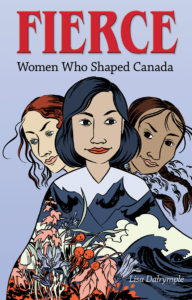
Today at 49thShelf, we’re featuring an excerpt from new book Fierce: Five Women Who Shaped Canada, by Lisa Dalrymple and illustrated by Willow Dawson, which is a book I’ve been reading aloud to my family over the last two weeks, and one we’re all enjoying. In particular the story of Alice Freeman, Toronto schoolteacher in the 1880s who led a secret double-life as an investigative reporter. It’s so good, and you can read it here.