November 23, 2022
Postcards to the Future
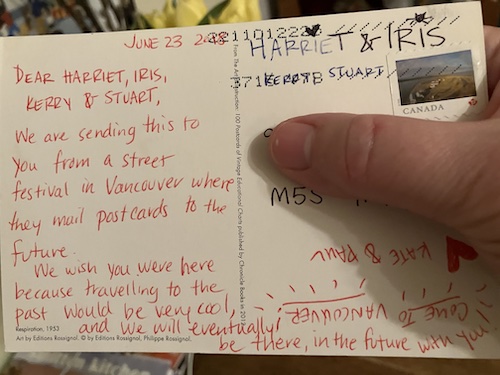
A few weeks ago, we received a postcard from our friends Paul and Kate who live in Vancouver. I will admit that I did not read the note on it very carefully (the image on the front was a diagram of the respiratory system?), but it read something along the lines of that they’d written the card at a street festival “where they mail postcards to the future.”
Which was kind of remarkable, I guess, but then aren’t all postcards letters to the future after all?
The salient part for me, however, was the way the postcard concluded: “…and we will eventually be there, in the future with you!” Because we haven’t seen Kate and Paul since 2019, but this month they’ve finally returned to Ontario for a whirlwind visit, and we’ve been lucky enough to be part of it, which is what I’d so been looking forward to when I received this postcard at the beginning of November.
Tonight we all sat together in my living room eating Thai food, celebrating Stuart’s birthday, Kate and Paul, and our friend Erin, and 3 year-old Clara whom we last saw as a baby, and her little brother Gabriel, who has just learned to climb stairs, and who we’ve been overjoyed to be meeting for the very first time.
“Oh, I got your postcard!” I exclaimed suddenly, remembering. Kate and Paul were both confused. They hadn’t sent us a postcard. “No, you know. The one from the street festival? Where you were sending a message into the future.” They had no idea what I was talking about. “It’s on my fridge!” I insisted. “Here, I’ll show you.”
I went to get it…and realized the most important thing I’d missed when looking at it before. The date at the top: June 23, 2018. The people at the street festival really weren’t kidding about the future thing. I realized too that the note was only signed from Kate and Paul, because Clara and Gabriel didn’t exist then. We hadn’t had a pandemic then. None of us had had any idea of what was coming. And yet.
“…and we will eventually be there in the future with you.” A line that might have hit very differently if this letter had arrived at any other moment during the last few years. But it was a promise.
What are the odds of this very postcard to the future arriving on the cusp of the first time we’ve all been together in so long?
But here we are. I feel so lucky. And looking forward to what other wondrous things the future has in store.
November 22, 2018
Margaret Laurence and Jack McClelland: Letters
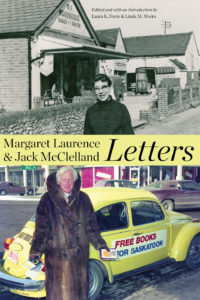 It’s not typically a ringing endorsement when I tell you in November about the book that I’ve been reading since June, but this is no ordinary book. Margaret Laurence & Jack McClelland: Letters, edited by Laura K. Davis and Linda M. Morra has been one of the highlights of my literary 2018, a mainstay on my bedside which I’d pick up and read a couple of pages from every night. It begins with a letter from Canadian Publisher J.G. McClelland who sends a letter to a “Mrs. Laurence” in 1959 upon learning from a mutual friend that she’d recently completed a novel whose description sounded like something he’d be interested in. “I would be delighted if you would let us have the opportunity to consider the manuscript,” he writes.
Three weeks later, Margaret Laurence sends her reply. along with her manuscript for This Side Jordan, and so a literary partnership was born, between one of Canada’s greatest writers and McClelland, of McClelland and Stewart, the iconic Canadian publisher. And what a thing to watch, to read—the camaraderie developing between them, Laurence finding her voice as a writer, McClelland’s nurturing of and respect for her talent, which continues through the book entire. By November 1960, they’ve dropped formalities and are “Jack” and “Margaret,” and they spar, and they gossip, and they worry for each other, and support each other, and their letters tell a great of the story of Canadian literature and publishing in the second half of the 20th century (which seems just as perilous and depressing as it is in the 21st, fuelled by passion and no cash. “The market for fiction is so bad,” McClelland writes Laurence in 1964).
She writes to him in 1965, “I have finally managed to get a novel finished, but do not know yet if it’s any good or not.” That novel was A Jest of God, which McClelland finally reads and responds to by telling her, “The thing that continues to amaze me about your writing, Margaret, is that you improve with everything you write.” I adored so many parts of this book in the specific, like when Laurence coerces McClelland into creating an LP to release alongside The Diviners, which was so not his jam and much more trouble than it was probably worth. Or when McClelland is speaking to a group of English teachers and railing against Alistair MacLean (“one of the worst writers in the world”—what a distinction!) and the teaching of his works in Canadian high school classes, and then one of the teachers responds with “here you have been complaining about the censorship of The Diviners and, at the same time, you are attempting to censor Alistair MacLean.” McClelland closes the anecdote with this: “It’s a crazy fucking world.”
I also really loved the story of Margaret Laurence’s trip to the Writers Development Trust fundraising dinner in 1982, mostly because I often find being an author in public is often an exercise in various humiliations (see my friend Rebecca Rosenblum’s recent post “Indignities”). There were various complications at this particular dinner, particularly involving Margaret Laurence having to wait for a long time in a stifling corridor with nowhere to sit down or get a drink, and then when she finally enters the event and arrives at her table, she discovers that her table is…empty. The businessman who bought her table is late, and then when he finally shows up, he spends 20 minutes talking to Pierre Berton, and he also neglected to invite anyone else to sit at their table. It’s agonizing, and hilarious, and so many of us have been there.
By 1986, however, the dust has settled enough that McClelland dares to invite Laurence to another fundraising dinner for the Writers Development Trust, but this time the party is in her honour, and he’ll even host it in Peterborough so she won’t have to travel, and she’s even in agreement. But in September of that year, he receives the news that Laurence has terminal cancer, and he writes to her immediately: “Funnily enough what catches me at this particular moment is that I wish to God I could write. I would like to write you such a superb letter that it would enchant your and enrich you and support you through whatever the months ahead have to impose on you. I just don’t have that gift [or] skill—the one in the world that I admire more than any other.”
Laurence would die the following January, and I must say I have some vague idea of how hard that must have hit McClelland, how much he must have missed her, because I could have read this book forever. And possibly I will.
May 3, 2018
At This Juncture: A Book of Letters, by Rona Altrows

“Dear Joan [of Arc],
It is impossible to know if this letter will get to you. Personally I am agnostic and have no idea whether there is any substance to the Christian praise of life after death for the deserving. Moreover, if there is a heaven, can it be reached by Canada Post? Another unknowable…”
The premise is this: Ariadne Jensen, a Canadian woman in her fifties, writes to the CEO of Canada Post with a modest proposal to inspire Canadians to start sending letters again (thereby increasing Canada Post’s profits). Letter-writing, for Jensen, has been a lifelong pursuit (she wrote letters to her Aunt Bella in Moosomin, Saskatchewan, from the age of six, and “[t]herefore, in the course of the years we were in postal contact, we purchased, by my calculation, at least 2,392 Canadian stamps”). Unfortunately, it would be difficult for even the most prolific letter-writer to save Canada Post single-handedly, and so she wonders instead if they could come up with a scheme whereby anyone who buys a pack of stamps also receives one of Jensen’s letters, one of her actual letters, or a letter she’s written to a historical figure (see Joan of Arc, above, or another to Lady Gaga) or even fictional letters she’s created between historical figures—from General James Wolfe to his mother, from Helen Keller to her lover, etc. etc. And in reading these letters, Canadians would be inspired to go out and write more letters of their own, buy more stamps, and so it goes. And Canada Post continues on into the future, a venerable institution.
There is no response from the Canada Post, and so Jensen rescinds her offer to write demographically targeted letters in exchange for a small office space, but her project continues and takes the form of Rona Altrows’ new book, At This Juncture: A Book of Letters. Comprising all the different kinds of letters outlined above, which means this book is basically a collection of stories, some of which are linked, and as the book progresses the reader gets a stronger sense of who Ariadne Jensen is and also of the characters who populate her world.
I do have a vague suspicion: I have a suspicion that Rona Altrows herself (an award-winning writer who has published two previous books of short fiction) has a hobby similar to that of Ariadne Jensen, writing gorgeous letters between fictional figures and then she amassed a nice pile of them and then faced the challenge of turning them into a book; i.e. the conceit of Jensen and the effort to save Canada Post was secondary to the book’s actual content, and it’s true while the former is charming, the latter is richer. It’s true too that this is a book that’s targeted toward a very specific audience, but I am that audience and I loved this book.
I love letters. I still don’t write as many as I should, but I try to make up for it with thank-you notes and Christmas cards. I love reading collections of letters (Blanche Howard’s and Carol Shields’ is my favourite), and also epistolary novels, I love writing about things that arrive in the post, and like Ariadne Jensen, I too have lamented the postal system’s decline. And so At This Juncture was right up my street. The prose is beautiful, each letter compelling, and I was curious about the organization of the book, its structure, the poetic fragments that introduced each section. I loved pondering the connections between the letters, wondering what each one’s point of origin might have been, and also enjoyed the glimpses into so many different worlds, different lives. Ariadne Jensen is a memorable character—she reminded me of Lillian Boxfish. And she has partially succeeded in her endeavour, it seems, because upon finishing At This Juncture, what else could I do but go buy a pack of stamps? (With bees!)
August 31, 2016
Extraordinary Day
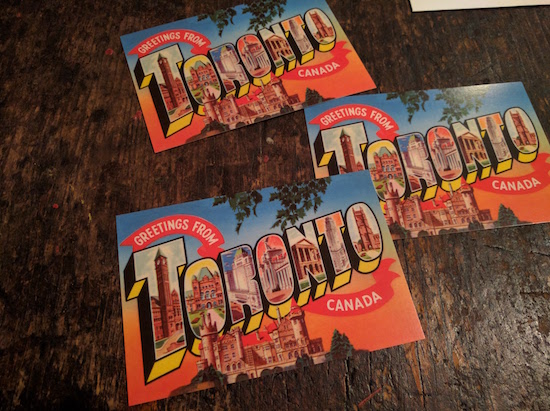
My favourite thing about being a parent is the way you get the make the world magic. The way you can wave an imaginary wand an transform an ordinary day into a extraordinary one. The way that my children had no idea what was up when we told them to get their shoes on at 8:30 this morning, and when they kept asking where we were going, we said they’d find out when they got there. They’d been expecting their daddy to leave for work as usual, but there we all were marching to the subway, south to Union. And then a walk along Front Street, and over the train tracks to the aquarium, because Harriet’s loves the aquarium, and had expressed a wish to go there again. There you go Harriet: wish granted. Amazing.
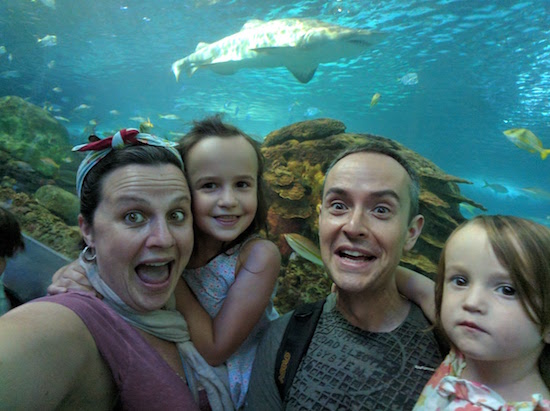
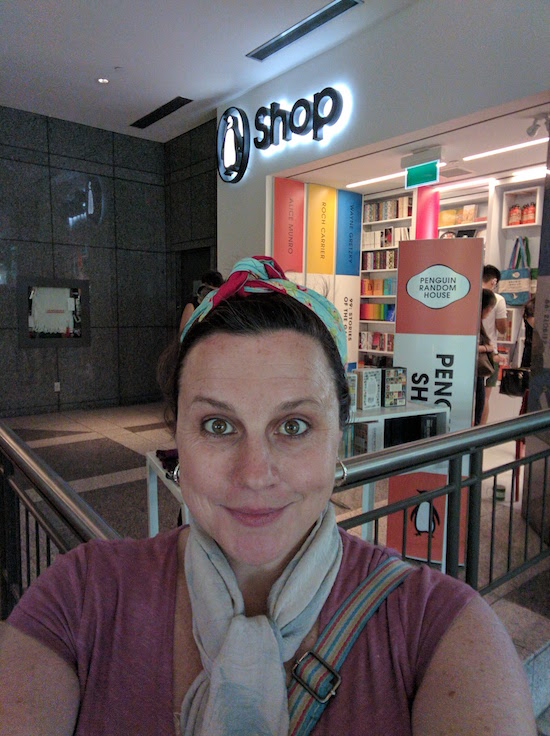
We had a terrific time at the aquarium, and the best part was when we ran into my best friend Jennie. After a few hours we were done though, and the place was completely bonkers, and so we left and meandered north to the place that had perhaps inspired this whole aquarium plan—the close-in-proximity, brand new Penguin Bookshop.
A bookstore that fits in your pocket, it is, or your closet, at least. Formerly a shoe repair kiosk. It features a lively selection of Penguin-branded goods and books they publish, Canadian and classic. I got the new Dave Eggers novel and The Bloody Chamber, by Angela Carter, and we bought a copy of Ooko because we’d had it from the library and loved it. It was very nice to finally stop by.
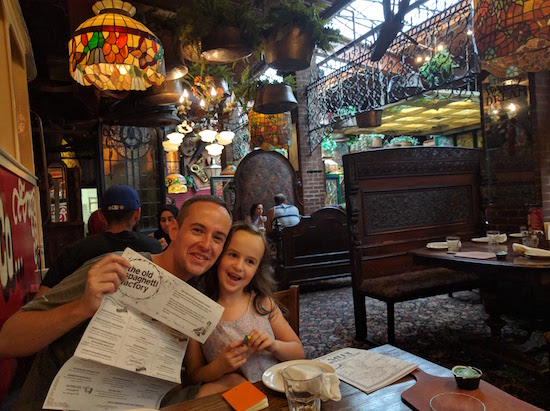
We had lunch at the Old Spaghetti Factory, which was completely fun, and totally not horrible or boring. And there was so much bread. The bad thing about being snobs who live downtown is that we don’t get free bread with our meals very often, and certainly not for lunch (and if we do, it’s spelt bread and nobody wants to eat it). The children thought the place was great and we thought it was surprisingly good, the perfect place to stop on this day of being tourists in our own city for a while.
“And what are you doing with the rest of your day?” our waiter asked us as we paid our bill. “We’re going to visit Toronto’s First Post Office,” I told him. I told him, “You’ve probably been there a hundred times, right?” He gave me a look. When he finally bid us adieu, he said, “Have fun at the…post office.”
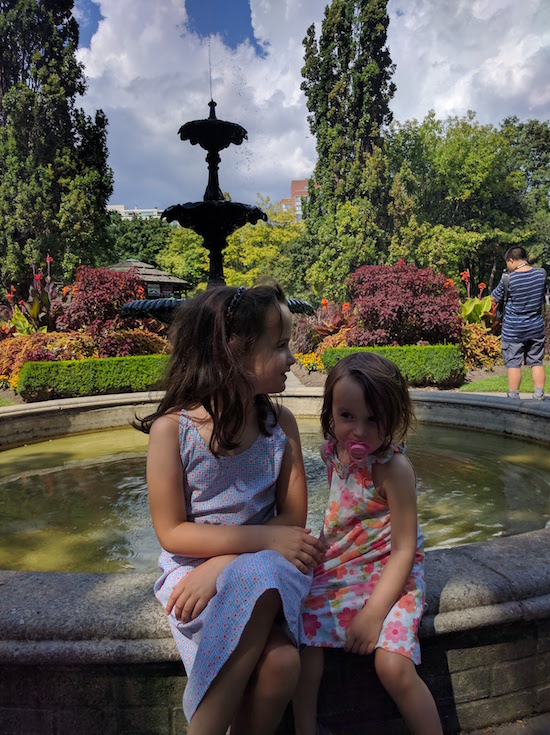
But not just any post office! It’s an actual working post office (and woo hoo! Canada Post and its employees have finally come to an agreement so we’re not going to be having a postal strike) AND a museum. From the restaurant, we walked through the beautiful St. Lawrence neighbourhood to get there, and finally arrived. Full disclosure, the children were being to lose their shit by this point.
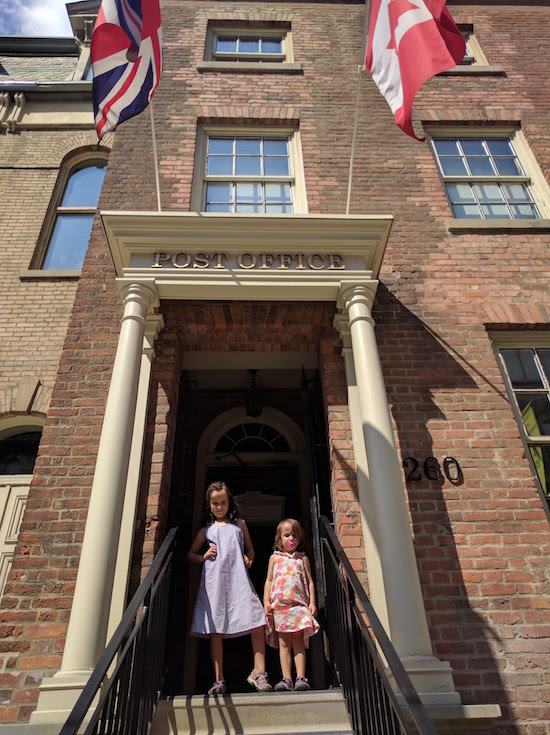
At Toronto’s First Post office you get to try writing with quills, and can also purchase stationary to write letters in their reading room. The place was marvellously busy, with tourists and also people coming in on ordinary errands. After finding out that writing with quills was really hard, Harriet and Iris sat down to write with ordinary pens, and they both ended up crying because a) over the summer Harriet had lost any writing skills she’d ever possessed and b) Iris had never possessed any anyway. And all I wanted to was write a letter to my friend, but the children were bananas and also doing dangerous deeds with ink, which ended up smeared all over Iris’s body, and then she blotted it with the sand provided for such things, and it all had gone a little bit awry. We pulled it together though, got letters written and even posted. And then it was time to admit that the day was coming to an end, so we headed for the subway, and nobody cried again, I think, so it all was a success.
February 15, 2016
Good things come
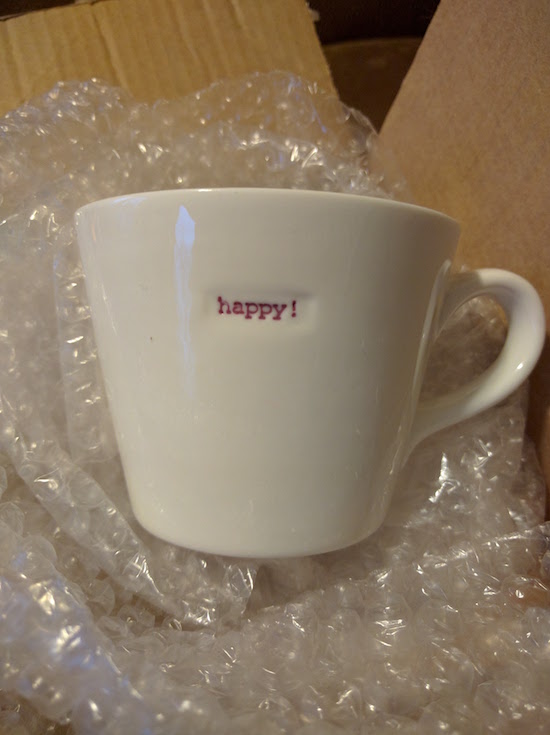
Sometimes the internet is portrayed as the opposite of the world proper, as the opposite of civility, and scapegoat for the end of all things ranging from bookshops to mail delivery, but my internet isn’t really like that. If it weren’t for the internet, I don’t know that I’d get much mail at all, and oh, I do get mail. Today, this most absolutely perfect object: a teacup! A gift from Jocelyn in Calgary whose manatea infusers delight me daily with her #TodaysTeacup photos. I am touched and delighted and overwhelmed, and so thrilled that this perfect object now has a home in my cupboard. happy! is exactly right.
(For me, Instagram is very much about happiness: I found a paragraph that articulated it exactly in The Republic of Love this weekend, even though Carol Shields wrote that book in the early 1990s, but then Carol Shields knew everything: “All morning there have been rain showers, but now a fan of sunlight cuts across the table and she stops to admire the effect. How fortunate a woman she is to possess this kind of skewed double vision. To be happy. And to see herself being happy.)
I do wonder if there is a direct correlation between happiness and being a person who gets a lot of mail. For me, the key is magazine subscriptions and ordering a lot of secondhand books, and being someone who regularly writes thank you notes and Christmas cards, thereby ensuring that I get a few of these in return. Yes, and also being publicly ebullient about the post in general, so that kind friends and strangers out there in online-land are inspired to reach out via the mailbox. After I wrote about Miss Rumphius last year, Theresa Kishkan mailed me a packet of lupine seeds. A few months ago, the write Jennifer Manuel sent me a beautiful card and a book by her late mother, Lynn Manuel, called The Lickity Split Princess, which I enjoyed reading with my family. I haven’t been in touch with my good friend Bronwyn for quite some time, although she sent me a lovely book called Ten Poems About Tea in the fall—and I sent the same book to my friend Melanie a while after that. I had a dream-come-true in December when my in-laws sent me a get-well cookie from The Biscuiteers (all the way across the ocean and everything!). I remember three years ago when I was very pregnant and also going through scary things like neck biopsies, the poet Gillian Wigmore mailed me a drawing of a unicorn her daughter had made. Recently we received an excellent package from our beloved Zsuzsi Gartner who’d heard about Harriet’s recent skating prowess and mailed her a copy of Hans Brinker, or the Silver Skates that had been lingering in a Free Little Library in her neighbourhood, and we look forward to reading it soon.
All of which is to say that I am very lucky, and perhaps kind of spoiled, but more importantly that people can be wonderful, and sometimes it’s true that good things come. The last line from Jane Gardam’s A Long Way From Verona: “But like at the Novelty Machine, I just felt filled with love, knowing that good things take place.” (I read that line back when I was in the midst of neck biopsy panic, and I remember the simple perfection of that sentiment, how it shifted my perspective. Plus, there were drawings of unicorns, which helped too.)
Today is the strangest day of all the others, the one holiday (Family Day here in Ontario, though it’s not celebrated across the country) upon which we also receive mail delivery. Mail delivery and a holiday: “the universe conspiring to delight me” I wrote today, and it’s true.
October 26, 2014
Would-Be Pickler Tries Nathan’s Famous
 In my blogging course last Monday, we were talking about blog titles, and I conceded that there was probably an expert out there who—for SEO purposes and issues of general confusion—would advise you not to call your book blog Pickle Me This. But the problem with expert advice (and why expert advice so often doesn’t work for blogs, which are characterized by their refusal to conform to expectations) is that such advice cannot take into account the forces of serendipity.
For example: You christen your blog “Pickle Me This” for no good reason in 2004, thereby enabling a delivery of actual pickles to land on your doorstep a decade later.
 Except that there was a reason I named my blog Pickle Me This. Not a good one, but still.
In 2004, I lived in Japan teaching English conversation to students with whom I usually had very little in common. This lack of commonality made our English conversation challenging. “What is your hobby?” became a conversation touchstone when all else had failed, mostly because the Japanese school system mandated that every student have a hobby. (Those students who were bad at everything usually ended up on sports teams charged with carrying equipment.) Bored housewives were also hobby connoisseurs, with interests including tea ceremonies, ikebana, and calligraphy, though more often than not, their answer to the hobbies question was “learning English,” which brought us full (albeit very small) circle, and made the minutes on our classroom clock tick by oh-so slowly.
 Living in Japan does something to the brain. To this day, all my favourite music is basically assembled from karaoke playlists, I was photographing my lunch before it was cool, and I’m still inclined to squeal, “Kawaii!” when the situation warrants it. Part of becoming “Japanified” was responding the experience of living abroad and discovering how wide the world was, all the while we were cut off from the culture around us by being foreigners. We forgot how to form proper sentences, how to behave, and partook in strange pursuits to the fill the gaps that had appeared in our lives now that they were being conducted so far from home.
 In 2004, I decided that I would learn how to pickle. This would be the beginning of something huge, I imagined. In Japan, anything was possible. I was picturing a sizeable cottage industry, adorable labels. They would say, “Pickle Me This,” the name of my company. One of my students—an avid pickler—wanted to support my ambitions and went as far as to give me a gift of pickling spice she’d made herself. “I want you to be a pickle success!” she told me.
 Except that I was a pickling disaster. Granted, a lot was working against me. My entire kitchen was a hot plate, and I didn’t own a measuring cup. I was illiterate, so could not read food labels to know what kind of vinegar I was employing for my pickling task (if it was vinegar at all). I had no culinary skills then, and struggled with following simple recipes, whose advice, I decided, was usually just a helpful suggestion, as I slung a fistful of something or other into my pot. In Japan, we ate spaghetti sauce that came out of pouches, and I thought that was just fine. So the precision involved in pickling was well beyond my ken.
 You can actually track the trajectory of my very short pickling career, which began with a blog post called “Are Pickles Supposed to Float?” and proceeded on to a post called “Dubious Pickles” the very next day, reporting that the pickles were shrivelling up in their jar. I don’t remember what happened to the pickles after that, but it is quite possible that I insisted on eating them even though they were vile and probably laced with botulism. I have a hard time admitting when my plans have gone wrong. I am a specialist in Stubborn as You Like. But I never made pickles again.
 I’ve called myself a “would-be pickler” in the years since, usually in the bio on the blog that was christened Pickle Me This not long after my failed venture. This blog as been much more successful than the pickles, proving that you can’t win ’em all, but also that just because you lose some doesn’t mean it’s all lost. I was always going to be a better blogger than a pickler anyway. Accepting being so far from perfect is probably one reason I’ve been able to do so well as a blogger too, the pickles were certainly a fundamental lesson in that respect.
 One consolation of failed pickledom is that it doesn’t keep one from eating pickles. Another consolation of failed pickledom is actual pickles on the doorstep from Nathan’s Famous, which are launching in Canada and are available in the refrigerated meat cooler sections at No Frills, Loblaws, and other grocery stores. Because a blog called Pickle Me This comes out on top when PR firms are searching for Canadian blogs about pickles. Perhaps this was part of my plan all along?
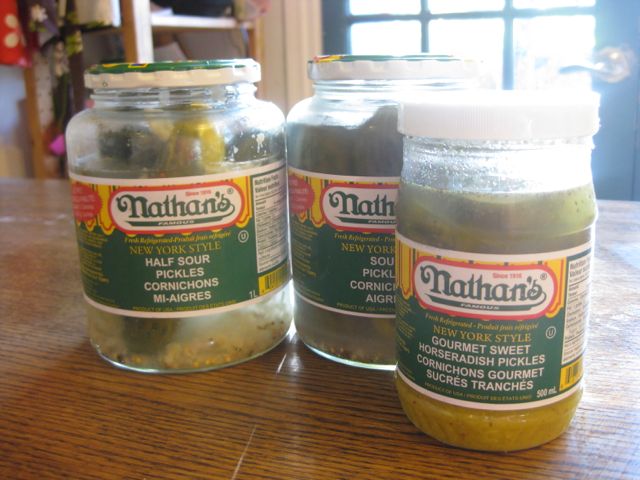 So we’ve been eating pickles all weekend, revelling in the bounty. I’m a bit crazy about the sweet horseradish pickles, though it’s possible I never met a sweet pickle I didn’t like. The sour and half sour are huge and full of crunch and flavour. Iris insists on eating them too, even though she makes the most ridiculous faces while doing so, but she keeps coming back for another bite, and so do I, because they’re good pickles.
And maybe you have to have been responsible for bad pickles to do know how precious a good pickle really is.
(Thanks to the people at Foodfest America for making my pickle dreams come true.)
April 22, 2014
#MakeSomething: The Most Magnificent Book
It is always a good day when we get a package in the mail from Kids Can Press. In particular, when that package has to do with a book that we’ve loved as much as we continue to love Ashley Spires The Most Magnificent Thing.

Remember that book? The book of which I wrote, “ It’s got everything. It’s got a dog, a girl who builds things, appealing illustrations that stand out against simple line drawings of an urban street-scape. It will appeal to both sexes. It’s got words, so many words, terrific verbs employed in the act of construction. It’s about coming up short, making mistakes and getting angry–the acknowledgement of such experiences is incredibly profound and has echoes of Sendak.”

So it was so cool to get this kit in the mail full of stuff for making, including a modified version of the book for us to “hack” and include in our creation. Harriet quickly set to work making blueprints, and was determined that her magnificent thing would be a monster.

The project came together fast. Harriet’s dad worked alongside her.

She cut, she stuck, she modified, she erred and tried again, and came up with something even better than her blueprints.
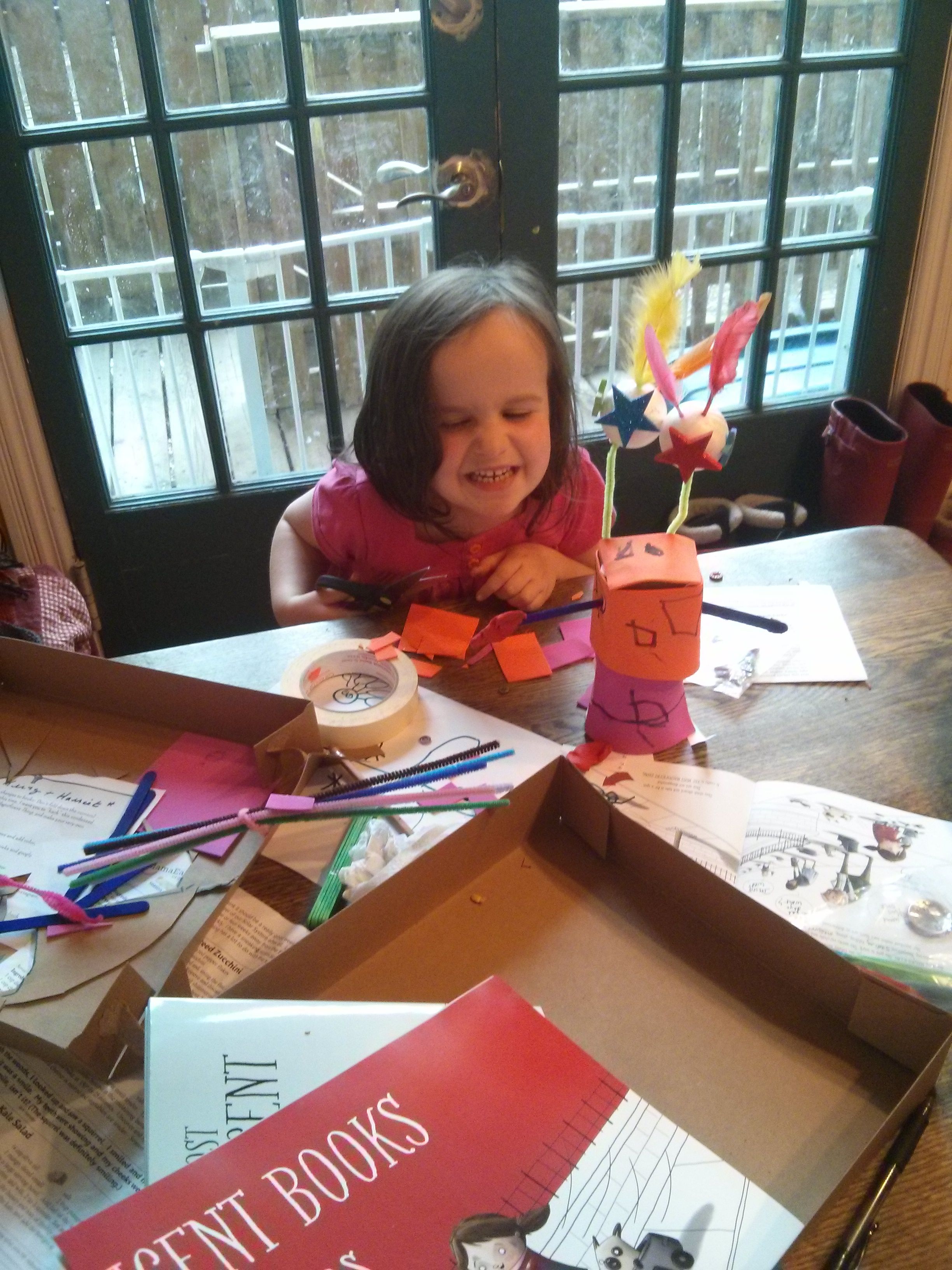
Like her mother, Harriet is blessed with not being a perfectionist, and so her final vision seemed more than satisfying. We hooked our guy up with the book, because monsters like reading just as much as anybody does.
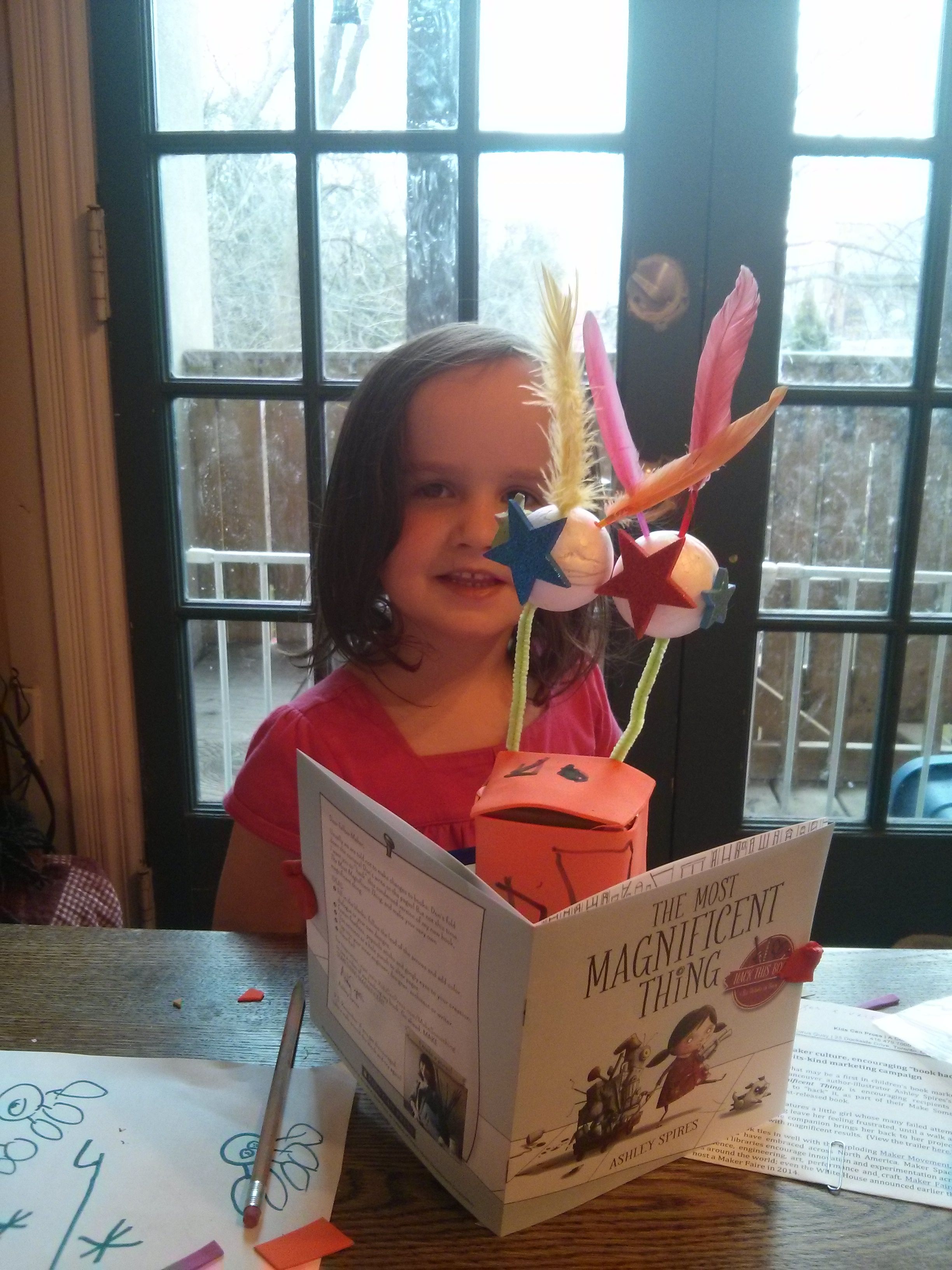
What fun fun fun, and just an example of the creativity this fantastic book will inspire. Thanks, Kids Can Press! So happy to spread the word about a book we love as much as this one.
December 16, 2013
A World Less Delightful
 “If I had to pick just one thing about the English novel, I don’t think I could, but if pressed to pick five things, one of them would have to be the post. Much in the same way that cell phones are pivotal to contemporary plotting, the British postal system is essential to the 20th century Englist novel. As are teacups, spinsters, knitting, seaside B&Bs, and the vicar, or maybe I’ve just been reading too much Barbara Pym, but the mail is always coming and going– have you noticed that? Someone is always going out to post a letter, or writing a letter that never gets posted, or a posted letter goes unreceived, or remains unopened on the hall table.”
Last week it was announced that Canadians are due to lose door-to-door mail delivery. Four years ago today, I wrote an ode to the post–foundation of not only my daily life, but also the plots of my favourite novels–from which the above paragraph is lifted. You can read the whole thing here and I haven’t changed my mind. With the elimination of postal service, we’re basically conspiring to make the world less delightful and this is not insignificant.
Without delight, what’s the point of anything?
December 2, 2013
City Noel
 Living in the city and not having a car, we have always brought our Christmas trees home quite conspicuously, carried on our shoulders (which is a bit awkward when pushing a stroller or carrying a baby, but we’ve made it happen in all these circumstances). And that is part of the reason I am so enamoured with the Christmas cards I’ve bought this year, which show another quite ingenious method for bringing home Christmas in the city. These cards are by Wendy Tancock, whose site is here. The image is beautiful and who doesn’t love a streetcar? I’m due to start writing a pile tonight
October 21, 2013
Excellent Mail Haul
Today was a very good day for the mail haul. Iris’s passport finally arrived, which is a good thing as we’re off to England in a few weeks. We also received a pair of orange socks for Iris, on the occasion of her first Halloween (thanks, Mom!). And then two books, one the latest collection by Karen Connelly, whose work I’ve admired for a long time now. And then Jennica Harper’s new book Wood, which is oh so exciting, because it’s not every day that you get a new book by one of your favourite writers ever. Very excited about this. Oh, what treasures a mailbox can hold!