May 11, 2026
Last week the internet went crazy

Last week, the internet went crazy. And I was so interested in the way that the internet went crazy, because instead of being in the crazy fray (where I use to hang out all the time!), I was looking on from the sidelines, in more than one sense. The most obvious sense being that this was a fracas among the children’s lit internet, of which I am not a part, so I had no skin in the game, the game being a comment by children’s writer Mac Barnett (from his recently released book on writing for children) in which he reports that “maybe more like 94.7 percent of kids’ books are crud.”
The thing I found most fascinating about this comment was how 94.7% of children’s authors in my feed seemed to believe without hesitation that their books were the books that he was talking about. I mean, the odds are high that they were, 94.7% being a sizable piece of the pie, but still. No doubt there is a gendered element to this. I’m not a children’s writer, BUT I was once a student in a university department of English, and I think the dynamics are the same, which is that 94.7% of the students are women and it’s the 5.3% of students who are not who are lauded as geniuses, dominate in-class conversations, and receive post-doctoral fellowships. So I suspect I understand why the community finds itself with a chip on its collective shoulder.
But still. I find myself thinking, “Can you get a little bit of male entitlement, people?” We could all do well sometimes (but not all the time) to channel the spirit of that guy who’s released an obscure book with a small press nobody has ever heard of that sells six copies and who is wide awake the morning of the announcement of the Giller Prize longlist waiting for his moment, and who’s indignant when they fail to call. As a writer of commercial fiction, I understand parts of what it must be like to be a kidlit writer (not being taken seriously, your poetry colleagues from your MFA have never published anything but still think they’re better than you, male writer colleagues with literally no interest in ever reading anything you’ve written), but we’ve got to hoist our spirits high above these petty grievances and/or get our heads out of our asses.
I know all this because of the years of my life that I wasted being triggered by things Jennifer Weiner was saying on the internet. It was my PRIME, people, and I spent it in the comments of Blogspots, either being really mad at Jennifer Weiner, or defending Weiner from her naysayers, and I don’t really remember why my views on Weiner were so all over the place, but also she was a lightning rod so it almost didn’t matter, and now I think about all the things I could have been spending my energy on instead.
The greatest revelation I’ve had in recent years is that so much of the frustration across the entire political spectrum (and also in my nervous system) is the result of fury that we cannot, in fact, control the things that other people think or the ways they behave. And this revelation lives alongside another fact that is just as true, that is we must keep working for a better, fairer world, not merely accepting the status quo. That we must change the world, but also there are parts of the world that are not ours for changing. That other people are going to think things, and say things, and I’m not going to like the things they think or say, and this is—in fact—part of the schema.
And yes, I’m talking about cancel culture, but I’m also talking about the people who were so opposed to cancel culture that they became their own cancel culture (which was a thousand times worse than campaigns removing men from positions of power for being sexual predators, no?).
It’s a mess, it’s a muddle, and I don’t really know a way out of it, except to shut down your browser when those synapses are flying and you find yourself in an internet pile-on, and go for a walk outside.
December 17, 2025
December Enthusiasms

My final “Enthusiasms” newsletter of the year is out! It includes some VERY DRAMATIC NEWS about the whereabouts of my Books of the Year list, and also a link to my recent spot on CBC’s “The Next Chapter” talking about whether literary awards are a scam (spoiler: UH HUH). Read it all here!
December 2, 2025
You are a sophisticated person if you think things are bad.
“We get accustomed to something improving, and we stop recognizing that actually matters. I think as well, there’s an element where for audience, it feels weirdly not smart to consume this kind of coverage. Like, you are a sophisticated person if you think things are bad.
Because you’re smart enough to see it, which actually is not hard to see. I think with solutions there’s no one to blame, which I think is a big part of news coverage and news consumption. Especially, again, in a more social media era, like we’re usually trying to identify very quickly what went wrong.
And in some ways, that’s a great step forward. Like, we’ve experienced these terrible floods in West Texas. The worst and the deadliest floods we’ve had in decades in the US.
And these things used to happen more often. And I believe when they did, the reaction was less, well, what went wrong? Because we didn’t presuppose we had the power to control things like that.
Now, almost instantly you’re going to who failed, right? Like, this shouldn’t happen, who failed? And that is true to a certain extent.
Like, things like that, incident in particular, shouldn’t have happened to this degree. But what that means is that there’s a constant feeling that there’s failure everywhere. Government’s failing, or people are failing, or businesses or institutions definitely are failing.
And I think trying to consume solutions, journalism, means you have to go back against that to a certain extent. If your attitude is that things are wrong, this is challenging that. There might be a bit of a cognitive disconnect, I think, that sort of pushes people away.”
Bryan Walsh – “Solving the Narrative Deficit” on the Hope is a Verb podcast
November 26, 2025
Keep that Candle Burning Bright

I’d heard legends about such practices, but until this summer I’d never witnessed it myself, the meticulously maintained collections of used books up for grabs at rural waste transfer stations. When we arrived at the dump in late August at the end of cottage holiday, it just rained in Haliburton, mercifully, for the first time in weeks (there’d been a fire ban on all summer). And the station attendant was carefully unwrapping the book tables from the layers of plastic tarp that had protected them from the deluge and other weather—there were all kinds of books, hundreds of books, absolutely bizarrely and serendipitously (un)catalogued, the most curious collection of thrillers, bestsellers, ancient paperbacks. There was so much good stuff. There was also so much that stuff that probably no one would ever want to read (weird old children’s books that were missing their covers, or a microwave cookbook for cocktail party appetizers made from Triscuits that smelled like a haunted basement).
And along with the good stuff, and the poor unwanted stuff, there was also the odd semi-obscure volume that had been placed at the dump by fate, just so that one day I could find it, the person it had always been meant for so that it could live forevermore on my shelf. There, alongside Ricky Martin’s autobiography (sadly devoid of its dustjacket) and a 20-year-old human resources manual, I found Keep That Candle Burning Bright, by Bronwen Wallace, a posthumous collection of her poetry I hadn’t encountered before, published by Coach House Press in 1991.
As someone who loves Wallace best for her fiction (her story collection People You’d Trust Your Life To is one of my favourite books) this book is a special treat, a collection of prose poems inspired by tue songs of Emmy Lou Harris:
“Well, what/ do you think we’re doing anyway, spinning out here,/ stuck with each other and no more able to get over/ that than we can get over our need for oxygen? Why/ not sing for what we can’t do, instead of all this/ booming and bragging, most of us stuck in the back/ row anyway, squawking, gimped-up. What if some/ tuneless wonder’s all we’ve got to say for ourselves?/ Off-key, our failings held out, at last, to each other./ What else have we got to offer, really? What else do/ we think they’re for?” —from “This is the Closest I Come to a Song”
October 17, 2025
Learning
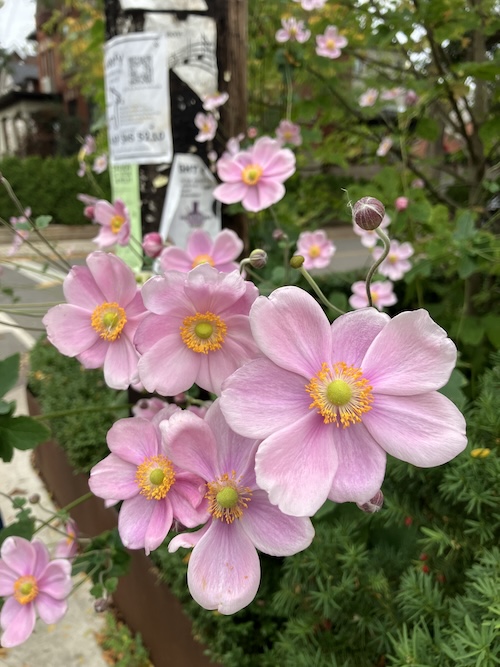
Brunswick Avenue, north of Bloor, has just been resurfaced, which makes flying down the bike lane there there smoothest and most exhilarating experience, and I was doing so not long ago on the most beautiful day (we’ve had a lot of those lately), speeding past the small group gathered at the Little Free Library, perusing the titles available, and there are always people there, a fact which, along with the blue blue sky, underlined me to how just how much the world was beneficent and people were good. And I felt a familiar compulsion to climb up on an online soapbox to declare this fact, because I’m still not entirely over the instinct that a feeling isn’t truly felt until it’s been broadcast on the internet. And thinking about this made me realize how much of my anxiety over the last ten years or more stemmed from me feeling responsible for the world in this way, in proving that hope was reasonable and that we were worth fighting for.
Which is weird, in a way, because doesn’t me feeling like I had to work so hard to make it true suggest I didn’t wholly believe it myself? The other evolution in my thinking since then, in addition to that I’m not responsible for proving the goodness of the world, is that that world actually isn’t good. Or isn’t just good. The way I’d wanted it to be, like managing to get a snapshot, A HA! There, you see, demonstrable evidence! I read a book earlier this year where the author reflected on how she used to think that we were all *this close* to getting on the right track politically, and then everything would be fine after that, and I could so relate to that naivete. And what I understand now is that the world is brutal, terrible, wondrous, perfect, violent, loving, balanced, unfair, beautiful, ugly, predictable, explosive, safe, dangerous, and miraculous all at the same time. The world (and its human inhabitants) are so many things, but “perfectable” isn’t one of them, and maybe I’m learning to accept this? That the world will always be good and bad in equal measure, and we can still love it all the same.
April 17, 2025
I like the way the world waits for you
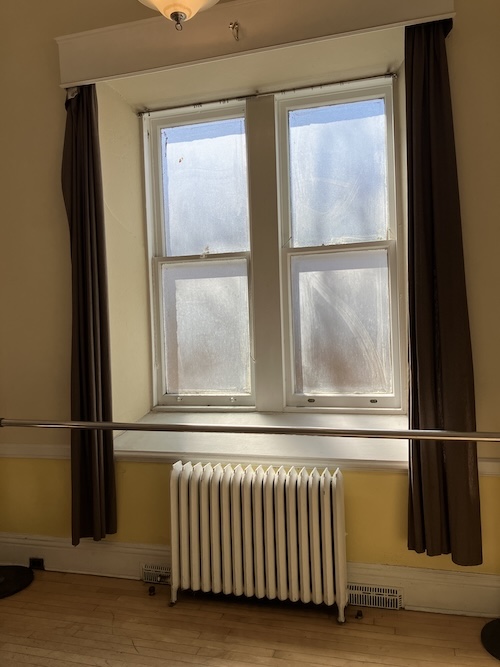
I’ve had a hard season, one whose heaviness I didn’t wholly recognize until the weight was gone. And throughout it all, my Thursday mornings with Singing Mamas have been one essential thing that kept me going, the sacredness of that space, the songs, that light. About three weeks ago, it occurred to me that this this was the first time I’d been attending the group and really felt genuinely joyous, as opposed to joy that was instead a brief respite from darkness and pain (which is not to say that such respite didn’t mean everything).
It’s curious to be showing up and know that I look the same, and that gorgeous light is just the same, and all those songs are just the same, but everything is different.
I like the way the world waits for you, that it’s possible to meet us where we’re at.
I’m very sleepy today after a later-than-usual night last night picking up my kid at her semi-formal, which happened to be her first school dance. She should have had her first school dance in 2021 as part of her Grade 6 graduation, and all such festivities were cancelled that year, along with so many other things, on account of the pandemic, and so it felt extra special that she had such a good time last night. Her younger sister is now the same age she was that year, when her class’s end of the year school trip was also cancelled (don’t worry—she’s had plenty of end-of-the-year trips since then!) and just yesterday we received the permission form for her sister’s trip, and it feels extra special to have this finally happening, the sort of thing I could possibly have been compelled to take for granted, but now I never will. We’re all so excited for her. (I feel like I’ll be tripping over pandemic losses and trauma for the rest of my forever.)
But still, I’m sleepy, and so when I went swimming today, I got in the medium lane and went so slow. Slow and easy, slow and easy, and I like this about swimming too, how it can meet you where you’re at. Just like the light in the room where we sing.
March 20, 2025
I Don’t Believe in Seeds
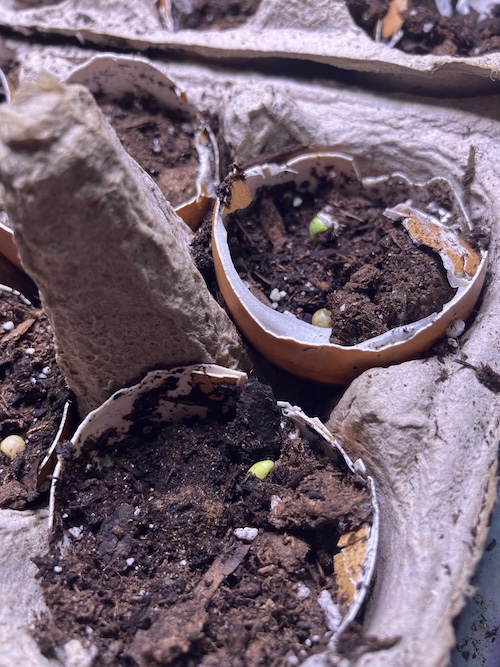
I don’t believe in seeds. I just can’t fathom the fact of what happens when you plant them, no matter how many times I’ve watched the miracle happen, which it always does, and it’s still never not blown my mind. That new life is possible*, how this can turn into that, the ordinary miracle. I still don’t believe it, I can’t. I mean, not so much that I don’t sow seeds every single spring, because I do, the most hopeful gesture I ever enact. I remember how counter-intuitive it felt to sow seeds in the darkness of March and April 2020, how beside-the-point, and even pointless, but I did it anyway, which felt daring and subversive in the depths of my anxiety, to imagine such a thing as a future. I like the hope and the promise therein, but I still don’t believe it, I never do.
Which means that when I do plant seeds, I go overboard. What are the odds, I consider, that a single seed is ever going to sprout? It’s a gamble, so I might as well sow five of them, maybe ten. What kind of magic is this, from a fairy tale, it seems like, spinning straw into gold, growing a single speck into a snapdragon, a gangling plant whose blooms I’ll be clipping until into November. To sow seeds is to take the long view, to have vision, to have faith, except I don’t, as we’ve established. Not really. Not enough that I can simply trust, instead hedging my bets, an entire handful of snapdragon seeds flung into the soil, because what if I was measured about it and then nothing happened?
Lately, I’ve been thinking a lot about faith, about notions of A faith, and about how useful and comforting it would be to have such a thing at this moment. To have a sense of the world and in justice and progress that had not completely been turned upside down and inside out, leaving me wondering if I really know the world at all, what I ever knew about people, and progress, and what the project of these lives we’re weaving together. I watch the world through my news feeds with terror and dread, so much grief and sadness, and I long for something firm to hold onto. I want to keep believing in people, and possibility, in this beautiful world and for our little place in it, and good things being possible.
But I guess that’s what faith is, when it’s hard to believe, but you do it anyway. When we sow those seeds, even when it seems impossible that they’ll ever turn into anything. And what if any doubt we have is a reason to chuck in a handful of seeds, instead of permission to give up sowing altogether?What if sowing seeds shows us that miracles happen all the time?
I woke up this morning, the first day of spring, to find that the seeds I’d planted on Sunday evening had already begun. After a beautiful morning singing songs of peace and joy, I came home and dove into edits on my fourth novel, which will be coming your way in a year less three days.**
I still don’t believe in seeds, and yet. Here we are.
*Not unrelated: I also can’t believe that my children exist. Like, what even is up with that? Where did they come from and how do they just keep getting more and more magnificent all the time?
**Which is exactly five years TO THE DAY after I first wrote about the project: “Making: A new novel that’s inspired by Barbara Pym’s books, and I just hit 10,000 words. It might not be good, it might never be published, but my goodness, am I having a good time.”
May 10, 2024
Peacocks in Public
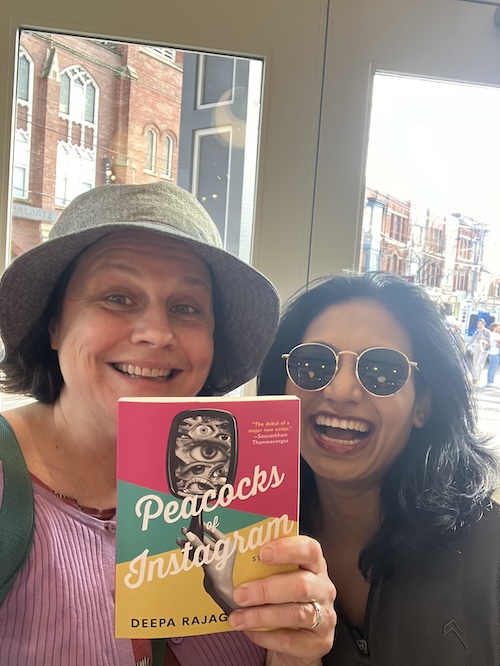
Raise your hand if you too are unable to resist the compulsion to stop any stranger in public you see reading or even just carrying a book you love in order to let them know—in case they didn’t already—JUST how good that book actually is.
But never before has the experience been quite as rich and rewarding as when I accosted @livingbyn_designs on Saturday night as she walked down Queen West bearing her newly purchased copy of PEACOCKS OF INSTAGRAM, a book that is not only THE best titled title of 2024, but also everything you’d hope a book with such a great title would be, as I found out in February when I read it for a podcast interview with its author, the talented @deerajagopalan (whose BOOKSPO episode goes up next week!).
The best thing about meeting Nila with her copy of PEACOCKS OF INSTAGRAM Is that she met all of my enthusiasm for this terrific book, and then even exceeded it, positively overflowing with pride and happiness at her friend having produced a book so terrific that strangers will stop you in the street to exalt its praises. I mean, JUST LOOK AT THE EXPRESSION ON HER FACE? Have you ever seen anything as awesome and real?
Our encounter was such a celebration of books and friendship and gorgeous summer nights, and it made me so happy, not least at seeing this book in the world for the very first time. Congratulations on your pub date, @deerajagopalan! I can’t wait to read PEACOCKS OF INSTAGRAM (again)!
(I posted this to Instagram this week, but wanted to add it to my blog for posterity!)
May 6, 2024
Light

I have a file in my head I’ve started calling the “Really Important to Understand Even if (ESPECIALLY IF?) You Don’t Agree” file, and the latest addition to it is Zadie Smith’s New Yorker essay “Shibboleth.” It joins Naomi Klein’s “We Need an Exodus from Zionism,” a speech she made in New York City last month at a Seder during Passover, and the essay “Resigned,” by Dashka Slater, which I think was the piece that started it all. Someone I admire a lot posted that essay, and the weird thing about that was the people who reacted to it with comments like, “This!” and “So good,” which didn’t seem entirely to be in keeping with the spirit of the piece, but maybe I just think that because of the parts of the piece that I didn’t agree with. And certainly I’ve posted similar responses to other things often in my time, particularly during the years when I was very on Twitter, and I have a visceral recollection of the relief of finally having someone articulate a reasonable point of view when everybody else seems to be infected with some kind of mania or fever dream, all those posts that felt like a lone thing to cling to in a chaotic world. THIS. THIS. But that kind of certainty isn’t what that I’m craving anymore.
Today, a bunch of people I really like on Facebook are sharing a piece called “50 Completely True Things,” a pretty unobjectionable piece (I might even comment, “This!”) but what bothers me about it and really makes me feel for its author, mo husseini (a Palestinian-American, who clearly is caught in a bind here and has issues that I can definitely relate to about people-pleasing and feeling like he’s required to mediate conflicts that he’s in no way I provoked [I’m not saying it’s the same, but I once published a literary anthology in an attempt to mediate The Mommy Wars]) is this requirement for unobjectionableness. (Not unrelated, but also in my file: Roxane Gay’s “The Age of the Open Letter Should End.”) The idea that such a thing is even possible.
It’s been a weird time, during which I’ve been admonished by people I don’t respect very much for both being an enemy of the Jewish people AND aiding and abetting Palestinian genocide with my silence. And funnily enough, people scolding me, yelling at me, or trying to shame me have not done a lot to enhance my point of view, and I’ve given up altogether at trying to persuade other people by doing the same, not just because the tactic is so ineffective, but also because I’ve become vehemently opposed to righteousness and self-righteousness, want nothing to do with either.
I keep thinking of that line from a book I read two weeks ago: “Wisdom is valuable. But the ability to find understanding is a gift that all creation enjoys… In some ways, you can think of wisdom of light. But it is understanding that carries the light. Understanding is what wisdom travels through.” (The author is Michael Hutchison, and it’s a line of dialogue delivered by a Cree Elder.)
Understanding carries the light. I don’t want to to change your point of view, but I seek to understand it, and I want you understand mine too, even if those points of view are different. ESPECIALLY if those points of view are different. There is room enough for complexity, and nuance, and I hope that with the light that comes with understanding, we can all feel braver and more secure, less defensive and afraid, that light not a beacon in the distance, but instead a shine that lights up everyone, everywhere. A kind of common ground.
April 29, 2024
On Being Chosen

I’ve had a very fun and action-packed couple of weeks literary-wise that continues with tomorrow’s trip to Waterloo to interview Iona Whishaw about her latest Lane Winslow book. And a highlight was Thursday’s Biblio Bash at the Toronto Reference Library, a gala event at which I was invited to be a guest author. I’d attended once before in 2017 when my first novel came out, and the whole experience was intense, awesome, very overwhelming—plus I got my makeup done at the drug store and told them the look I was going for was “very dramatic” and ended up resembling a drag queen, and I’m still traumatized, no offence to drag queens. This time I had the benefit of hindsight and hired someone excellent to do my makeup, plus I’m about 300 years older than I used to be (pandemic effect) which meant I behaved with aplomb, looked quite fantastic, and drank so little that I woke up in the morning without a hangover, but still had lots of fun. It was a very good night and the Toronto Public Library Foundation raised more than a million dollars.
But I was cognizant through the entire process too that a big part of the experience (and one of its chief appeals, beyond the stunning portraits) was the feeling of being chosen. An exclusive event, an opportunity to mingle with the fancy people and wear a floor length gown. And I’ve been reflecting on this a lot, how much of the reality of publishing is often about the experiences of being chosen, or otherwise. Finishing your book, signing with an agent, getting a book deal, getting an impressive book deal, a book deal with a big press, becoming a bestseller, sustaining bestsellerdom, continuing that success with your next book, winning prizes, getting reviewed in all the best places, being “picked” by Oprah, Heather, Reese or Jenna, and on and on and on. And even when you get chosen on one level, there are all kinds of tiers and ways to still feel like you’ve been chosen (or that you’re falling short) and it’s all so urgent and arbitrary and so little of it (as with most things) is actually within any of our own control. Who gets to matter, to be important, and the pressure—even if you happen to be one of the ones—of staying on top, remaining relevant.
And all of it—it’s excruciating. I spent most of last fall feeling like such a failure, my self-worth so undermined by my latest novel’s failure to launch in the way I had envisioned—and thinking into the future, in which I might no longer be able to publish books at all, to be once again un-chosen by a publisher, and on one level, the stakes are negligible here, life goes on, but on the other, this is my career, and the thought of failure is just devastating once one has built their entire sense of self around the identity of not just being a writer, but one of those rarest of cases—a successful one.
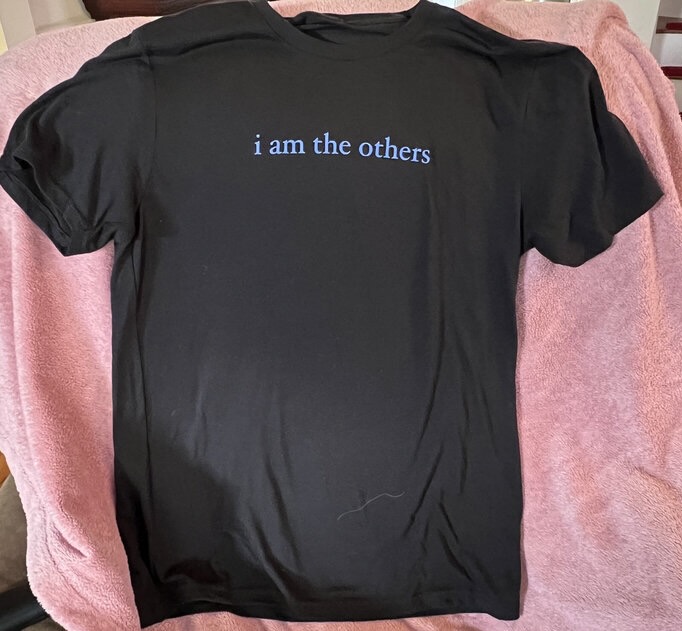
There is a line from the Dar Williams song, “As Cool as I Am“, that I think (ugh!) I’m going to continue to be reminded of for the rest of my life: “And then I go outside to join the others; I am the others.” (You can even get a t-shirt!). So much of my own yearning to be chosen, to be validated, is to be offered proof that I am special and have worth. And of course I am special and have worth, by virtue of my existence as a human being, just like you do, but how to deal with that desire for distinction, for proof that I am not merely one of the others—it’s something else I’m figuring out at the age of almost-45, along with how to look good at a gala.
To accept that I am the others is realize that my sense of value and self-worth is intrinsic, rather than extrinsic, and that often nobody else is going to be see it but me, which means that I really have to know it, or no one will.
To quote another line from “As Cool as I Am”: “Oh, and that’s not easy.”
It’s really not, it’s so much easier to be seen by others than to see our ourselves as we really are, warts and all, and not even just accept it, but hold that reality as something worthy and sacred. It’s so much easier to share a photo of myself looking stunning at an exclusive shindig and have hundreds of people LIKE it than to sit with myself and know that this is all I’ll ever be.
But I’m working on it, little by little, building up a solid core, something unimpeachable.